
Suffolk County Council watchdog marks own homework, then decides it can wait
Suffolk County Council's monitoring officer found two breaches of law in a process he was part of. He then decided for himself how serious they were, and that the consequences could wait. A leaked report confirms the breaches, but does nothing to explain the delay.

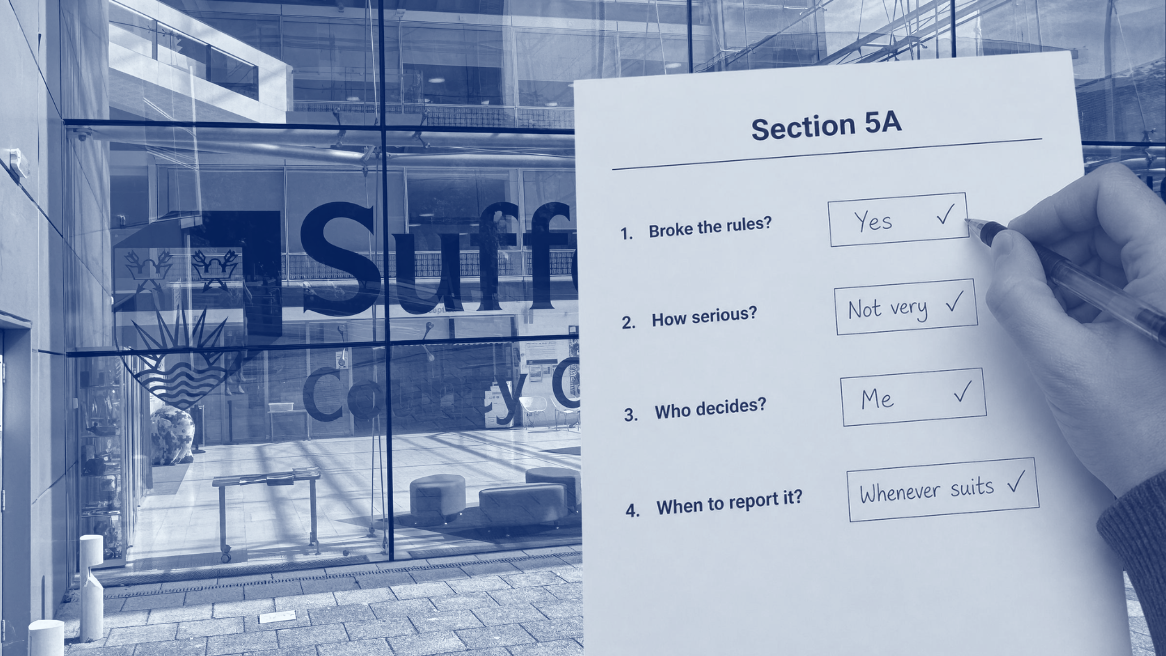
The report, leaked to Ipswich.co.uk, was written by Nigel Inniss, the council's Assistant Director – Governance, Legal & Assurance, who also holds the statutory role of monitoring officer. Dated 3 August 2026, it was produced in response to a series of challenges from councillors over how the council decided to launch judicial review proceedings against the Secretary of State for Housing, Communities and Local Government, over his decision to impose a three-unitary model on Suffolk.
Councillor Martin Cook had raised five potential contraventions of law with the council's deputy monitoring officers, asking whether any required a report under Section 5A of the Local Government and Housing Act 1989. Mr Inniss's report finds no breach in three of those five, but – crucially – identifies two separate matters in which he accepts a breach did occur.
The first is a failure to publish the record of council leader Michael Hadwen's decision to file the judicial review claim "as soon as reasonably practicable", as required by the Local Authorities (Executive Arrangements) (Meetings and Access to Information) (England) Regulations 2012. The decision was taken on 18 June 2026; the notice was not published until 26 June. No explanation was given for the delay.
The second is a breach Mr Inniss identifies himself, rather than one raised by Cllr Cook: a failure to provide him with the claim form and related documents within the statutory timescale, following his request as a member of the Scrutiny Committee.
Mr Inniss's report states plainly that both breaches, taken together, mean a report to cabinet under Section 5A is required.
A watchdog examining his own conduct
The two confirmed breaches sit alongside decisions in which Mr Inniss himself played a direct part. His report records that he personally sent Mr Hadwen an email on the morning of 17 June 2026 summarising legal advice, which underpinned the leader's decision the following day to authorise the claim. It also records that, on 6 July, Mr Inniss personally agreed with the chairman of the council that the cabinet's decision to serve the claim had reasonably been treated as urgent, rejecting the challenge to that urgency raised by opposition councillors.
The council marked its own homework — we made sure you could see it
This story only exists because Ipswich.co.uk chased a leaked report and pressed the council for answers it didn't want to give. Independent, accountable journalism like this survives on readers, not owners. Support more of it for just £4.75 pre month.
Cllr Cook had suggested that, given this involvement, the matter should be handled by one of the council's deputy monitoring officers rather than by Mr Inniss himself. The report addresses this directly, citing Section 5A(10) of the 1989 Act, which states that the duty "shall be performed by him personally", with the only exception being where the monitoring officer is "unable to act owing to absence or illness". Mr Inniss's report concludes that the exception does not apply, and states that the involvement of independent counsel throughout the process was sufficient to address any concerns about his own conflict, adding that engaging further external lawyers would be "disproportionate".
Minor, in his own words
Having identified the two breaches, Mr Inniss goes on to characterise them himself. His report describes both as "relatively minor and inadvertent breaches", and states it will be "sufficient to place the matter on the agenda of an ordinary cabinet meeting in the autumn" – rather than a special or urgent meeting.
That characterisation sits awkwardly alongside the mechanism itself. Section 5A is not a general-purpose reporting tool: it is reserved in law for cases where a monitoring officer concludes that a breach or act of maladministration stems from a council's executive, rather than the full council, and its effect is to freeze the decision concerned the moment it is issued.
Cllr Rout has previously described the mere issuing of a Section 5 or 5A report as "serious and incredibly rare", telling Ipswich.co.uk he could not recall one ever being issued at Suffolk County Council. Mr Inniss's own report does not explain how breaches he grades as minor and inadvertent meet that threshold, only that they do.
It is the 'nuclear option'.
The report gives no separate reasoning for why an ordinary autumn cabinet slot, rather than a report issued at pace, meets the statutory requirement. It does not address the 21-day timetable that governs a cabinet's response once a Section 5A report is formally issued, nor explain why that timetable does not currently apply, because the report itself has not yet been submitted.
The council refused to answer this question directly when challenged by this publication.
The urgency that applies everywhere except here
Urgency is a recurring theme throughout the rest of the report. It is cited to justify the leader taking his decision alone rather than waiting for cabinet, to justify publishing notice of the extraordinary cabinet meeting of 29 June only three days beforehand – bypassing both the normal 28-day notice period and the reduced five-day alternative, via a statutory urgency exception – and to justify serving the claim as quickly as possible once it had been issued by the court. In each case, Mr Inniss's report argues that the statutory test is whether urgency genuinely existed, not whether it ought to have existed, and concludes that it did.
No equivalent urgency is applied to the reporting of the two breaches he has identified. It is a convenience for the council that is impossible to ignore.
Councillor Richard Rout, leader of the Conservative group, has previously told Ipswich.co.uk that Section 5A reports "exist to have consequences, that's the point of them", and that "holding off on the issuing of such a report so that a decision can run its course, or become irrevocable, would not, in my opinion, be in the spirit of the law." He said he would expect any monitoring officer to act "at pace and not to suit the timetable of the council or any other political or legal objective", adding: "If that requires a special meeting to be convened, then that should be the case."
Councillor Andrew Stringer, leader of the Green group, has said he wrote to the monitoring officer directly asking whether the 21-day timetable would be adhered to, "or if SCC is waiting for the autumn", and asked whether the delay amounted to "a deliberate planned breach of protocol".
What the council says
Suffolk County Council was approached for comment on the report's contents and on the timing of the Section 5A report. A spokesperson said:
"Some council reports have to remain confidential for legitimate legal reasons, so it is extremely disappointing that someone has chosen to leak this one to the media.
"Council officers and legal advisers must be able to give free and frank advice to councillors. Leaking confidential material undermines the proper functioning of a council's decision-making processes.
"We can confirm that a Section 5A report will be submitted. We are not yet in a position to confirm a timetable for this, but we can reassure residents that it relates to minor procedural matters and will have no impact on the ongoing judicial review process."
Ipswich.co.uk is publishing the contents of the report in the public interest, given the questions it raises over the timing of a statutory mechanism designed to hold a council's executive to account, and given the council's own confirmation that a report is coming without a stated timetable.
The council's description of the breaches as "minor procedural matters" echoes Mr Inniss's own language in the report. But it is difficult to reconcile with the nature of the mechanism being used to address them. A Section 5A report is not issued for routine administrative slips; it exists, in law, for breaches serious enough to warrant freezing an executive decision until the cabinet has formally responded. Whether two breaches genuinely warranting that mechanism can, at the same time, be fairly described as minor is a question the council's statement does not resolve.
On the substance of the council's position, the report itself sets out in detail why Mr Inniss rejected the other grounds for challenge raised by opposition councillors, including whether the decisions should have been treated as "key decisions", whether they were properly within budget, and whether cabinet members had adequate information before them. According to the council, these findings support its wider view that the decision-making process was sound.
However, the point at issue is narrower than that. The council's own report confirms two breaches occurred. What it does not state, and what the council's statement does not address either, is why a mechanism designed to freeze a disputed decision the moment a breach is identified should instead wait until an ordinary autumn cabinet meeting to be formally issued.
The bottom line
Suffolk County Council's own leaked report confirms what has long been suspected: two breaches of law occurred in how it decided to seek judicial review against the Government, and a Section 5A report – one of the most serious mechanisms available under local government law – is coming as a result.
What neither the report nor the council has explained is why. Not why the breaches happened, which the document addresses at length, but why the formal reckoning for them can wait for a routine autumn meeting rather than being issued at the pace the law, and Suffolk's own councillors, say it demands.
The council marked its own homework — we made sure you could see it
This story only exists because Ipswich.co.uk chased a leaked report and pressed the council for answers it didn't want to give. Independent, accountable journalism like this survives on readers, not owners. Support more of it for just £4.75 pre month.
 Oliver Rouane-Williams
Don't forget: If you enjoy our content, please add Ipswich.co.uk as a "preferred source" on Google so you can easily find more of the content you value.
This article cost us ~£135 to produce
It's free for you to read thanks to the generous support of our partners. Please support us by supporting them.
Below the line