
Council's reorganisation legal challenge process to be scrutinised
Suffolk County Council’s Scrutiny Committee will examine how the authority decided to take the Government to court over reorganisation. The Chair’s casting vote sent just one question to a cross-party task and finish group, which will take place in February.

Why it matters: The council's own monitoring officer has already found that the Reform UK administration breached regulations twice: in how the decision was recorded, and in how a councillor's request for documents was handled. The Cabinet resolved on 17 September to take no further action.
The details: The committee met at Endeavour House on Thursday, 1 October, to consider two referrals under Rule 11.9.1 of the council's constitution, which allows any member of a scrutiny committee to place a matter on its agenda.
- Cllr Martin Cook, leader of the Labour group, referred 12 matters on 29 June and a further 16 on 22 September, making 28 in total.
- Cllr Richard Rout, leader of the Conservative group, referred a single, narrower matter on the same afternoon as Cook's first referral, concerning how the decision was classified.
- Both referrals were lodged 94 days before the meeting.
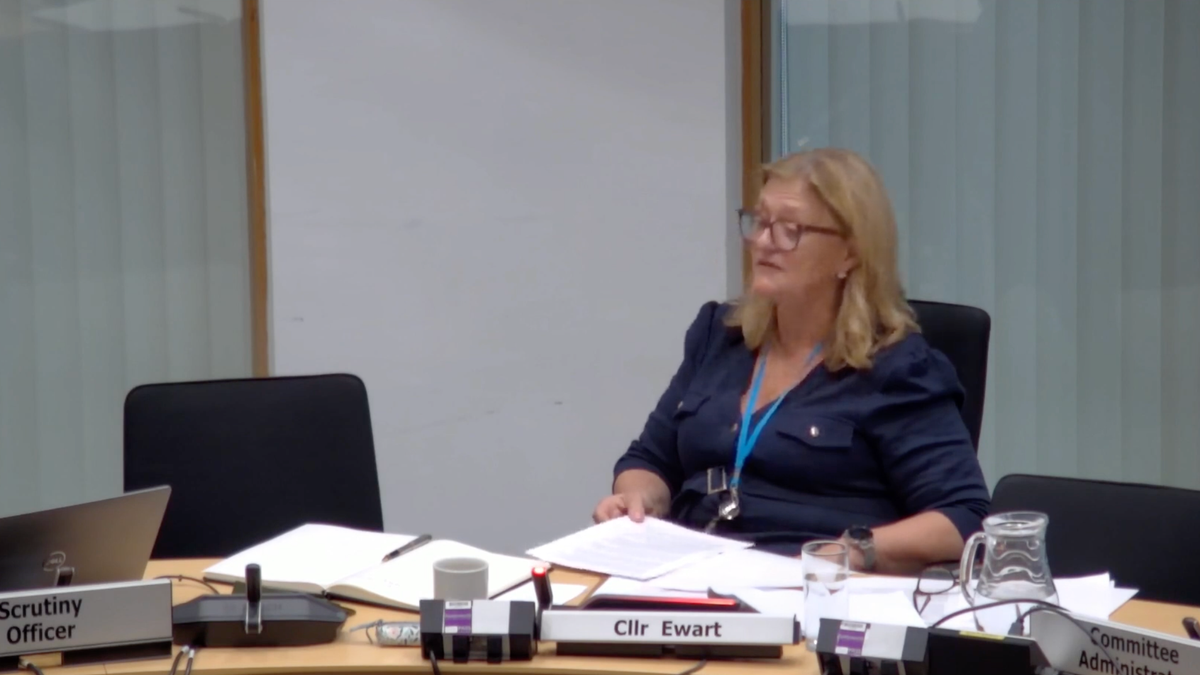
The committee divided evenly on whether to take the case to scrutiny. Chair Cllr Julia Ewart, who sits as an independent, used her casting vote in favour, and the matter will go to a cross-party task and finish group in February, and report back to the committee.
The background: Council leader Cllr Michael Hadwen took an individual executive decision on 18 June to issue a legal claim against the Government's decision to replace Suffolk's six councils with three. The claim was filed at court on 24 June. The record of the decision was published on 26 June, eight days after it was taken and two days after the claim was filed.
An extraordinary Cabinet meeting on 29 June agreed to continue the claim. The decision was declared urgent, which meant it could not be called in for review by councillors.
The monitoring officer's report under section 5A of the Local Government and Housing Act 1989, considered by the Cabinet on 17 September, recorded two breaches of the regulations governing executive decisions: one concerning the recording of the decision, and one concerning the handling of a request for documents. Cook requested four documents on 1 July and received them on 17 August, 47 days later, against a statutory limit of 10 clear days.
 Oliver Rouane-Williams
What they're saying: Cllr Martin Cook, Leader of the Labour Group at Suffolk County Council, told the committee his referral was not about whether reorganisation was a good idea or whether the council's legal case was a strong one, and not about the conduct of any officer. He said no finding was being made against anyone and that the people who could answer the 28 questions were the leader and the monitoring officer.
Rout told members his referral was narrower and, in his words, "quite dry". It concerns whether the decision should have been classified as a key decision, which would have required 28 days' notice on the council's forward plan.
He said the published notice gave the reasons for the decision as the impact on Suffolk, the financial implications and the risks to frontline services, and asked that if a decision taken for those reasons was not significant in its effect on communities, what would be.
Cllr Joe Mason, Conservative, said scrutiny existed to give the public assurance that lessons had been learned rather than simply being told they had. He said the council breaking the law, although relatively minor as communicated by the monitoring officer, was nonetheless breaking the law.
Cllr Keith Welham, Green, said taking evidence on what had happened in the past and making recommendations for the future was precisely what scrutiny committees did.
The other side: Cllr Rupert Tonkin-Galvin, Reform UK, who was elected vice chairman at the start of the meeting, accepted that the committee had the power to review the decision but questioned whether it had a duty to do so, or whether doing so would be useful.
He said the two admitted breaches related to the timing of documents, that the standard set out in the report was to act as soon as reasonably practicable, and that the remedy for the second breach was simply not to exceed the 10-day limit again.
Cllr Mark Barber, Reform UK, said lessons had already been learned, that he was not clear on the objective benefits of the exercise, and that it detracted from the committee's role in supporting forward planning.
Cllr James Patchett, Green, supported the referral going to scrutiny but said some of the 28 questions had been answered by the passage of time and others were weak, putting the number requiring attention at around 10.
The transparency row: Cook's paper setting out the 28 matters was not included in the agenda pack published on 23 September. He circulated it to committee members and published it on his own website on 30 September after the council declined to publish it – a move that could still jeopardise his opportunity to be heard.
At the start of the item, Cook moved under section 100B of the Local Government Act 1972 that the paper be admitted as a committee document. Ewart refused, ruling that the referral was already properly before the committee, that members were deciding only whether the matter warranted further scrutiny rather than the substance, and that the urgency provision he relied on did not apply because the events had already occurred.
She said the paper would not be published by the council as part of the proceedings and did not form part of the formal agenda documentation.
Cook told the committee it was ironic that a referral concerning record keeping could not form part of the record of the meeting, and that anyone later consulting the webcast or the minutes would not be able to see what had been discussed.
Ewart also noted that she might be required to seek advice from the monitoring officer as to whether any standards, governance or procedural considerations arose from the circulation and publication of the paper. She made clear that she made no finding against any member and did not suggest that any breach had occurred.
Rout, who circulated his own material to members but did not publish it, told the committee that a parallel public debate was the reason papers were published in advance.
Ewart said she remained neutral on the merits of the referral and that her role was to lead the process, not to influence the outcome.
The bottom line: More than three months after opposition councillors asked the Scrutiny Committee to examine how Suffolk County Council committed itself to legal action against the Government, the committee has agreed to look – decided by the independent chair's vote.
Don't forget: If you enjoy our content, please add Ipswich.co.uk as a "preferred source" on Google so you can easily find more of the content you value.
This article cost us ~£108 to produce
It's free for you to read thanks to the generous support of our partners. Please support us by supporting them.
Below the line