
William Hardy: The hero who ran through machine-gun fire for his comrades
An Ipswich soldier twice volunteered to cross ground swept by German machine-gun fire to bring ammunition to his comrades during the desperate retreat to Dunkirk. Six days later, he was dead. He left behind a wife and a two-year old daughter.

On 21 May 1940, somewhere near the Belgian town of Comines, a young soldier from Ipswich made a decision that would earn him one of Britain's most respected military decorations.
His platoon was under heavy German fire. Ammunition was running dangerously low, and the men needed supplies if they were to continue defending their position.
The ground between them and their ammunition was being swept by machine-gun bullets.
Guardsman William Frederick Hardy volunteered to cross it.
He made the journey and returned with ammunition.
Then he volunteered to do it again.
Both times he risked his life to ensure that his comrades could keep fighting.
His actions would earn him the Military Medal, awarded for bravery in battle.
But William would never live to receive it.
Six days later, aged just 26, he died from wounds received during the fighting.
Back home in Ipswich, his wife Ada was left to raise their little daughter Gillian, who was only two years old.
The Ipswich boy who became a Grenadier
William Frederick Hardy was born in Ipswich on 7 February 1914, just months before the outbreak of the First World War.
He was the son of Alfred William Hardy and Mabel Blanche Hardy, née Tooley.
The family lived at 49 Beaconsfield Road, where William grew up with his sisters Marjorie and Dorothy.
His father was a foundry crane driver, working for Vickers & Petters on Hadleigh Road, part of Ipswich's substantial engineering and manufacturing industry.
It was a working-class upbringing in a town where the factories and engineering works employed thousands of local families.
In September 1932, aged 18, William joined the Grenadier Guards.
One of the British Army's oldest and most prestigious regiments, the Grenadiers were known for their distinctive ceremonial uniforms and demanding military discipline.
But William was more than a soldier.
According to a letter his daughter later wrote to the regiment's magazine, he was an accomplished sportsman who won medals for swimming, football and running during his military service.
The young Ipswich man evidently enjoyed competition as much as military life.
He served until October 1936, when he left the regular Army and entered the Reserve.
In 1937, he married Ada May Hodge, originally from Chard in Somerset.
The couple settled at 619 Bramford Road, Ipswich, and had a daughter, Gillian.
They were beginning an ordinary family life when Europe once again descended towards war.
Called back to the Army
In August 1939, with Britain preparing for the possibility of conflict, William was recalled from the Reserve.
Following further training, he joined the British Expeditionary Force in France with the 3rd Battalion Grenadier Guards.
When Germany invaded Belgium, the Netherlands and Luxembourg on 10 May 1940, British and Allied forces advanced into Belgium to confront the invasion.
But the German offensive moved with devastating speed.
German armoured divisions broke through the Allied front further south, threatening to cut off British and French forces.
Within days, the British Army was retreating towards the Channel coast.
The fighting was confused, exhausting and frequently desperate.
Units had to hold bridges, roads and defensive positions to prevent the advancing Germans from overrunning the retreating troops.
William's battalion found itself involved in the battle around the Comines Canal, close to the French-Belgian border.
It was here that the Ipswich Guardsman performed the action for which he would be remembered.
Twice into the machine-gun fire
The official citation for William's Military Medal records that on 21 May 1940 he twice volunteered to leave his forward position and collect ammunition.
The ground he had to cross was exposed to intense German machine-gun fire.
It was a task that might easily have ended in his death before he reached the supplies, let alone returned with them.
Yet he volunteered, not once but twice.
The citation makes clear that his actions allowed his platoon to continue firing and inflict casualties on the attacking enemy.
There was no elaborate plan, no great military manoeuvre and no guarantee of survival.
Just a young man from Ipswich carrying ammunition to soldiers who desperately needed it.
At a time when the British Army was facing one of the greatest crises in its history, such individual acts of bravery helped units continue their resistance.
William's courage was formally recognised with the Military Medal, announced in the London Gazette on 20 December 1940.
By then, he had been dead for almost seven months.
Six days later, he was gone
William died of his wounds on 27 May 1940.
He was buried at Comines Communal Cemetery in Belgium, where his grave remains today.
His burial place is shared with other men of the 3rd Battalion Grenadier Guards who died during the fighting.
Among those buried nearby is Lieutenant Crompton-Roberts, William's platoon officer, who also lost his life.
The German advance would eventually force hundreds of thousands of Allied troops into the evacuation from Dunkirk.
Operation Dynamo began on 26 May and continued until 4 June, rescuing more than 338,000 British and Allied personnel.
It became one of the defining events of the Second World War.
But behind the famous photographs of soldiers arriving home and the stories of the little ships were men whose resistance had helped make the evacuation possible.
Some would never return.
William Hardy was one of them.
The little girl who went to Buckingham Palace
Back in Ipswich, Ada Hardy faced the task of bringing up their daughter without her husband.
Gillian had been just two when her father died.
Yet his memory remained an important part of her life.
In October 2025, a woman identifying herself as William's granddaughter, Diane Birch, left a message on the Ipswich War Memorial Project website.
She explained that her mother, Gillian, was then 87 and still living in Ipswich.
Gillian remained immensely proud of her father's courage.
And although she had been so young when he died, one particular memory had stayed with her.
She remembered going to Buckingham Palace with her mother in connection with the presentation of William's Military Medal.
It must have been an extraordinary occasion for a little girl whose father would never come home.
Her family had lost a husband and father, but the country had formally recognised what he had done.
The medal could not replace him.
It could, however, help explain to his daughter why he had never returned.
A daughter who never stopped remembering
There is another remarkable chapter to the Hardy family story.
In 2018, the Grenadier Guards published a letter written by Gillian herself, by then known as Gillian Welton.
She described how her father had been recalled to the colours in 1939 and recalled his earlier sporting achievements.
But the most moving part concerned his grave.
For many years, Gillian and her family had travelled to Belgium to attend commemorations of the Battle of the Comines Canal.
They had been welcomed by local people who continued to honour the British soldiers killed defending their country in May 1940.
Gillian described visiting the communal cemetery where her father lies among his fellow Grenadiers, close to the grave of his officer.
Nearly eight decades after the battle, the people of Comines were still remembering the men who died there.
And William's daughter was still making the journey from Ipswich.
The regimental magazine had previously recorded, in 2010, that Gillian visited her father's grave whenever she could.
It was a connection maintained across generations and across national borders.
For the people of Comines, the British soldiers were men who had died defending their town.
For Gillian, one of them was Dad.
The courage that outlived him
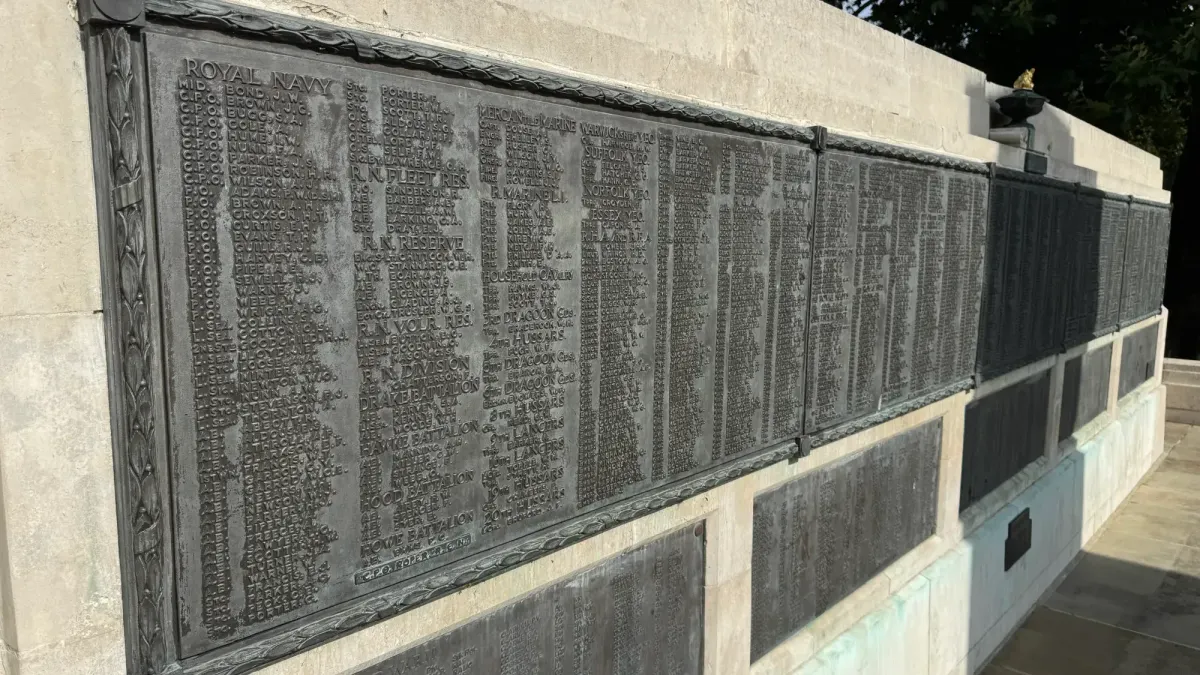
William Frederick Hardy's name is among those commemorated on the Second World War memorial at Ipswich Town Hall.
He was 26 when he died.
He had been married for only three years.
His daughter was two.
There is something especially poignant about his story because the act of courage that earned him his medal was not an attempt to achieve personal glory.
He was trying to get ammunition to his comrades.
The official military records tell us what he did and when he died. The family's recollections tell us something rather more important about what happened afterwards.
A young widow carried on.
A little girl grew up knowing that her father had been extraordinarily brave.
And decades later, that daughter was still crossing the Channel to stand beside his grave.
In a letter published by the Grenadier Guards in 2018, Gillian recalled the medals her father had won for running, swimming and football before the war.
Perhaps that is another way we should remember him.
Not merely as a soldier carrying ammunition across a battlefield, but as an athletic young Ipswich man who loved his sport, married his sweetheart and hoped to raise a family.
He never had the opportunity to grow old.
But more than 80 years after his death, the courage of Guardsman William Frederick Hardy was still being remembered by the daughter he left behind.
Don't forget: If you enjoy our content, please add Ipswich.co.uk as a "preferred source" on Google so you can easily find more of the content you value.
This article cost us ~£54 to produce
It's free for you to read thanks to the generous support of our partners. Please support us by supporting them.
Below the line