
Will Ipswich sink or swim?
Ipswich enters the summer of 2026 with an empty lido it cannot yet fund, an ageing main pool it plans to demolish, and a £38m replacement that its own council will not exist long enough to build. We ask: where will Ipswich swim?

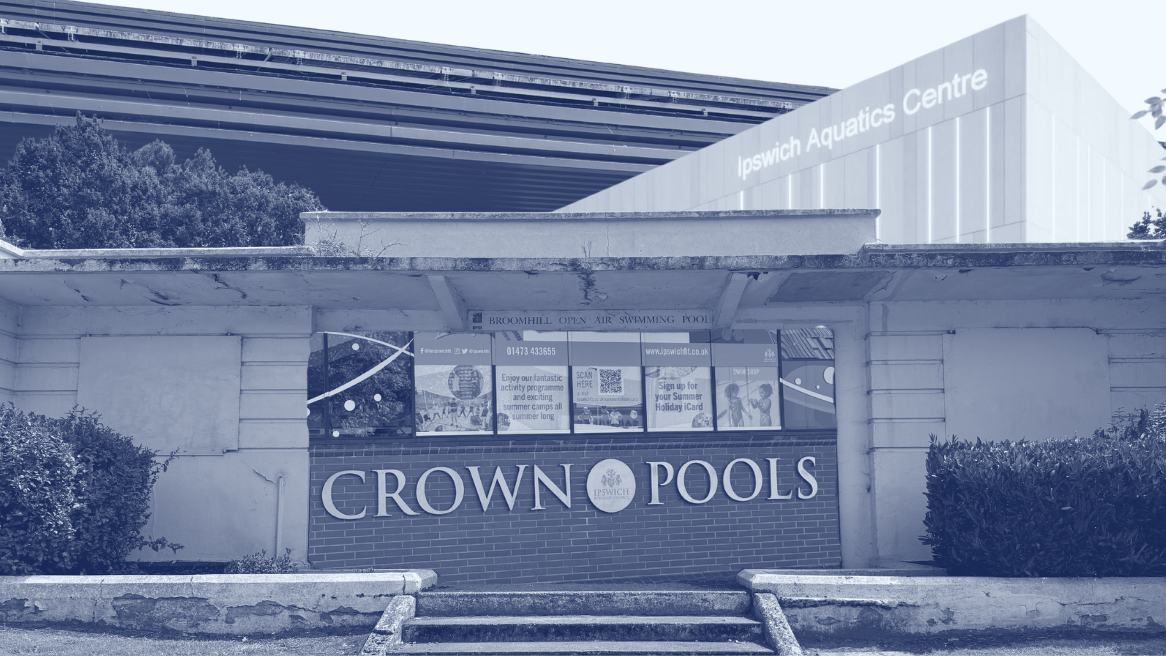
Two projects sit at the centre of the town's swimming future: the restoration of the Grade II listed Broomhill Lido on the northern edge of town, and a new £38m aquatics centre planned for the car park at Portman Road. The first has stalled after the intended operator collapsed; the second has planning permission but an uncertain timetable. Together, they will determine whether, after 24 years of plans, surveys and false starts, Ipswich's swimming provision is something worth making a splash about.
A town that needs swimming
Whatever else is disputed, the need is not. Ipswich Borough Council's own planning report for the new aquatics centre states: "Ipswich is the least active place in the East of England, and this proposal aims to change that." The same report links the town's poor health outcomes to "relatively high levels of deprivation", and the council's Sports Facilities Strategy identifies a gap in public swimming water equivalent to a full-sized 25m pool.
Swimming, the council notes, is not a luxury here. Unlike gyms, affordable pools are rarely provided by the private market, which makes the council's pools, in the strategy's words, "hugely important" for both exercise and teaching a "vital life skill". For a town where too few people are active, where children learn to swim, and clubs train their next generation, the water matters more than the politics that surround it.
Which is what makes the present moment so uncomfortable. The council's town-centre swimming rests on three pools: Crown Pools, the Victorian Fore Street Baths, and the closed Broomhill Lido. The council is trying to replace the first and revive the third, while the second carries on as it has for more than a century — and neither the replacement nor the revival is yet certain.
The warnings raised from a lifelong swimmer
Of the town's two swimming projects, Broomhill came first.
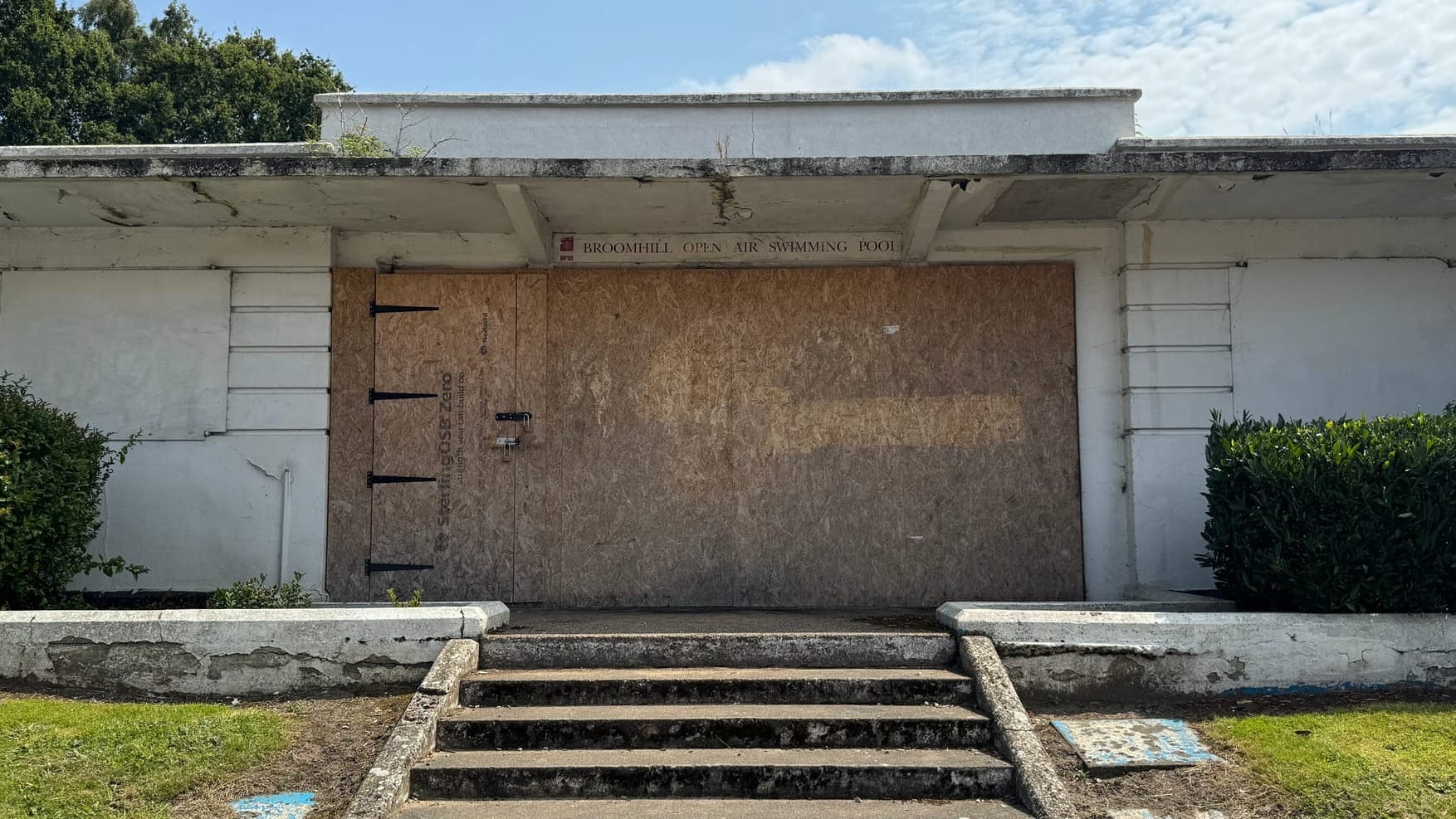
The 1938 Art Deco lido on the northern edge of town has been closed since 2002, and a campaign to reopen it began the following year, when the Broomhill Pool Trust was formed. Reviving a listed lido on this scale needed a professional operator behind it, and from 2011, the council's partner on the project was Fusion Lifestyle — a charity that specialised in restoring and running historic pools and lidos. It was Fusion that applied to the National Lottery Heritage Fund, winning the grant in 2018. The council came in as funding partner and freeholder, and the scheme was approved in 2019.
For years, one resident saw the danger in that arrangement. A lifelong Ipswich swimmer who competed and held club office in the town for more than 60 years — and who has asked not to be named — began writing to councillors, the local press and two MPs in the summer of 2022. His warning was specific and, as it turned out, prescient: Fusion, he argued, was not financially sound enough to deliver the restoration it had been entrusted with.
"How stakeholders in the restoration of Broomhill Pool did not have serious concerns about the financial status of Fusion Lifestyle, post covid, remains a mystery," he says. "I have consistently raised questions about the financial health of Fusion Lifestyle since 2022 with Ipswich councillors and MPs, but these were either never answered specifically or just ignored."
His concerns were well-founded. Fusion's accounts for 2021 showed it was around £4m in the red. It was also carrying a £13m government-backed coronavirus loan, due to be repaid in November 2023, and its own auditors had flagged "material uncertainty" over whether the charity could survive as a going concern. The swimmer says the deficit then deepened to almost £11m the following year, after which Fusion stopped filing its accounts on time.
The operator the council backed
How the lido restoration took a back seat is a question with more than one honest answer.
The Broomhill Pool Trust, which has campaigned to reopen the 1938 lido since 2003, is generous towards the company that ultimately failed it. Trust chairman Mark Ling, says Fusion was "an outstanding operator" when appointed — a pioneer in restoring heritage pools, and a genuine partner. It was Covid, he argues, that broke a once-healthy business. "The Fusion that we recognise pre-COVID and post-COVID were not the same outfit," he says.
The council's documents tell a more cautious story. A December 2021 report to its executive recorded that the council had taken independent advice on Fusion's creditworthiness, noted that the company could now contribute only £200,000 to the project instead of the £2m originally promised, and explicitly identified the risk that Fusion might enter administration. That report recommended lending Fusion £1.8m to keep the scheme alive.
Crucially, the council says that the loan was never made. "The Council did not subsequently enter into a loan agreement with Fusion Lifestyle," it confirmed in response to questions from Ipswich.co.uk. Nor did any of the council's own £3.3m contribution reach the company: that money, it says, "would only be drawn down on the evidence of completed works", and because the restoration never restarted, there was no completed work to pay for. Whatever else went wrong, no public money was lost to Fusion's collapse.
The funding, by then, was almost entirely in place. After costs rose to £10.25m, the council and the National Lottery Heritage Fund between them guaranteed around 98% of the scheme — the lottery contributing close to £6.8m, the council £3.3m. The problem was never the grant. It was that Fusion could not bankroll the work and wait to be repaid, because heritage funding is paid out only once work is completed — and the company no longer had the financial strength to carry that gap. By 2025 it could not provide audited accounts, and in July the lottery withdrew its grant.
"We are disappointed that the National Lottery Heritage Fund has made this difficult decision," the council said at the time, noting that Fusion "had been unable to provide assurances about their financial position". On 1 April 2026, Fusion Lifestyle entered administration.
What is not in dispute is the outcome. The risk that Fusion might fail was set out in the council's own 2021 report; the same year, the company's accounts showed both a juxtaposing image of a deficit and a business that had survived the pandemic and was forecasting recovery. One resident warned, from 2022, that the finances did not stack up. The council says it monitored the position and protected its money. The lido did not fail for lack of grant funding — 98% was in place — but because the operator could not carry out the work.
Stories like this take time. Your membership makes it possible.
Diving deep into Ipswich's swimming future takes hours of research, scouring council documents, and interviewing sources. Members keep that kind of journalism funded and free to read.
Too precious to lose, too costly to keep
Broomhill now sits in limbo. The lido — 55 yards long, Grade II listed, and, in the trust's words, "one of the finest in the United Kingdom" — has been closed since 2002. Its planning permission expires in December 2027, with roughly £250,000 already spent, and no new operator yet secured.
The trust argues that doing nothing carries its own cost. The lido sits in protected parkland with, as Ling puts it, "no commercial value"; the council, as freeholder, retains a duty of care for a listed building, and the trust estimates demolition and return to parkland would itself cost around £1.5m. "We are not lido fundamentalists," Ling says. "After 23 years of campaigning, it is incredibly frustrating what has occurred, but we remain committed to the task and we think IBC is too."
The council says its £3.3m contribution remains ringfenced for the restoration — protected within its budget, and removable only by a formal decision by the full council. But the path forward is slightly more foggy. Because the lottery grant cannot be transferred from Fusion to a new applicant, the council would have to prepare a fresh bid; and it must first regain possession of the site from the administrators. Until that is resolved, the council says, "it is not possible to set a realistic timetable for the project", though it remains "fully committed to restoring the much-treasured Broomhill Lido".
A new pool to replace the one we have
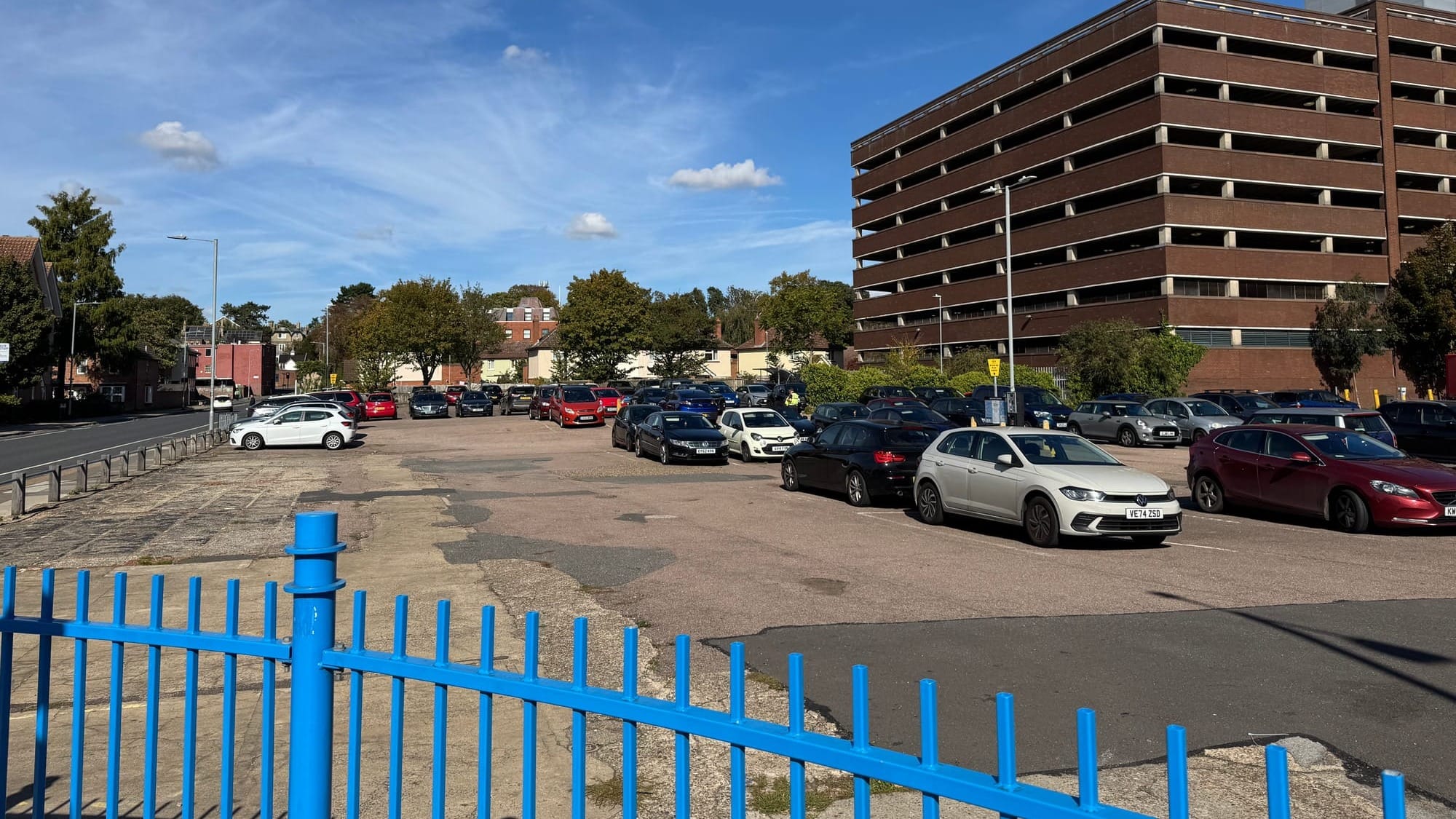
While the lido stalled, the council pressed ahead with its other swimming ambition: a £38m aquatics centre on the surface car park behind Portman Road's Cobbold Stand, brought forward by the council through its development company.
The first thing to understand about the new centre is that it is a replacement, not an addition. It is intended to take over from Crown Pools, the town-centre complex opened in 1984, which the planning report describes as "coming to the end of its lifecycle" and "proving costly to maintain". The council says it considered simply refurbishing Crown Pools and rejected the idea, partly because doing so would have closed the town's main pool for almost two years. Importantly, it says Crown Pools "will remain in use until a new Aquatics Centre is complete and open" — so on the council's account, there should be no period in which Ipswich has no main pool.
The questions raised by critics — and by at least one objector in the council's own planning file, who "questions the need of another pool, that does not go beyond the provision at Crown Pools" — is what, exactly, the town gains for £38m if it is replacing a 25m pool with another 25m pool.
The consented plans describe a 25m main pool, a 17m learner pool and a leisure and splash area aimed at families with young children, alongside a café, fitness suite and soft play across two floors.
Despite some reporting to the contrary, there will be no water flumes and no diving facilities; the planning report records that flumes "would be cost prohibitive in relation to ongoing operational costs", as would providing the depth needed for diving.
There will be no 50m pool: the report concludes there is "insufficient space" for both a learner pool and a 50m pool, and that splitting a longer pool would push up running costs.
That last decision is at the heart of our source's second objection. The nearest 50m pool to Ipswich, he points out, is around 50 miles away, and he believes the town should have built one as part of a wider sports complex. As things stand, he judges the Portman Road plans harshly: "The plans as shown in the planning document do not provide aquatic facilities as good as currently available at Crown Pools."
The council's documents do not entirely bear that out. On some measures the new centre improves on Crown Pools: gala seating rises from 600 to around 663, and a studio pool will double as a warm-down facility, which Crown Pools lacks. On others — no flumes, no diving, no deep water, no competition-length pool — the offer is narrower than some had hoped. The truth is a trade-off, and revealingly, both sides of it sit in the same council report: the case for a modern centre to revive the least active town in the region, and the case that what is being built does not go far beyond what the town already has.
The aquatic centre is not a competition pool, but neither is it a proper leisure destination. Can a facility that is neither nor justify it's £38m price tag?
Swimming next to the football
There is also the matter of where the new pool will sit. The site is wedged between Ipswich Town's stadium and a flood-prone corner of the town centre, and both facts have drawn attention in the planning process.
Suffolk Constabulary, responding to the application, asked for a management plan precisely because of the stadium next door, recommending monthly meetings between the centre, the football club and the police "to ensure events at the Aquatic Centre do not clash with events (including matches) at ITFC in order to reduce the risk of congestion and conflict", along with private security on event days. It is a concern the swimmer raised as far back as 2022, when he questioned how a family pool would function on a match day.
Then there is the question of the journey to the outcome.
The aquatics centre cannot be built until a new multi-storey car park is completed — and even the timetable for that has slipped. When the council announced the car-park plans in March 2026, it expected construction to run from late summer 2026 to the end of 2027. By June, in response to questions from Ipswich.co.uk, it set out a later sequence: construction starting in early 2027, the car park opening in the summer of 2028, and that being "the earliest time that further development work i.e. the aquatics centre could start".
On the council's own most recent account, work on the pool itself could not begin until after the council that approved it has ceased to exist. The car park, at a cost of £19.7m, will provide 718 spaces where 810 stand today, a net loss of 92.
Building for a council that will not exist
For all the detail, the largest uncertainty is the simplest. The council approved the £38m for the aquatics centre, within a wider £70m capital programme, in February 2026. It expects the centre to open in 2030 — and, on its latest timetable, work on it could not even begin until after the summer of 2028. Ipswich Borough Council is due to be abolished in 2028, when it is replaced — along with Suffolk's other district, borough and county councils — by new unitary authorities. The body that approved the pool will not be the body that builds or pays for it.
Borrowing the full £38m over 25 years would cost around £2.86m a year, some £71.5m in total, and the council has said it would seek external funding from government or Sport England to reduce that, though how much it could secure is unclear.
That the reorganisation itself is now the subject of a legal challenge only deepens the uncertainty about who, in a few years' time, will be answerable for any of this. And for the swimmer, that is the heart of it: the town is being asked to trust that a pool it will not start building until after its own council has gone will arrive, on time, from a body that does not yet exist.
The bottom line
Twenty-four years after Broomhill Lido closed, Ipswich is no closer to a settled answer to a simple question: where will the town swim?
It has a lido it cannot yet fund, a main pool it wants to knock down, and a £38m replacement that, on the council's own timetable, will not be finished until two years after the council itself has gone.
The decisions have been made in good faith, and the need is real — this is the least active town in the East of England, and good swimming could play a part in change. But the town has been here before: years of ambition it could not deliver, and a plan that outlives the people who made it.
For one lifelong swimmer, who watched the lido stall and fears the new pool repeats the pattern: if both schemes proceed as planned, "Ipswich will be repeating past mistakes."
For Mark Ling, the Broomhill Pool Trust chairman who has championed the lido's restoration for more than two decades, the setbacks have not changed his mind: "It is incredibly frustrating what has occurred, but we remain committed to the task, and we think IBC is too."
Stories like this take time. Your membership makes it possible.
Diving deep into Ipswich's swimming future takes hours of research, scouring council documents, and interviewing sources. Members keep that kind of journalism funded and free to read.
Don't forget: If you enjoy our content, please add Ipswich.co.uk as a "preferred source" on Google so you can easily find more of the content you value.
This article cost us ~£187 to produce
It's free for you to read thanks to the generous support of our partners. Please support us by supporting them.
Below the line