
Why we're reluctantly withdrawing our support for Ipswich's City of Culture bid
We were the first to champion it. We have continued to do so relentlessly ever since. Today, with great sadness, we are withdrawing our support for Ipswich's City of Culture bid. Here's why.

Firstly, this is not a decision we have taken lightly.
We were the first media outlet to champion this bid. We reported on its original ambition, amplified its early momentum, and stayed with it through every significant stage of its development. We have spent countless hours challenging negativity and misinformation on social media, encouraging everyone to get behind it, and chatting to anyone who walks through our doors to talk about it. We wanted this to work. We still desperately want Ipswich to win.
However, as a small, independent, two-person newsroom, we simply cannot justify continuing to dedicate our very limited resources to backing a bid that has opted to make a national media company with titles in two competing cities its exclusive official media partner – a decision by the council's CEO Helen Pluck that has created unnecessary and unfair hierarchy among media partners at exactly the moment the bid needed all of us pulling in the same direction.
How we got here
When we first became aware of the council's decision to make Newsquest, the US-owned media company that owns the Ipswich Star and East Anglian Daily Times, the exclusive official media partner of the bid, we did not go straight to publication. We contacted the council directly to request clarification on the terms of the agreement and politely asked that they extend the designation to all media partners backing the bid.
The response we received was not an official council statement — it was a note from a member of the project team, clarifying that there was no contract, no financial commitment, and no exclusivity attached to Newsquest's designation.
On that basis, we followed up by asking whether the council would be prepared to then offer Ipswich.co.uk (and all other media outlets) the same designation, on the same terms as those offered to Newsquest. We simply wanted a level playing field on which all media partners that were backing the bid were treated equally.
They refused, so we wrote an open letter to Helen Pluck, the council's chief executive, setting out our position clearly and publicly.
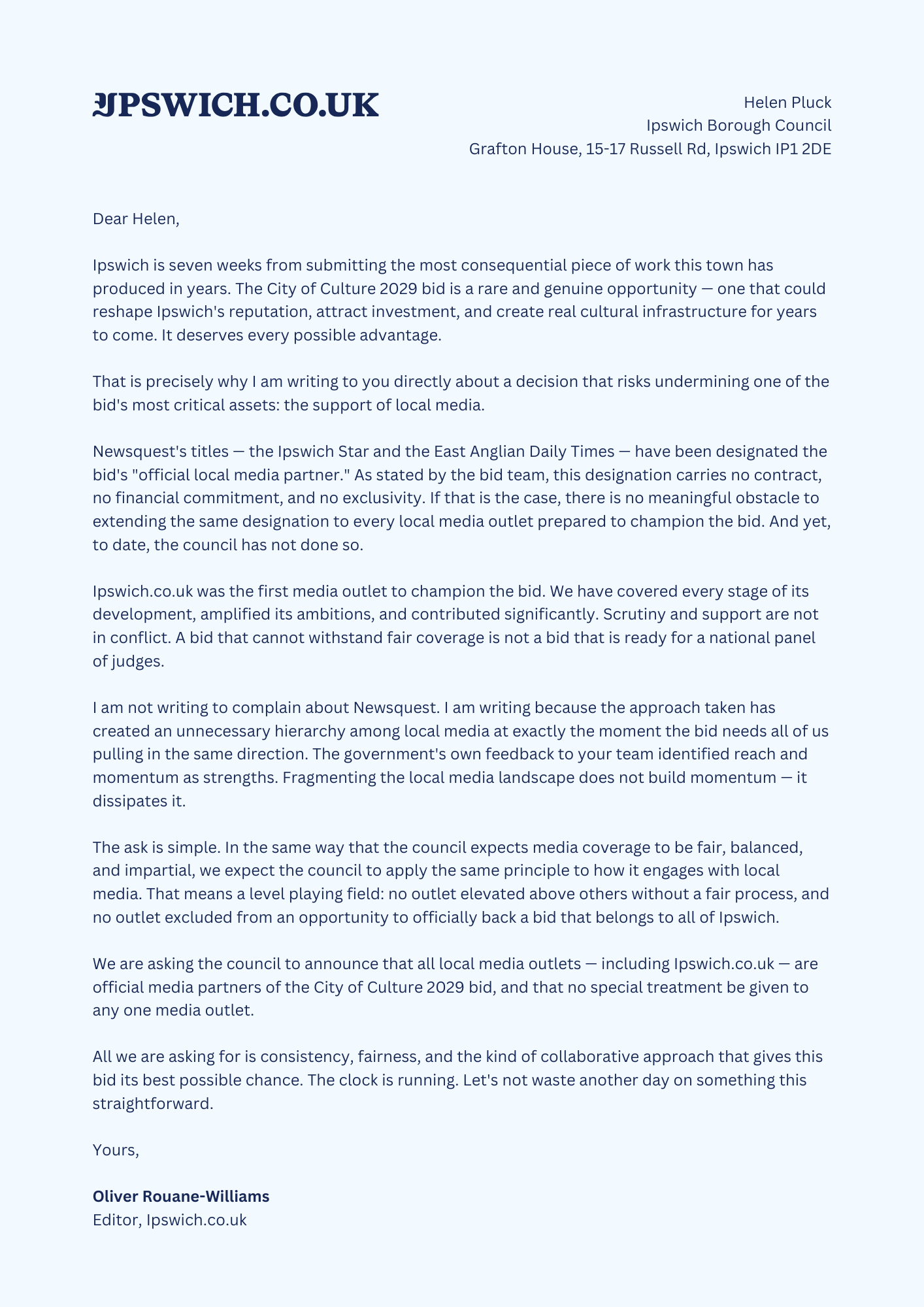
The public response was massive – tens of thousands of people read our coverage, hundreds emailed us in solidarity, and dozens emailed Pluck directly, urging her to reconsider.
Pluck, who has refused to have a single conversation with us about this, eventually responded in the form of an official council statement via the council's press office.
She described Ipswich.co.uk as "one of the most valuable media voices in our town" and said the council wanted to work with us as a "valued media partner."
However, she was only willing to offer us an alternative designation: "Independent and Youth Media Partner" — a frankly insulting title that would place us in a different, and by any reasonable reading, lesser category than Newsquest's titles.
We declined.
Our position had not changed: a level playing field, or no playing field at all. We set a deadline to reconsider. Yesterday, that deadline passed without resolution.
The council's justification
Pluck's justification for the exclusive Newsquest media partnership rested on one claim: national reach. She stated that the partnership was set up to extend the bid's reach beyond Suffolk and connect it to national media through Newsquest's wider network.
Just two problems.
Firstly, Newsquest operates titles in Swindon and Wrexham — both on the City of Culture 2029 longlist, both competing directly against Ipswich for the same shortlist places. The council has asked a commercial media group with a presence in two rival cities to prioritise Ipswich's interests above those of two other cities. No one at the council has yet explained how that is supposed to work in practice.
And then there is the paywall. Newsquest operates paywalls across its titles. Anyone outside Suffolk who finds a piece about the City of Culture bid in a Newsquest title will, in most cases, be unable to read it. The national audience the council says it is trying to reach will hit a payment screen. A media strategy built on national cut-through, delivered through paywalled local titles, is not a strategy, and certainly isn't a feasible justification to prioritise one local media outlet over another.
Exclusively 'non-exclusive'
The council has been consistent on one point: the partnership with Newsquest is non-contractual and non-exclusive. Yet only one media group has been publicly designated as the official media partner of the bid. And the council is refusing to extend the same title to other media. That is not a non-exclusive arrangement. That is, by definition, an exclusive arrangement.
We're awaiting a response to a Freedom of Information request to better understand the terms of the exclusive arrangement with Newsquest.
A bid under huge pressure
Before the council took control, confidence among those close to the campaign was sky-high and well-founded. The Expression of Interest that earned Ipswich a place on the longlist — beating 16 other applicants — was not a council document. It was the product of a cross-party coalition of local leaders with real momentum behind them.
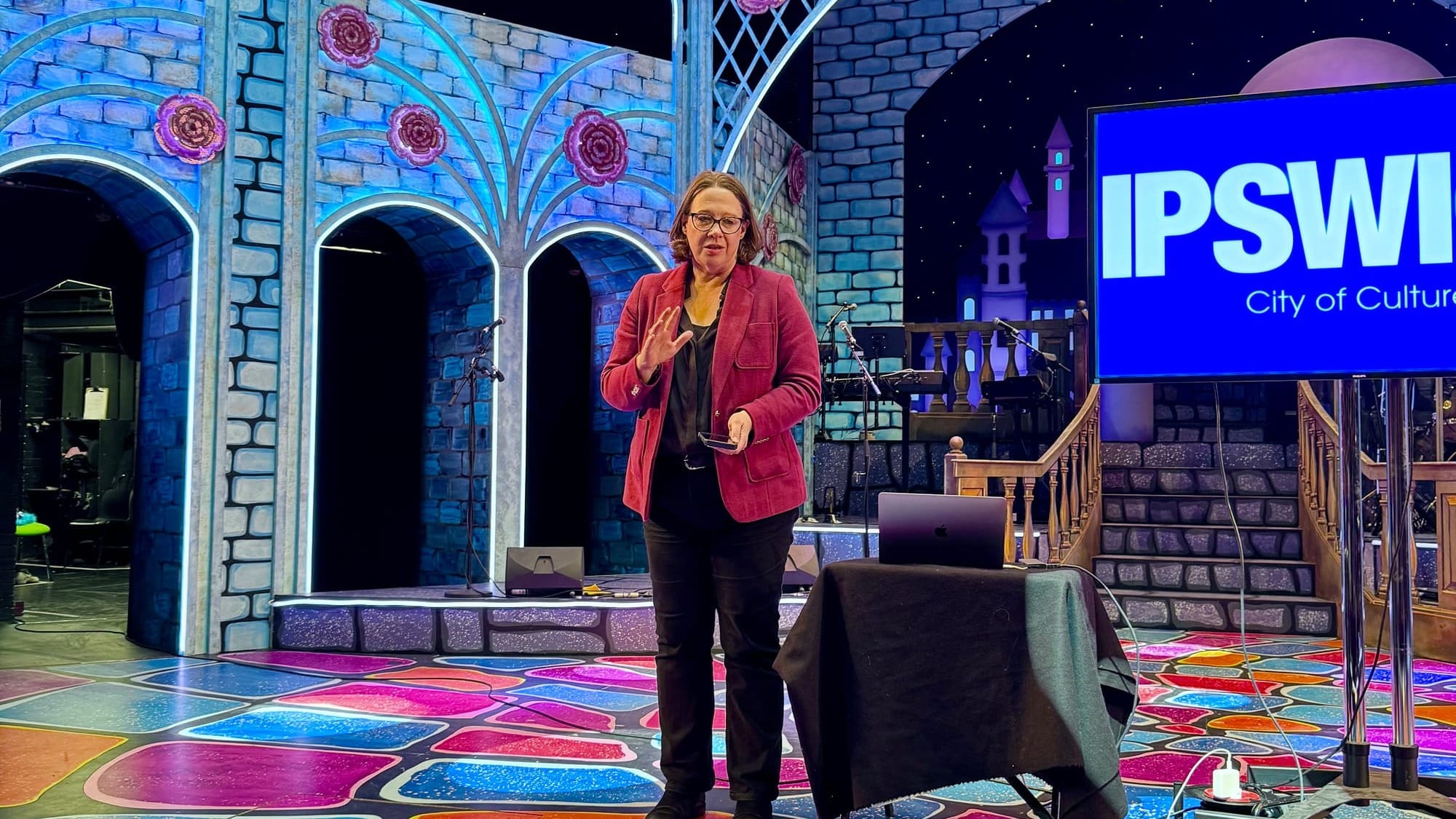
That coalition has since been largely dismantled, and the council has been dragging its heels since. The council only formally announced its bid director, Amy Vaughan, this month. Vaughan is highly regarded and has a strong track record, but at the first vision workshop at The Regent Theatre on Wednesday, 18 June, she was unable to introduce her team because there were no contracts in place. With just seven weeks remaining until the submission deadline of 10 August, the people who will write and deliver the most consequential document this town has produced in years had not yet been formally appointed.
The government's judging panel has been explicit: it wants to see delivery and governance arrangements that inspire confidence. A bid team that cannot confirm its own composition seven weeks before submission is not projecting it.
In just a few short weeks, what was an unrivalled optimism has curdled into an all-too-familiar sense of pessimism. The council must now prove its doubters wrong.
The bottom line
This was a reluctant decision, but a necessary one. We gave the council every opportunity to resolve a simple and fair ask for a level playing field. We raised it privately before we raised it publicly. We set multiple clear deadlines. The council's CEO would not budge.
In declining to act, she has not only lost the active backing of the outlet that championed this bid from the beginning — she has compounded a growing sense, among people who know this campaign well, that the opportunity Ipswich worked so hard to create is at risk of being squandered by a council that has become synonymous under Pluck's executiveship with an inability to execute.
The council took the reins. It must now show it can deliver. If it doesn't, there will be no ambiguity on why Ipswich's City of Culture bid failed, and where responsibility lies.
As for our withdrawal of support, it is not irreversible. The council knows exactly what it needs to do: announce Ipswich.co.uk as an official media partner of the bid, on the same terms as every other local media outlet. That is all we have ever asked for. The door remains open.
Don't forget: If you enjoy our content, please add Ipswich.co.uk as a "preferred source" on Google so you can easily find more of the content you value.
Local journalism is expensive to produce
It's free for you to read thanks to the generous support of our partners. Please support us by supporting them.
Below the line