
They came from Ipswich: Brian Cant, 'The voice of our childhood'
Trumpton, Chigley, Camberwick Green and Play School. How a boy from Ipswich became one of the most loved voices in British television history.


There was something wonderfully reassuring about children's television in the 1960s and 70s. Nobody was in much of a hurry, the grown-ups were generally agreeable, and the most pressing emergency of the day might involve a missing delivery of flour or a windmill refusing to turn.
And presiding over much of this glorious nonsense was a man from Ipswich.
Brian Cant. What a lovely fellow he was.
If you're of a certain age, you won't need reminding of that voice. Warm, unmistakably English, gently mischievous and possessed of the remarkable ability to make even the most ridiculous situation sound perfectly reasonable.
He was the voice behind three of Britain's most fondly remembered and notably bonkers children's television programmes: Camberwick Green, Trumpton and Chigley.
And here's something that might surprise you. Between all three programmes, just 39 episodes were made. Thirteen of each. That's it. Yet they entertained British children for decades.
More about those extraordinary little programmes in a moment.
Brian was born in Ipswich on 12 July 1933 and attended Northgate Grammar School for Boys. His early ambitions were rather different from the career that eventually made him famous. He was a promising footballer, even training with Ipswich Town's youth side.
Professional football wasn't to be, however, and he found work with a local printing company as a lithographic artist.
He was also developing an interest in acting, helping out at Ipswich Theatre and enjoying the music hall entertainment at the town's Hippodrome. Eventually, the theatrical bug won, and he left printing behind.
By 1958 he was working professionally in repertory theatre, and during the early 1960s began appearing in television dramas.
Then, in 1964, came the audition that changed everything.
The BBC was launching a new programme for very young children called Play School. Its creator, Joy Whitby, had a rather unconventional approach to finding presenters.
She asked Cant to climb into a cardboard box and pretend to row out to sea.
He duly obliged, cast an imaginary fishing line and hauled aboard a Wellington boot filled with imaginary custard.
Perfectly normal behaviour, obviously.
He got the job.
For the next 21 years, Brian Cant became one of the defining faces of Play School, alongside Big Ted, Little Ted, Humpty, Jemima and the famous round, square and arched windows.
It was simple television, but deceptively clever. The presenters weren't talking at children. They were talking to them.
Cant later explained that the trick was to imagine addressing just one child, wherever they happened to be watching. It was a philosophy he followed beautifully.
But there was another side to his career, one where you never saw his face at all.
In 1966, producer and puppeteer Gordon Murray created Camberwick Green, a stop-motion animation about life in a fictitious English village.
The opening was magical. A musical box turned, opened, and revealed the character whose adventures we were about to follow.
There was Windy Miller, operating his windmill and enjoying the occasional glass of cider. Dr Mopp, whose medical practice seemed wonderfully free of administrative difficulties. PC McGarry, maintaining law and order in a village where almost nobody did anything wrong.
And, should matters become serious, Captain Snort and his soldiers at Pippin Fort could be summoned to deal with the emergency.
Watching it today, Camberwick Green is gloriously peculiar.
The characters inhabit a Britain that probably never existed, even in 1966. Everybody knows everybody, the shops are independently owned, and a broken windmill can become a matter of almost national importance.
Cant narrated the stories, performed the character voices and sang the songs, making the whole unlikely world seem utterly believable.
A year later came Trumpton.
Now things became really strange.
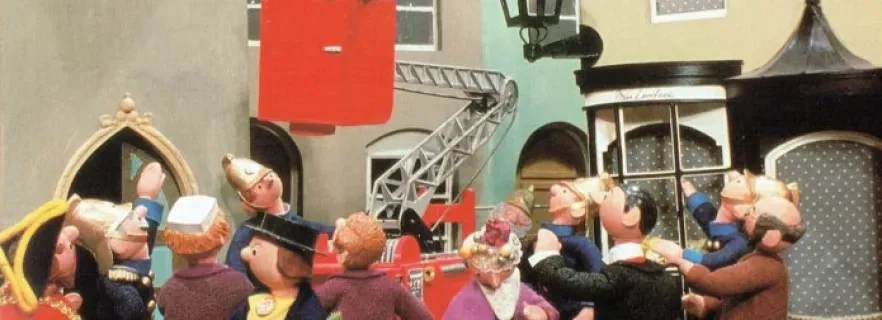
There was a town hall, a mayor, a clock, various tradespeople and, most memorably, the fire brigade.
Pugh, Pugh, Barney McGrew, Cuthbert, Dibble, Grubb.
Go on, admit it. You've just said that aloud.
The astonishing thing about Trumpton's fire brigade is that, throughout all thirteen episodes, they never actually put out a fire.
Not one.
The explanation was wonderfully practical. Scriptwriter Alison Prince later revealed that producing realistic flames, smoke and water using stop-motion animation was virtually impossible.
So she wrote thirteen stories about a fire brigade that never attended a fire.
You really couldn't make this stuff up. Except, of course, they did.
By 1969 we had Chigley, the third instalment in Gordon Murray's increasingly eccentric miniature universe.
Chigley was the industrial centre of Trumptonshire, complete with a biscuit factory, a stately home and Lord Belborough, an aristocrat who spent a surprising amount of his time driving a steam engine called Bessie.
His butler, Brackett, accompanied him on railway expeditions, usually to solve some minor logistical disaster.
And every evening, when the biscuit factory whistle sounded at six, everybody finished work and gathered at Winkstead Hall, where Lord Belborough played his magnificent Dutch organ and the workforce danced.
Imagine suggesting that arrangement to a modern workforce.
The music was another essential ingredient. Composer Freddie Phillips provided those infectious melodies, while Cant supplied the singing and narration.
In fact, Cant later recalled that the Trumpton voices were recorded in Phillips' bedroom, sometimes three episodes in a day. He didn't even see the Camberwick Green sets until the finished programme appeared on television.
The animation itself was painstaking work, undertaken by Bob Bura and John Hardwick, moving miniature figures frame by frame.
It explains why so few episodes were made, but also why they looked so good.
Their success wasn't dependent on spectacular effects. It was down to imagination, craftsmanship and a narrator whose voice made everything fit together.
Cant's career continued well beyond Trumptonshire. He presented Play Away, the livelier companion to Play School, appeared in Bric-a-Brac and later introduced another generation of children to Dappledown Farm.
He also performed in theatre, appeared in adult television dramas and enjoyed the curious distinction of being killed off twice in Doctor Who.
In 2010 he received a special BAFTA recognising his outstanding contribution to children's television. He was characteristically modest about the fuss.
Sadly, Brian had been diagnosed with Parkinson's disease in 1999. He lived with the condition for many years before dying in June 2017, aged 83.
Those who worked with him remembered a kind, funny and generous man. There was none of the manufactured excitement that sometimes characterises children's television. He genuinely seemed to enjoy what he was doing.
And perhaps that's why we remember him with such affection.
A boy who grew up in Ipswich, dreamed of playing football at Portman Road and worked in a printing shop somehow became the comforting voice of millions of British childhoods.
Thirty-nine little animated adventures. Three imaginary communities. One extraordinary voice.
And all these years later, somewhere in our memories, the Trumpton clock is still ticking, Windy Miller is still tending his sails, and Lord Belborough is preparing to start Bessie.
Thank you, Brian.
One of Ipswich's finest. And what a lovely legacy to leave behind.
Don't forget: If you enjoy our content, please add Ipswich.co.uk as a "preferred source" on Google so you can easily find more of the content you value.
Local journalism is expensive to produce
It's free for you to read thanks to the generous support of our partners. Please support us by supporting them.
Below the line