
The woman who went to prison over a dog licence, and helped change Britain forever...
She was a music teacher, a keen cyclist and a perfectly respectable resident of Norwich Road. But Constance Andrews had a rebellious streak that would take her from the streets of Ipswich to the cells of Holloway Prison and make her the subject of secret police photographs.

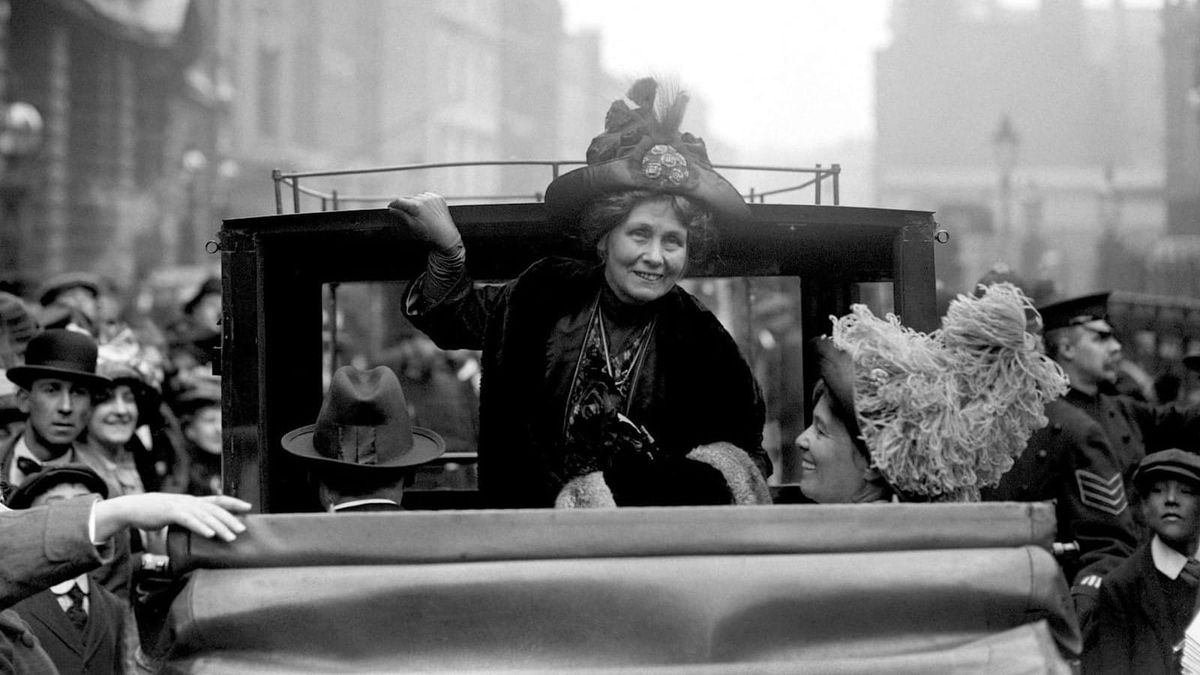
This story begins, rather wonderfully, with a dog. In the next in our series, "They came from Ipswich", we pay tribute to a woman who played her own unique part in changing modern history.
A most unusual welcome home
On the morning of Friday, 26 May 1911, a crowd gathered outside Ipswich Gaol in St Helen's Street. They were waiting for a woman whose crime had been rather less dramatic than the reception suggested.
She had refused to buy a dog licence.
The prison gates opened, cheers erupted, and out stepped Constance Andrews, a 47-year-old former music teacher who had just spent a week behind bars for an act of deliberate disobedience.
Waiting to greet her was Charlotte Despard, one of the most formidable figures in Britain's campaign for women's rights, along with a collection of local supporters determined to turn an otherwise unremarkable Friday morning into something of a public spectacle.
A photographer had positioned himself on a wall opposite the prison. A carriage was waiting, banners appeared, and the procession made its way through Ipswich towards Arcade Street, attracting curious spectators along the route.
At the Women's Freedom League headquarters, breakfast had been prepared. The tables were decorated in green, white and gold, there were speeches, and the assembled company sang For She's a Jolly Good Fellow.
Constance, fresh from prison, entertained them with an account of her incarceration.
It was a splendid piece of political theatre, particularly considering that the whole business had started with a dog licence.
But the dog was merely the excuse. Constance Andrews was fighting a much bigger battle.
And she was only getting started.
A music teacher with unconventional ideas
Emily Constance Andrews was born in Stowmarket in 1864, the daughter of Oliver Andrews, an architect and surveyor, and his wife Mary.
Her early life offered few obvious clues that she would become one of Suffolk's most determined political agitators.
She was musical, accomplished and well educated. As a teenager, she performed piano recitals, and by the 1890s she was teaching music professionally, having become an Associate of the London College of Music.
But Constance was not especially interested in being conventional.
In 1896, she helped establish the ladies' section of the Stowmarket Cycling Club and became its first captain. At a time when a woman riding a bicycle could still excite considerable public comment, this was an early indication that she was not particularly troubled by what society considered appropriate.
She was also involved in a building business, an unusual commercial undertaking for a woman of her generation.
By the early 1900s she had moved to Ipswich, where she lived at 160 Norwich Road with her sister Lilla and brother-in-law.
She was unmarried, independent-minded and increasingly interested in politics.
The question troubling her was simple enough.
Why should a woman obey the laws, pay the taxes and contribute to the running of the country when she was denied any say in choosing the people who governed it?
It was a question to which the British establishment had remarkably few satisfactory answers.
Ipswich discovers a troublesome woman
There had been campaigning for women's votes in Ipswich for decades.
In 1866, thirteen local women signed an early national petition demanding the parliamentary franchise. Later generations organised meetings, distributed literature and attempted to persuade politicians that women were perfectly capable of putting a cross on a ballot paper.
Progress was painfully slow.
Constance became involved in the established Ipswich and County Women's Suffrage Society, serving as its secretary in 1907. But she grew frustrated with what she regarded as its cautious approach.
She wanted something livelier.
In 1909 she helped establish the Ipswich branch of the Women's Freedom League, an organisation committed to direct political action without the deliberate destruction of property associated with some other suffragette campaigns.
Constance understood something that modern campaigners would recognise immediately.
If you wanted people to pay attention, you had to give them something worth talking about.
The League organised public meetings, exhibitions, demonstrations and colourful events. One was a Green, White and Gold Fair, held in Ipswich in July 1909, which highlighted women's voting rights overseas and the treatment of imprisoned campaigners in Britain.
The movement was becoming increasingly visible in the town.
Its members were not content merely to discuss injustice over afternoon tea.
They intended to make a nuisance of themselves until somebody listened.
The night the women of Ipswich disappeared
On the evening of Sunday, 2 April 1911, something peculiar happened in Museum Street.
Around thirty women gathered at the Old Museum Rooms, a building that survives today as Arlington's, for what might reasonably be described as the most politically motivated sleepover in Ipswich history.
That night, the country was being counted in its national census.
Constance and her companions intended not to be counted.
Their reasoning was beautifully straightforward. If women did not count politically, why should the government be allowed to count them statistically?
It was part of a nationwide campaign known as No Vote, No Census.
The women assembled in the building, where they spent the night eating, singing, playing cards and exchanging stories.
According to an account Constance subsequently gave to the press, disguises were worn in case of intruders, and ghost stories were told as the night progressed.
It must have been a curious scene.
Outside, Edwardian Ipswich went about its Sunday evening business. Inside, a gathering of respectable women was deliberately frustrating the machinery of government, armed principally with sandwiches, songs and an unshakeable sense of injustice.
Constance's sister Lilla was among them, as was Isobel Tippett, whose young son Michael would eventually become one of Britain's most distinguished composers.
The authorities were not entirely fooled.
When the census enumerator visited the Andrews household at Norwich Road, he discovered that two women were absent.
His handwritten explanation on the census form recorded that two female suffragists had gone to an unknown location for the night. The household's female servant had accompanied them.
It is a wonderfully revealing little piece of history.
The enumerator knew perfectly well what was going on, but the women had made their point.
The protest succeeded in drawing attention to the campaign.
And Constance had already identified her next opportunity to embarrass the establishment.
This time, the government would have to decide what to do about her dog.
No vote, no tax, and no dog licence
In Edwardian Britain, keeping a dog generally required the purchase of a licence.
Constance refused.
Her objection had nothing to do with the animal, and everything to do with taxation without representation.
Women were expected to contribute financially to a government in whose election they could take no direct part. Constance considered that fundamentally unjust.
The protest formed part of the Women's Tax Resistance League's campaign, summed up in the simple slogan No Vote, No Tax.
Constance was prosecuted for failing to obtain the required licence and refused to pay the resulting penalty.
Rather than surrender her principles, she went to prison.
She had even arranged her affairs so that there were no possessions available for the authorities to seize in payment of the fine.
It was a remarkable choice for a respectable middle-class woman with a professional career and social standing to protect.
Prison in 1911 was not a comfortable place. Neither was it somewhere women of Constance's background could expect to emerge without reputational damage.
But she understood that her imprisonment would expose the absurdity of the situation more effectively than another dozen speeches.
It certainly did.
The Women's Freedom League made sure everyone in Ipswich knew what had happened. Meetings were arranged on the Cornhill. Posters and newspapers were distributed, and a decorated costermonger's barrow was pushed through town to publicise the campaign.
By the time Constance emerged from prison, she had become something of a local celebrity.
The celebration at Arcade Street was reported in the suffrage newspaper The Vote, which described people peering from windows as the procession passed.
Constance was delighted with the attention.
She suggested that other women should refuse to pay their dog tax too. Those without a dog, she advised, might consider acquiring one.
It was an appealingly mischievous suggestion.
Unfortunately for the authorities, this troublesome woman had no intention of retiring quietly to her piano.
Taking the revolution into the Suffolk countryside
One of the more delightful chapters in the story of the Ipswich suffragettes involved a caravan.
The Women's Freedom League raised money to purchase one so that campaigners could carry their message beyond the town and into the surrounding villages.
The caravan set off from Ipswich in 1909, initially heading towards Debenham.
Imagine the scene: a travelling party of politically outspoken Edwardian women arriving in rural Suffolk to explain why women deserved the vote.
Some villagers were welcoming, others less enthusiastic.
The caravan provided accommodation, a mobile headquarters and a convenient means of taking the argument to women who might never have attended a political meeting.
The following year, the campaign continued towards Felixstowe.
Constance later travelled around Suffolk with fellow campaigners, including Charlotte Despard.
These were not always easy journeys. The women faced heckling, poor weather and considerable hostility.
But they persisted.
Constance's political interests were also broader than votes for women. She was involved in the labour movement and helped organise women workers, including those employed in Ipswich's corset industry.
She understood that winning the vote would mean relatively little if poorer women remained trapped by low wages, insecure employment and a lack of opportunity.
For Constance, political freedom and economic independence belonged together.
The woman Scotland Yard wanted to photograph
By 1912, Constance's reputation had spread far beyond Suffolk.
She had become sufficiently important within the Women's Freedom League to take on national responsibilities, travelling around Britain to organise meetings and promote the cause.
But greater prominence brought greater attention from the police.
In June 1913, she was arrested following an attempt to speak outside St James's Palace in London. She was charged with obstructing the police and, after refusing to pay a fine, was imprisoned.
Her campaigning continued.
In March 1914, Constance was among four Women's Freedom League members prosecuted after picketing Scotland Yard and the offices of the Director of Public Prosecutions.
Their protest concerned the continued employment of police officers who had admitted knowing about alleged criminal conduct involving another officer and a 14-year-old girl.
The women were convicted of obstruction and sentenced to fourteen days in prison.
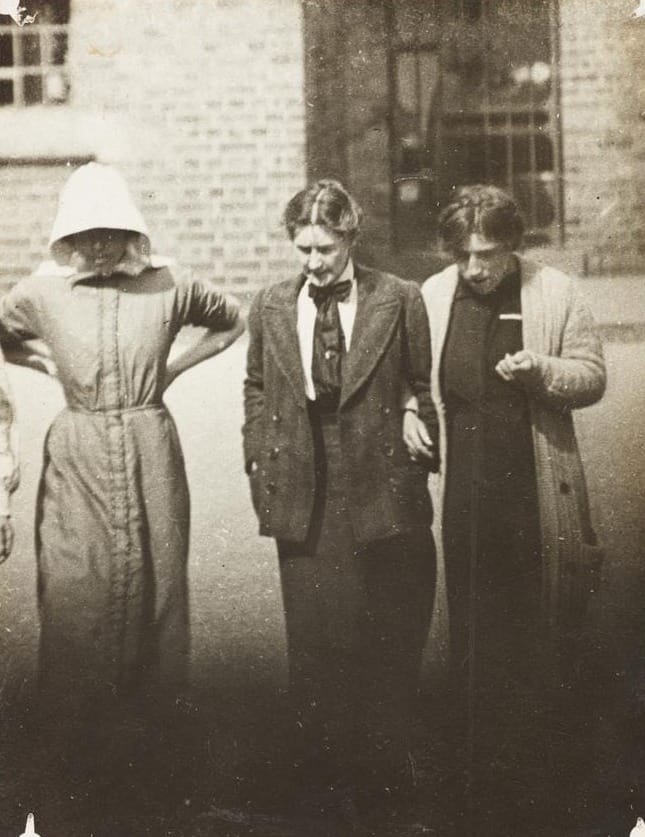
It was during this period that Constance became the subject of one of the more unsettling surviving images of the suffragette movement.
The London Museum holds a photograph of her exercising in the yard of Holloway Prison.
It was taken secretly by a police photographer.
Scotland Yard had begun compiling surveillance photographs of suffragettes, partly to identify women suspected of planning direct action in public buildings.
Constance's photograph was preserved among those records.
There is something particularly striking about that image today.
The respectable music teacher from Norwich Road had become a person whom the British state considered worth secretly photographing while she was in prison.
All because she insisted that women should be allowed to vote.
The victory she lived to see
The First World War changed the course of the suffrage campaign.
In 1918, Parliament finally extended the parliamentary vote to some women, although the qualification was restrictive. Women had to be at least 30 and meet certain property conditions, while men generally qualified from 21.
It was progress, but it was not equality.
That came in 1928, when women were granted the parliamentary franchise on the same terms as men.
Constance was 64 years old.
She had lived long enough to see the central demand of her political life become law.
Her later years took her away from Ipswich. She became involved in progressive religious and social movements, including the Church of the New Age, whose outlook reflected her interest in equality and social reform.
She died in Sale, Cheshire, in 1947, aged approximately 83.
There was no grand national monument to the woman who had once brought cheering crowds onto the streets of Ipswich.
For many years, her remarkable story was largely forgotten outside the circles of local historians and those interested in women's suffrage.
But the traces of her life have not entirely disappeared.
A blue plaque and a rather wonderful legacy
Walk along Museum Street today, and you can find a blue plaque outside Arlington's, commemorating Constance Andrews and the women who gathered there to defy the 1911 census.
It was unveiled on 8 October 2016, more than a century after their extraordinary night of resistance.
Nearby Arcade Street, once the headquarters of the Women's Freedom League, is another reminder that Ipswich played a part in the national struggle for women's equality.
There is something rather satisfying about the modest scale of these surviving landmarks.
Great political changes are often remembered through famous speeches, grand buildings and celebrated national leaders.
Yet much of the real work was done by people whose names have scarcely survived.
Women who distributed leaflets, argued in public halls, travelled through villages in caravans, endured ridicule and sometimes went to prison.
Constance Andrews was one of them.
She was not born in Ipswich, but it was here that she made her mark, organising ordinary women into an extraordinary local movement and challenging a political system that had excluded them for generations.
Her story is a reminder that history is not always made by the rich, the famous or those who hold public office.
Sometimes it is made by a music teacher from Norwich Road, armed with a bicycle, a considerable amount of determination and a dog for which she absolutely refused to buy a licence.
And that, surely, is another Ipswich life worth remembering.
Don't forget: If you enjoy our content, please add Ipswich.co.uk as a "preferred source" on Google so you can easily find more of the content you value.
This article cost us ~£215 to produce
It's free for you to read thanks to the generous support of our partners. Please support us by supporting them.
Below the line