
The grand old Ipswich department store, where shopping was an occasion, and lunch upstairs was half the pleasure
For more than 150 years, Grimwades was part of the fabric of Ipswich life. Grab a cup of your choice and join us for a detailed dive into its history.

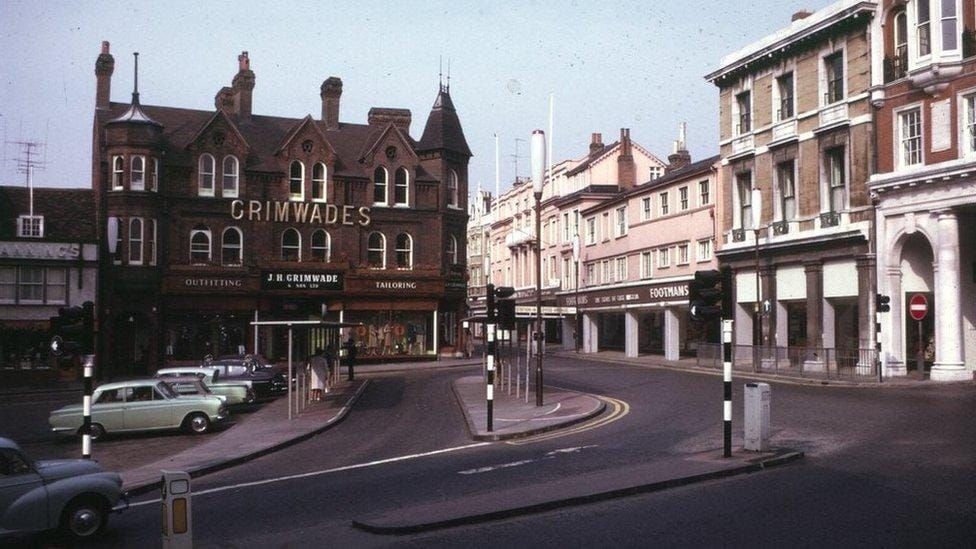
Behind the magnificent red-brick frontage on the Cornhill, generations of shoppers bought their school uniforms, ordered suits, browsed the departments and climbed upstairs to a much-loved restaurant. Its story is one of Victorian ambition, a remarkable Ipswich family, changing shopping habits and a building that has somehow managed to survive almost everything thrown at it.
The shop that everybody knew
There was a time when going shopping in Ipswich meant rather more than arriving at a retail park, negotiating an enormous car park and discovering that the thing you wanted was only available online.
Shopping was an outing. Sometimes a family expedition. Occasionally, if money was particularly tight, an exercise in looking at things you had absolutely no intention of buying.
And in the middle of it all stood Grimwades.
Its great red-brick building occupied one of the most prominent corners in Ipswich, where Westgate Street meets the Cornhill. It was the sort of shop that people used as a landmark. You might arrange to meet somebody outside Grimwades, pop in for a particular item, or find yourself spending rather longer inside than intended.
There were clothes, tailoring, school uniforms, gifts and an assortment of other departments. There was even a restaurant on the top floor, fondly remembered long after the business itself had disappeared.
The building was impressive without being particularly intimidating. It had the architectural confidence of a prosperous Victorian merchant announcing to the world that he intended to be around for some time.
And for well over a century, he was.
Today, the shop has vanished, but its building survives. And behind those decorated windows lies a story that begins not with a grand department store, but with a Suffolk draper called Richard Grimwade.
A family business that began in 1844
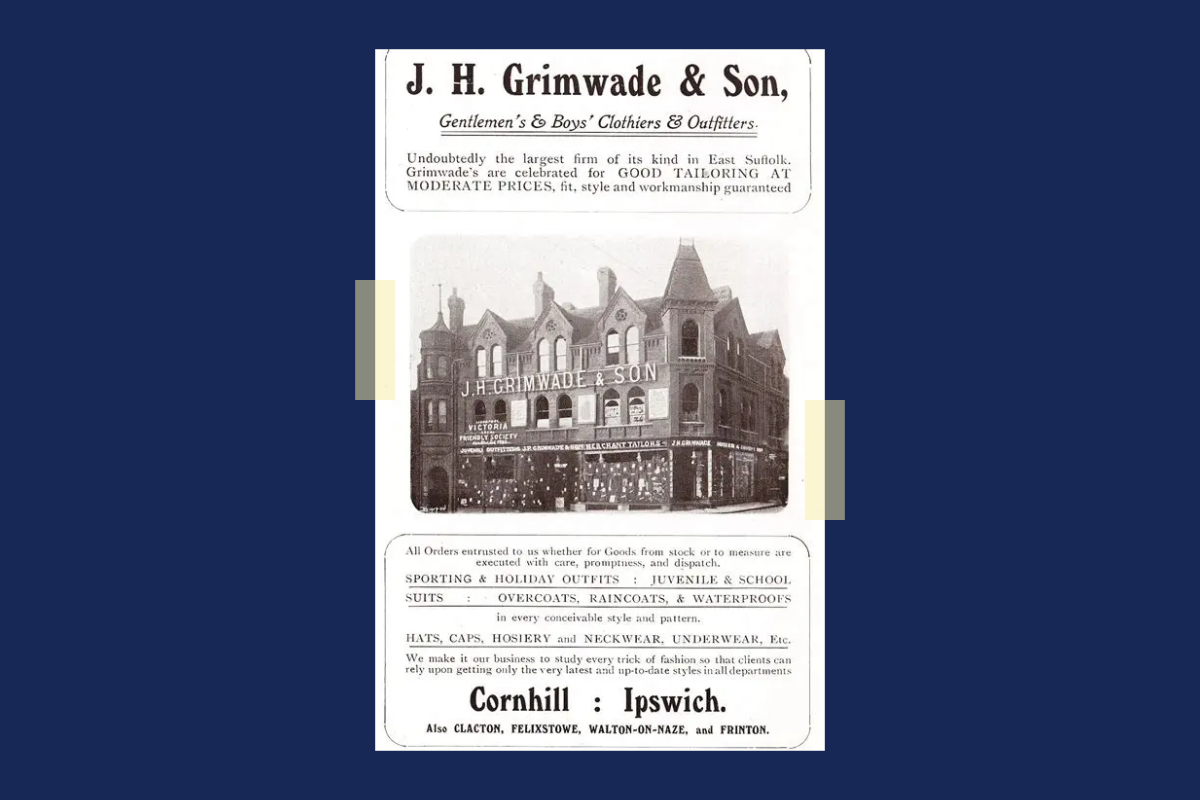
The Grimwade story begins in 1844, when Richard Grimwade established himself in the clothing trade in Ipswich.
Richard was a woollen draper and hatter, operating initially in Providence Street before moving to Westgate Street. In the middle of the 19th century, this was a business with considerable possibilities.
Clothing was changing. Industrialisation was transforming the production of fabrics, ready-made garments were becoming increasingly accessible, and the growing prosperity of provincial towns created opportunities for ambitious retailers.
Ipswich was well placed to benefit. It was a busy port, a commercial centre and an expanding railway town, drawing customers from a substantial rural hinterland.
Richard's business began modestly, but his son, John Henry Grimwade, would take it in an altogether more ambitious direction.
Born in Ipswich in 1848, John Henry grew up surrounded by the business. The 1851 census places the family in Providence Street, with his father recorded as a woollen draper and hatter.
By 1861, they had moved to Westgate Street.
Ten years later, at just 22, John Henry was recorded as a tailor and head of the household at 39 Westgate Street.
He was hardly a man who needed an introduction to the clothing trade. By the time he reached adulthood, it had been the family occupation for virtually his entire life.
In the decades that followed, John Henry transformed the enterprise from a relatively conventional tailoring and drapery establishment into one of Ipswich's best-known shopping institutions.
And the Grimwade name became increasingly prominent far beyond the shop itself.
A businessman who became Mayor of Ipswich
John Henry Grimwade was not content simply to sell clothes.
He entered local politics, was elected to Ipswich Borough Council in 1887, representing Westgate Ward, and became Mayor of Ipswich for 1904-05.
He was a Liberal and a committed Nonconformist, at a time when religion, commerce and civic life were often closely entwined.
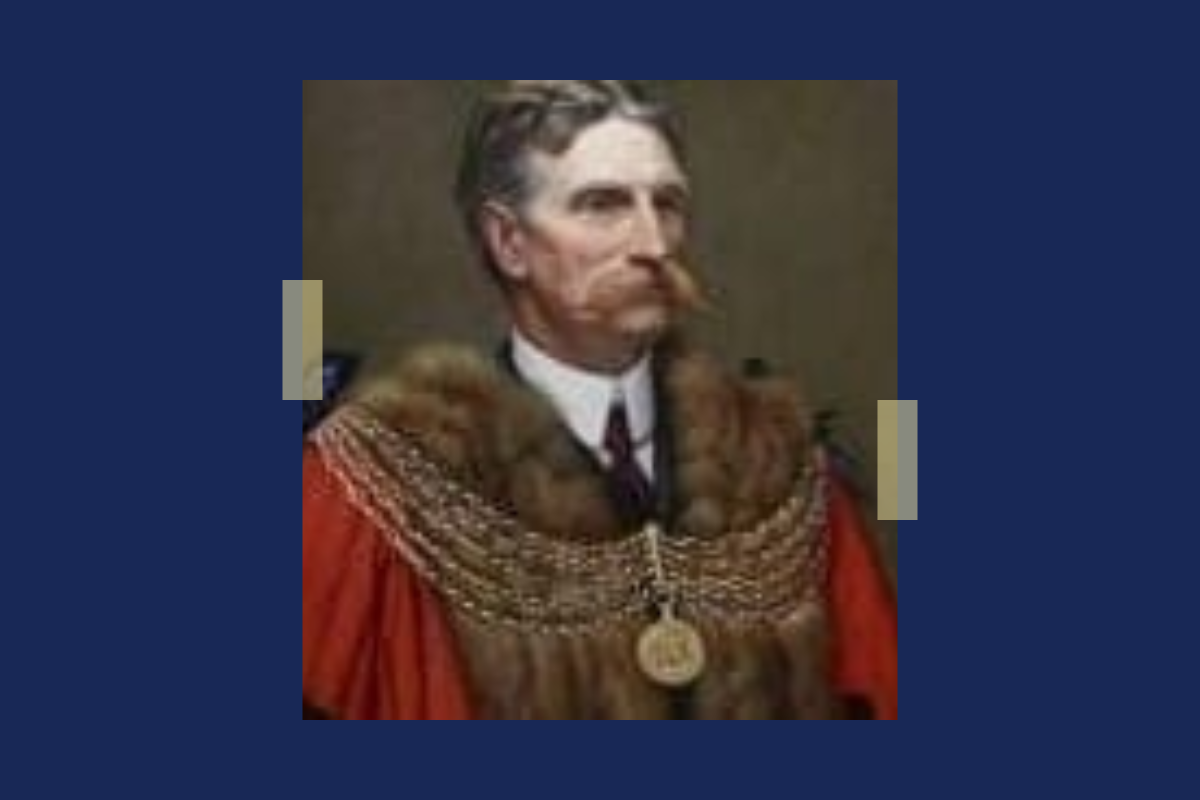
Successful Victorian businessmen frequently regarded public service as both a duty and an expression of their standing in the community. They built businesses, supported churches, contributed to charitable organisations and occasionally found themselves occupying the mayoral chair.
John Henry fitted that tradition rather well.
His family lived first at Richmond House in Handford Road before moving to Bacton House in Fonnereau Road, a substantial home befitting a prosperous local merchant.
He married Mary Bayley in 1874, and the couple had eight children.
Religion was central to his life. He was closely associated with the Congregationalist movement in Ipswich and devoted decades to Sunday school work.
The memorial to him at St Clement's Congregational Church records a man whose interests went well beyond trade, particularly his commitment to young people.
It is easy to think of Victorian shopkeepers purely as businessmen, calculating prices and inspecting stock. John Henry's surviving story suggests a rather broader character: an employer, councillor, churchman and influential figure in the development of Ipswich.
When he died in September 1929, aged 80, he left behind not merely a flourishing business but a family name embedded in the history of the town.
A red-brick palace on the Cornhill
The building itself is one of Ipswich's most striking Victorian commercial landmarks.
Dating principally from 1884, it is a splendid example of the period's enthusiasm for decorative architecture.
Stand on the Cornhill and look upwards, away from the shopfronts, and it becomes much easier to appreciate what the Victorians were trying to achieve.
There are pointed gables, arched windows, elaborate brickwork, projecting bays, decorative details and steeply pitched rooflines.
Two distinctive corner features rise above the building, giving it something of the appearance of a small Gothic castle that has somehow found itself selling trousers.
The facade belongs to an architectural age that believed a successful shop should make an impression.
This was long before the standardised retail units of modern shopping centres. Commercial buildings were expressions of their owners' confidence, taste and prosperity.
A good shopfront was advertising in bricks and mortar.
Grimwades was particularly fortunate in its position. Facing the Cornhill, alongside Manning's, and looking across towards the imposing Town Hall and other major commercial buildings, it occupied some of the most valuable visual territory in Ipswich.
There is an especially interesting architectural clue on the building itself.
Above the doorway beside Manning's, incorporated into decorative detailing beneath a projecting upper-storey window, is the date 1904.
That was also the year John Henry Grimwade became Mayor of Ipswich.
Whether the date specifically commemorated his mayoralty or simply marked alterations to the building has not been conclusively established. But it is a remarkable coincidence, and a reminder that buildings sometimes preserve details overlooked by generations of people walking beneath them.
The building we see today was not necessarily one single shop from the beginning. Ipswich Borough Council's architectural records indicate that it originally consisted of two premises, believed to have been joined during the 1960s or 1970s.
That helps explain some of its character. Like many old department stores, Grimwades was not a perfectly uniform retail box. It evolved with the business, absorbing and adapting space as commercial requirements changed.
And, unusually for such a prominent Victorian building, it is not statutorily listed.
Inside Grimwades: a different kind of shopping
The most interesting thing about Grimwades was not necessarily what it looked like from the street, but what happened behind the windows.
This was a department store in the older sense: a collection of specialist retail activities brought together under a single, trusted name.
There was tailoring and outfitting, the foundations on which the business had been built.
Men could purchase clothing and arrange for garments to be fitted. Families could buy school uniforms. Women's garments, gift items and other merchandise occupied departments elsewhere in the building.
The basement and upper floors were all used as part of the shop.
It is worth remembering how different the experience of buying clothes once was.
Today, most clothing shops expect customers to examine the stock, find the appropriate size and make their own decisions. Assistance is available, but frequently only when requested.
Traditional outfitters operated differently.
The assistant was expected to know the merchandise, understand fitting and help customers navigate an often bewildering assortment of sizes, fabrics and styles.
For an important purchase, particularly a suit or formal outfit, the transaction might be a fairly lengthy affair.
Measurements mattered. So did the fit of a jacket, the hang of a pair of trousers and the suitability of a particular fabric.
The relationship between customer and retailer was often personal.
A family might return to the same shop year after year, particularly when children needed new school clothing or a special occasion demanded something more substantial than everyday wear.
At Grimwades, the family name provided continuity. It represented an established Ipswich business rather than an anonymous national chain.
We should be careful not to imagine that every part of the store remained unchanged throughout its history. Interiors were altered, departments moved, and the business adapted to changing fashions.
But the essential character of the place survived for generations: a traditional outfitter that became a broader department store while retaining its strong association with clothing.
And, of course, there was the great annual ritual of the school uniform.
The annual pilgrimage for school uniforms
For generations of Ipswich families, Grimwades was closely associated with buying school clothes.
It was an important part of the shop's later identity, and a business in which reliability mattered.
School uniforms are a peculiar form of clothing retail. They are not generally bought because the customer likes the colour, admires the cut or wants to make a fashion statement.
They are bought because a school has decided that everybody must look approximately the same.
For parents, there were practical questions: would the blazer last? Was the jumper the correct shade? Would the trousers survive a year of playground activity? And, most importantly, would the child grow out of everything by Christmas?
It is easy to imagine the negotiations that took place in shops like Grimwades.
Parents wanted value and durability. Children wanted to be somewhere else.
And somewhere in between stood the shop assistant, attempting to establish whether a garment was too large, too small or merely being rejected on principle.
The school uniform trade was not particularly glamorous, but it was dependable, seasonal and deeply connected to local communities.
It gave businesses such as Grimwades an important advantage over retailers without the same relationships or knowledge.
For many older Ipswich residents, it is likely to be the first department that comes to mind when the name is mentioned.
Yet there was another attraction, rather less associated with scratchy new jumpers and sensible shoes, which seems to have inspired even more affection.
The restaurant.
Upstairs for lunch: the café everybody remembers
Perhaps the most evocative part of Grimwades was its top-floor café and restaurant.
Ask people about the old store and the restaurant is one of the features that repeatedly finds its way into local histories.
It was not simply an incidental refreshment counter somewhere beside the tills. It was a recognised part of the building's identity, remembered affectionately long after the clothing departments had gone.
And it belonged to an important tradition in British department-store history.
From the late Victorian period onwards, larger shops increasingly realised that customers might welcome something to eat or drink without having to leave the premises.
Tea rooms and restaurants encouraged shoppers to stay longer, offered a pleasant break during a day in town and helped transform shopping into a social occasion.
For women in particular, department-store refreshment rooms historically provided respectable and convenient places to meet friends outside the home.
By the 20th century, a shopping expedition could be organised around a meal just as easily as a particular purchase.
Grimwades fitted into this tradition.
The restaurant was upstairs, away from the busy streets and shopfronts below. Getting there meant leaving the immediate bustle of shopping behind.
There was something appealing about that separation.
Downstairs, one could concern oneself with school uniforms, shirts, presents and practical necessities.
Upstairs, there was the prospect of sitting down.
The surviving published histories do not provide a reliable contemporary description of the restaurant's furnishings, layout or daily menu. Nor have we uncovered a surviving menu card.
That is rather frustrating, because it is precisely the sort of detail that can bring an old shop to life.
Were there white tablecloths? Did customers order at a counter or receive table service? What were the favourite lunches? Were there cakes displayed beneath glass covers, and was afternoon tea a particular attraction?
Somebody in Ipswich almost certainly knows.
What is established is that the restaurant was sufficiently important to remain part of the building's remembered identity decades after closure.
That alone tells us something.
People rarely remember the details of a perfectly ordinary lunch. They remember places in which something happened: an outing with a grandparent, a meeting with an old friend, a treat after shopping, or a little escape from the routine of everyday life.
The Grimwades restaurant seems to have been one of those places.
And in a town whose shopping streets have changed beyond recognition, memories of the upstairs restaurant may provide some of the most revealing glimpses into how Ipswich once spent its afternoons.
The curious business in the attic
There is another delightful, and rather unexpected, detail about the building.
High above the retail floors, the attic rooms were once used as offices by the National Protestant League.
This was an organisation associated with the religious controversies of its time, and its presence is a reminder of the Grimwade family's strong Nonconformist connections.
A sign advertising the organisation reportedly faced onto the Cornhill.
Imagine that for a moment.
On the lower floors, the practical business of selling clothes. Higher up, people having tea and lunch. And above them, in the attic rooms, a religious organisation pursuing its affairs.
It is an extraordinary mixture of activities, although perhaps a perfectly natural one to a Victorian businessman whose commercial and religious worlds overlapped so closely.
It also shows how large town-centre buildings once accommodated a remarkable variety of uses.
They were not always exclusively shops or offices. Commercial, social and civic functions could all exist under the same roof.
Grimwades was a particularly interesting example.
The family that left its name across Ipswich
The influence of the Grimwade family stretched well beyond the Cornhill.
Grimwade Street remains an obvious reminder, but the family's connections with Ipswich's religious and charitable history are equally significant.
The Grimwade Memorial Hall in the Fore Hamlet area was associated with the Congregationalist tradition, while the name also appears in the history of Hope House.
The family's public standing was substantial, with several members serving as Mayor of Ipswich over the years.
John Henry himself remained involved in religious and civic activity throughout much of his life.
He was associated with the establishment and work of St Clement's Congregational Church, where a memorial records his long service.
That wider history matters because Grimwades was not simply another business that happened to occupy a shopfront.
It emerged from a period when successful local merchants could exert enormous influence over the physical and social development of a town.
Their businesses employed people, their families became involved in local government, their philanthropy supported institutions, and their names became part of the local landscape.
Of course, there was a paternalistic side to Victorian commerce. Employers enjoyed a degree of authority that would seem unfamiliar today, and civic influence was not distributed equally.
But the contribution of families such as the Grimwades to Ipswich's development is difficult to overlook.
When Ipswich was a town of department stores
Grimwades existed in a remarkable retail environment.
For much of the 20th century, Ipswich supported a collection of substantial department stores, specialist shops and independent traders.
Footman Pretty, later absorbed into the Debenhams business, occupied a commanding position nearby.
Corders, Frederick Fish and other established names contributed to the town's reputation as a regional shopping centre.
The Cornhill and the adjoining streets provided a concentrated shopping district in which customers could spend an entire day without travelling very far.
It was a world of window displays, specialist departments, personal service and familiar business names.
And there was genuine competition.
Grimwades stood almost opposite one of its most significant rivals, Footman Pretty.
For the customer, this was rather convenient. If one establishment lacked the required item, another might have it.
For the owners, the competition must have been rather less relaxing.
As the 20th century progressed, however, the character of British retailing began to change.
National chains grew more powerful. Department stores became consolidated into larger groups. Shopping centres altered the geography of town centres, while the growth of out-of-town retailing placed additional pressure on traditional businesses.
Ipswich was no exception.
Footman Pretty's integration into Debenhams changed the competitive environment. Grimwades continued trading, but the independent department-store model was increasingly difficult to sustain.
There were still customers who valued its traditions, but familiarity and affection were not always enough to overcome the commercial realities.
The shop finally closed in the mid-1990s.
A business that had begun in 1844, and had helped shape shopping in Ipswich for roughly a century and a half, was gone.
Goodbye to Grimwades
It is remarkable how quickly a once-familiar name can disappear from a town centre.
The buildings remain, often acquiring new signs and new occupants, but the original business gradually fades from everyday conversation.
After Grimwades closed, parts of the premises were occupied by other retailers, including Clinton Cards.
Eventually, the building became empty.
By 2012, it had ceased to have an active commercial use, and the years that followed were not particularly kind to it.
The prominent corner site became a conspicuous reminder of the difficulties facing Ipswich town centre.
A building originally designed to announce commercial prosperity now stood largely unused.
There were proposals to bring it back into operation. In 2018, for example, the Ipswich Society reported plans for a Pret A Manger restaurant, with substantial seating on both the ground and first floors.
It would have been a curious return to the building's catering history, although the proposal did not result in the envisaged opening.
As the years passed, the empty shopfronts attracted increasing attention.
The condition of the structure deteriorated, and the council eventually considered using compulsory purchase powers.
In 2023, Ipswich Borough Council reported that negotiations with the owner had failed, raising concerns about the property remaining vacant.
It was an unhappy position for one of the Cornhill's most distinctive buildings.
A new chapter for an old survivor
In April 2025, Ipswich Borough Council acquired the former Grimwades building, bringing a long period of uncertainty to an end.
Repairs and refurbishment followed, with the aim of returning the premises to productive use.
Then, in July 2025, something rather pleasing happened.
A café opened.
Jamaica Blue began trading on the ground floor, bringing customers back into a building that had stood empty for more than a decade.
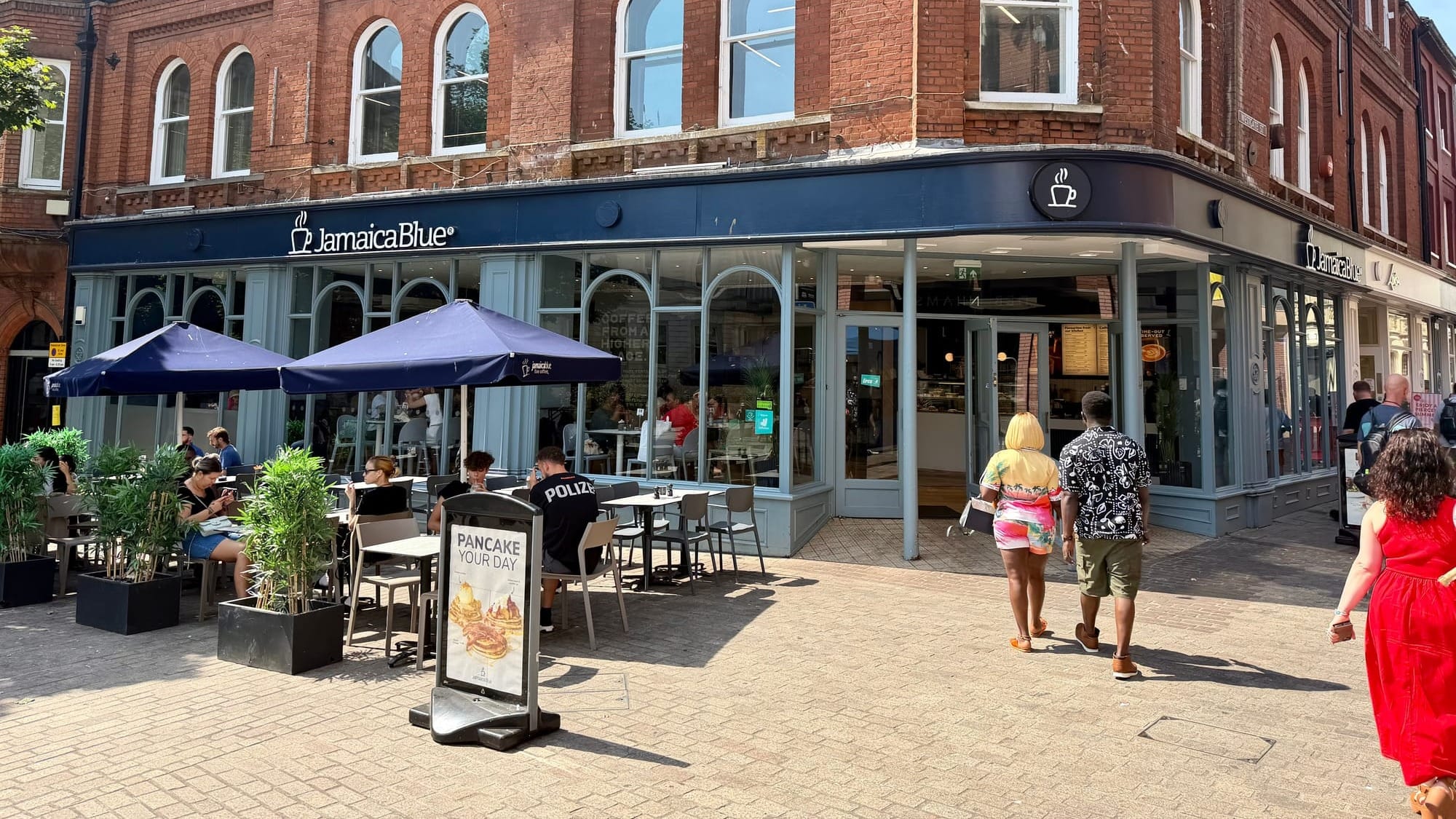
There is a certain symmetry in that.
A building remembered partly for its upstairs restaurant was beginning a new chapter with another place to eat and drink.
The new café is, of course, a very different establishment from the old Grimwades restaurant, but the fundamental idea is much the same: somewhere in the heart of Ipswich for people to meet, sit down and spend a little time.
The jewellery retailer Lovisa subsequently opened in another ground-floor unit, while plans were brought forward to convert the first floor into an adult education facility in partnership with Suffolk New College.
A building that once combined clothing sales, dining and offices is once again being adapted for a mixture of uses.
And the architecture, thankfully, remains.
The pointed gables still rise above the Cornhill. The decorative brickwork can still be admired. The unusual corner towers continue to punctuate the Ipswich skyline.
The building has outlived its founder, his descendants, generations of employees and an astonishing assortment of changing retail fashions.
Not bad for an old shop.
More than a shop, and more than a memory
There is something particularly satisfying about the survival of Grimwades.
It would be easy to regard it merely as another attractive Victorian building, a pleasant architectural backdrop to the Cornhill.
But buildings like this are more than their bricks and windows.
They are repositories of ordinary life.
Somewhere behind those walls, generations of Ipswich children were fitted for school uniforms. Customers collected new suits. Shop assistants served familiar faces. Families searched for presents, and people climbed upstairs for lunch.
There were important occasions and completely unremarkable ones, all of them contributing to the history of a town.
The most famous buildings tend to be associated with kings, politicians, architects and great public events.
Department stores have a rather different history.
Their stories are made by ordinary people doing ordinary things.
That is why the missing details of the Grimwades restaurant are so tantalising. A surviving menu, a photograph of the dining room, or the recollections of somebody who worked there could tell us more about everyday Ipswich than another grand civic portrait ever could.
Perhaps someone still has a receipt tucked inside a drawer. Perhaps there is a family photograph taken during an outing. Perhaps an old employee can remember the arrangement of the departments, the bustle of Saturday mornings or the busiest time of day in the restaurant.
Those are the fragments from which the most interesting local histories are made.
And if you happen to pass through the Cornhill, there is one small thing worth doing.
Look up.
Ignore the shopfronts for a moment and examine the building above them. Find the pointed gables, the decorative brickwork and the little date of 1904.
Then imagine the Grimwades name stretching across the facade, the windows filled with merchandise and the upper floors busy with shoppers.
Somewhere up there, perhaps, a family is sitting down for lunch after the annual ordeal of buying school uniforms.
A little girl is insisting that the new shoes are uncomfortable. Her father has retreated behind a newspaper. Her mother is wondering whether the jumper will last until Easter.
And the waitress is on her way.
Grimwades may have closed thirty years ago, but it is still very much part of Ipswich.
Don't forget: If you enjoy our content, please add Ipswich.co.uk as a "preferred source" on Google so you can easily find more of the content you value.
This article cost us ~£176 to produce
It's free for you to read thanks to the generous support of our partners. Please support us by supporting them.
Below the line