
The glove-maker's son from Ipswich who conquered America and revolutionised journalism
In this weeks 'they came from Ipswich', we feature the story of a artist that emigrated, and reported on some of the biggest events in history. We run these columns every week. Please subscribe to our newsletter - its free of spam and free of cost, you'll be notified of stories that interest you.

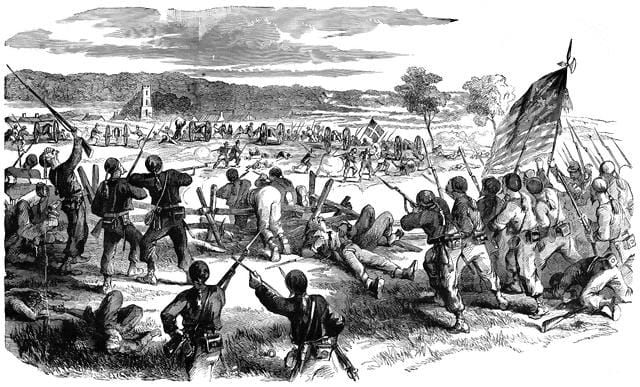
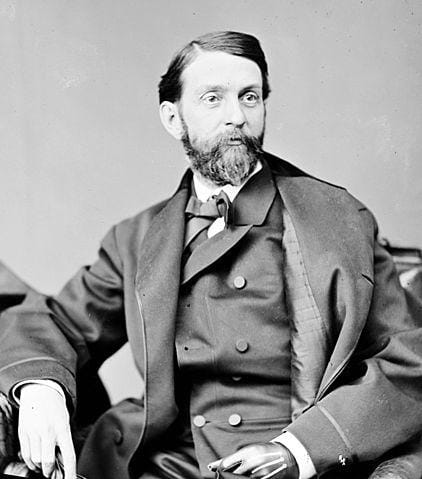
Born Henry Carter in Ipswich in 1821, he was expected to follow his father into the family glove business. Instead, he secretly taught himself to engrave, invented a new way of producing illustrated newspapers and sailed to America, where he built a publishing empire. He exposed corruption, brought the American Civil War into people's homes and became fabulously wealthy. Then he very nearly lost everything. This is the extraordinary story of Frank Leslie, the Ipswich boy who helped change the news forever.
The boy who wasn't supposed to draw
Somewhere in early 19th-century Ipswich, a young boy was doing something his father thoroughly disapproved of.
He was drawing.
His name was Henry Carter, and there was a perfectly respectable future waiting for him in the family glove-making business. His father, Joseph, was a prosperous manufacturer, and there seemed little reason why his son should not eventually follow him into the trade.
Henry, unfortunately, had other ideas.
He loved pictures. More particularly, he loved making them, and he had developed an interest in the intricate business of engraving images onto wooden blocks so they could be reproduced by a printing press.
It was clever, painstaking work, requiring remarkable patience and a steady hand. It was also, in his father's opinion, a thoroughly unsuitable occupation for a young man with a family business to inherit.
So Henry developed a solution.
He invented somebody else.
The name he chose was Frank Leslie, a disguise under which he could pursue his artistic ambitions without attracting the disapproval of his father and uncle.
It was a sensible enough arrangement, although one suspects it must have made things rather complicated whenever anybody asked to see his work.
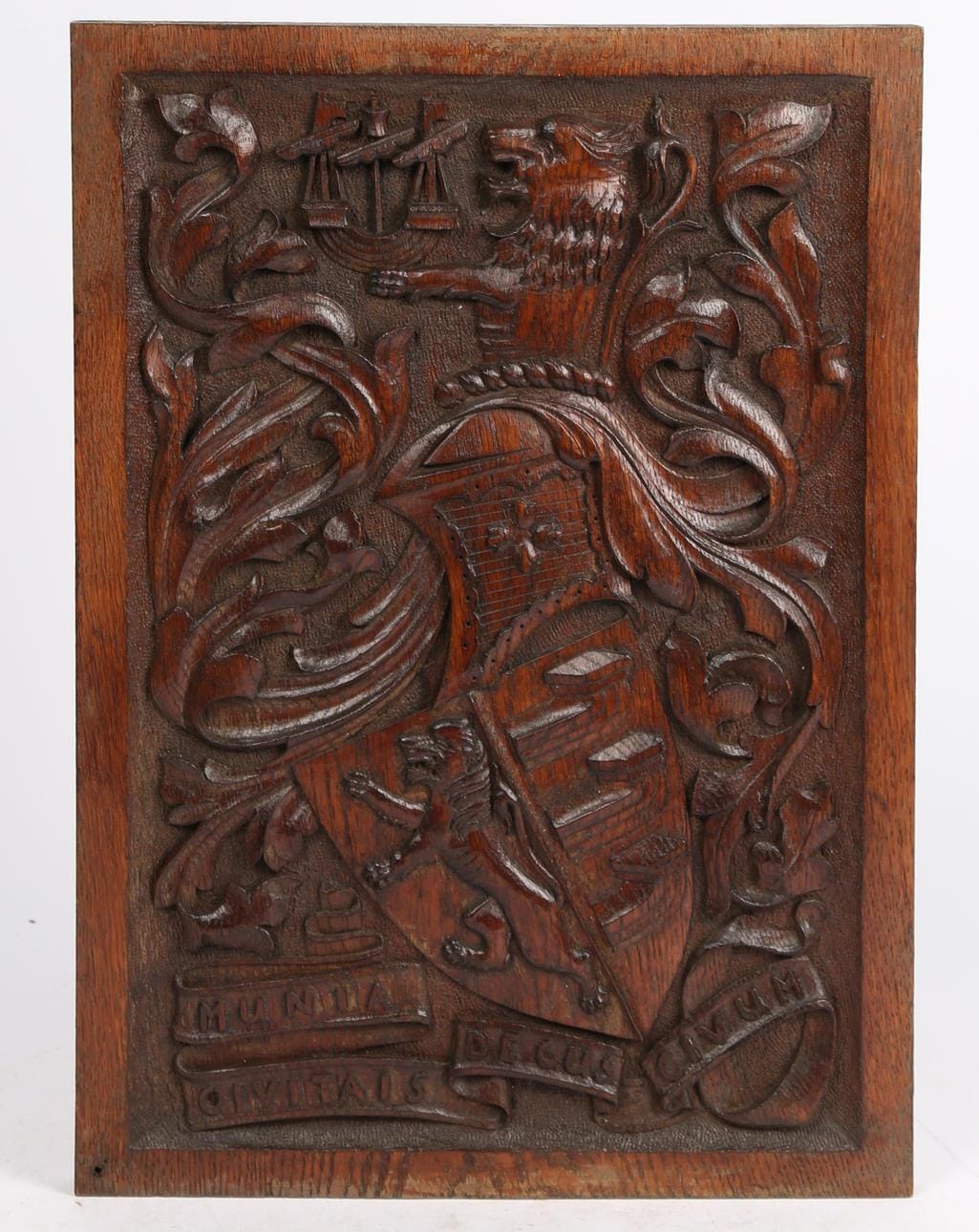
There is something wonderfully appropriate about the subject of one of his earliest surviving engravings.
It was the coat of arms of Ipswich.
The young man who would eventually fill American newspapers with images of presidents, battles, murderers and disasters began by making a picture of his hometown.
And he was very good at it.
A perfectly good career going to waste
Henry was born on 29 March 1821, into an Ipswich that was growing commercially but still recognisably a provincial market town.
The waterfront was busy, industry was developing and the town's merchants were making respectable livings from the manufacture and movement of goods.
For the Carter family, those goods were gloves.
At seventeen, Henry was sent to London to work with an uncle who ran a substantial drapery establishment. The intention was that he should learn more about commerce, acquire useful experience and eventually become a dependable businessman.
Instead, he spent as much time as he could drawing.
By his early twenties he had abandoned the career chosen for him and joined the Illustrated London News, which had been founded in 1842 and was pioneering a new kind of newspaper.
Its great innovation was to show readers what was happening.
This sounds fairly unremarkable today. We can watch a revolution unfold on a telephone while waiting for a bus.
In the 1840s, however, newspapers were overwhelmingly printed words. Photographs could be taken, but there was no practical way to reproduce them directly on an ordinary newspaper press.
If you wanted to show your readers a great fire, a royal procession or a battlefield, somebody had to draw it, and then an engraver had to painstakingly reproduce the drawing on a printing block.
It took time.
And Henry Carter, now increasingly known as Frank Leslie, was about to discover how to make it take rather less.
The invention that changed everything
His great breakthrough was gloriously simple.
A large illustration might take an engraver a fortnight to prepare. That was inconvenient if the subject was something that had happened yesterday.
Leslie's solution was to divide the wooden printing block into smaller sections and give each piece to a different engraver.
Instead of one person spending two weeks carving a picture, a whole team could work on separate pieces simultaneously.
When they had finished, the blocks were assembled into a single image.
A drawing that might previously have taken a fortnight could now be prepared in about a day.
It was, in effect, the Victorian equivalent of discovering that you could run several computers on the same job.
The idea was so effective that other publishers adopted it.
Leslie had made pictures commercially practical for news reporting on a scale that had previously been difficult to achieve.
And, having mastered the process in London, he decided that Britain was no longer quite large enough for his ambitions.
In 1848, aged 27, he crossed the Atlantic.
Henry Carter of Ipswich was about to become Frank Leslie of New York.
New York, New York
America was an interesting place to arrive in 1848.
Its cities were expanding, its population was growing and its newspapers were engaged in increasingly ferocious competition.
New York was noisy, ambitious, crowded and commercially ruthless.
One suspects Frank Leslie felt entirely at home.
He worked initially for other publishers, including Gleason's Pictorial, and developed valuable contacts.
Among them was the celebrated American showman P. T. Barnum, whose extraordinary talent for publicity would later make his name synonymous with entertainment on a spectacular scale.
When the Swedish singer Jenny Lind toured America in 1850, Leslie produced engravings for the programmes. Barnum was promoting the tour, and the two men developed a professional relationship.
It was an excellent introduction to the American public's appetite for celebrity.
People wanted to see famous faces, spectacular events, murders, scandals and everything else that made their ordinary lives seem comparatively peaceful.
Leslie understood that appetite.
In 1854, he began publishing on his own account, starting with a fashion publication.
Then, on 14 December 1855, the first issue of Frank Leslie's Illustrated Newspaper appeared.
The title lacked subtlety, but it had one considerable advantage.
Nobody could mistake whose newspaper it was.
It was the beginning of something enormous.
When America discovered the picture newspaper
Leslie's paper was designed for people who wanted to see the news as well as read it.
Its pages were filled with elaborate engravings of current events, politicians, public figures, buildings and disasters.
There were stories about theatre, literature, sport and society. There were sensational crimes, political scandals and the occasional subject selected principally because it would make an excellent picture.
Leslie was not inventing illustrated journalism from nothing. He had learned the trade at one of Britain's pioneering illustrated newspapers, and he faced American competitors.
But he understood how to make the process faster, commercially attractive and accessible to a mass readership.
The results were impressive.
By the end of 1858, his newspaper's circulation was estimated at around 140,000.
For the period, that was a considerable audience.
And then came a story that demonstrated precisely what his sort of journalism could achieve.
It concerned milk.
Very unpleasant milk.
The milk scandal that shook New York
In 1858, Leslie's newspaper launched an investigation into the milk being sold to families in New York and Brooklyn.
What his artists and reporters uncovered was horrifying.
Some dairy operators were keeping cows in filthy urban buildings, feeding them waste mash from whisky distilleries.
The animals were often sick, overcrowded and inadequately cared for. The milk they produced could be poor quality and was sometimes adulterated before reaching customers.
Much of it was being sold to families with young children.
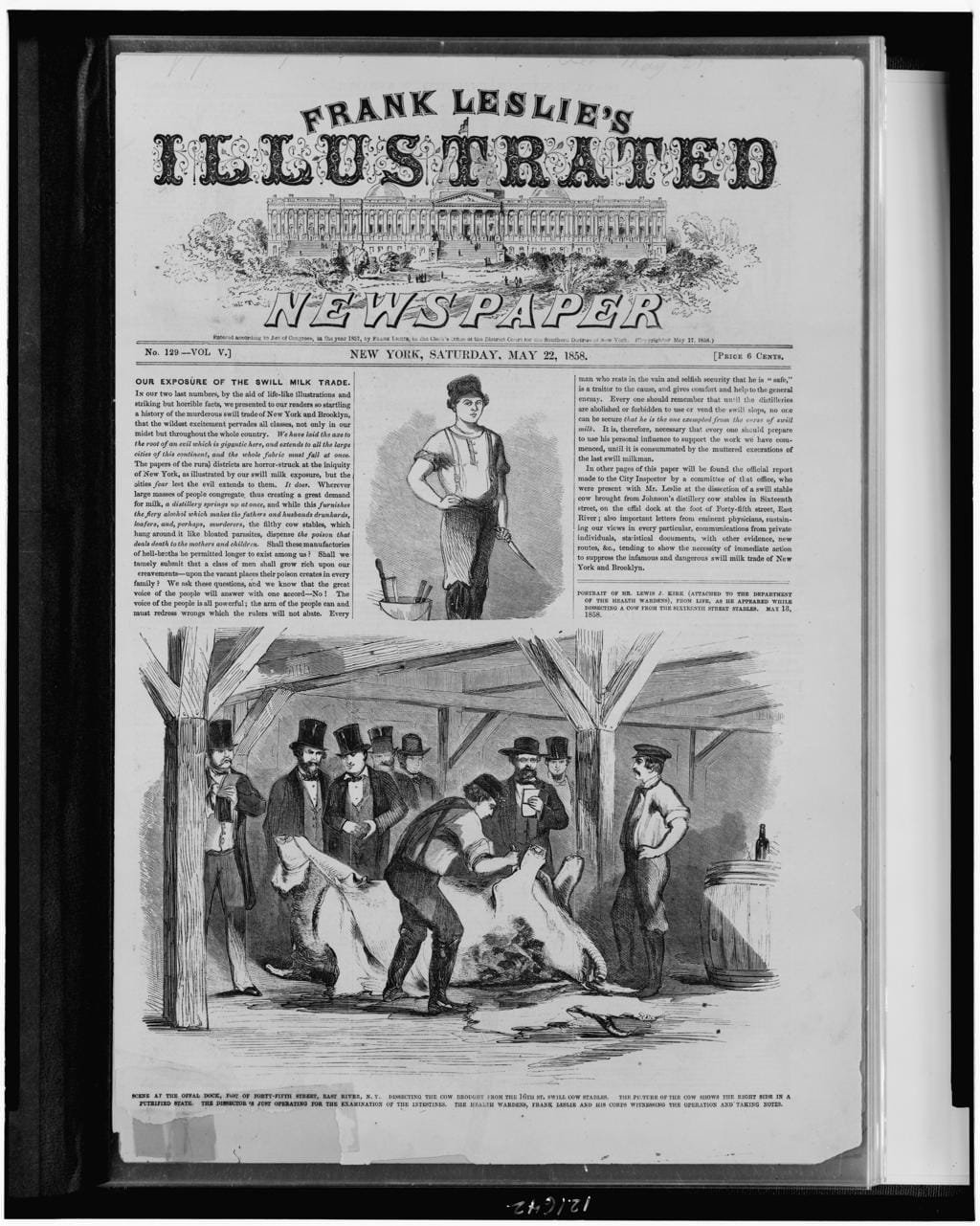
Leslie's newspaper sent artists into the establishments to record what was happening.
The resulting illustrations were extraordinary.
There were cows crowded together in foul conditions, pictures of diseased animals, and diagrams revealing the grim reality behind an apparently innocent household product.
The investigation did something that text alone might have struggled to achieve.
It allowed readers to see the conditions in which their children's milk was being produced.
The paper continued its campaign over successive editions, naming establishments, questioning official supervision and challenging those profiting from the trade.
The response was furious.
Those implicated disputed the reporting, and some of the artists involved faced threats and intimidation.
But the investigation became a celebrated early example of illustrated investigative journalism.
It also helped build public pressure for tighter regulation of the milk trade.
Here was a newspaper doing something rather more important than merely entertaining its customers.
It was exposing a public-health scandal and demanding answers from people who would rather not provide them.
For a boy who had grown up in a Suffolk manufacturing family, it was quite an achievement.
America goes to war
Three years later, in April 1861, Confederate forces fired on Fort Sumter in South Carolina.
The American Civil War had begun.
For the next four years, the United States would be torn apart by a conflict over slavery, secession and the future of the Union.
It was an appalling war, killing hundreds of thousands of people and transforming the country forever.
It also presented illustrated newspapers with an unprecedented challenge.
Americans wanted to know what was happening on the battlefields.
More than that, they wanted to see it.
Leslie assembled a substantial network of artists and correspondents, sending them with armies, to military encampments and into the aftermath of battles.
Among the artists associated with his wartime coverage were William Waud, Henri Lovie, Arthur Lumley and Edwin Forbes.
They sketched soldiers, ships, artillery, towns and the terrible consequences of fighting.
Their pictures were rushed back to the publishers, transformed into engravings and printed for readers across the country.
The resulting illustrations have become an important historical record of the conflict.
There were limitations, of course. Artists could not always witness the events they depicted, and the competitive pressure to produce dramatic pictures sometimes encouraged theatrical interpretation.
These were illustrations, not instantaneous photographs.
Nevertheless, readers could study the battlefields, the troops and the machinery of war in extraordinary detail.
Leslie's great competitor was Harper's Weekly, which became the more successful of the two illustrated weeklies by the war's end.
But Leslie's publications were central to this new visual reporting.
The boy from Ipswich had helped build a system through which ordinary Americans could follow the most consequential events in their country's history.
A millionaire with a taste for spending
By the 1860s, Leslie had become a publishing magnate.
His company produced magazines for women, children and general readers, alongside newspapers, books and illustrated histories.
There were publications devoted to fashion, family entertainment, humour and literature.
Some were extremely profitable.
Others were less successful, but Leslie seemed constitutionally incapable of leaving a potential publishing opportunity unexplored.
His business eventually employed hundreds of people, including artists, engravers, printers, editors and office staff.
And he made a remarkable amount of money.
Unfortunately, he was also exceptionally good at spending it.
He acquired a magnificent country estate near Saratoga Springs, entertained lavishly and enjoyed the fashionable social life that his success made possible.
His private affairs became almost as complicated as his publishing accounts.
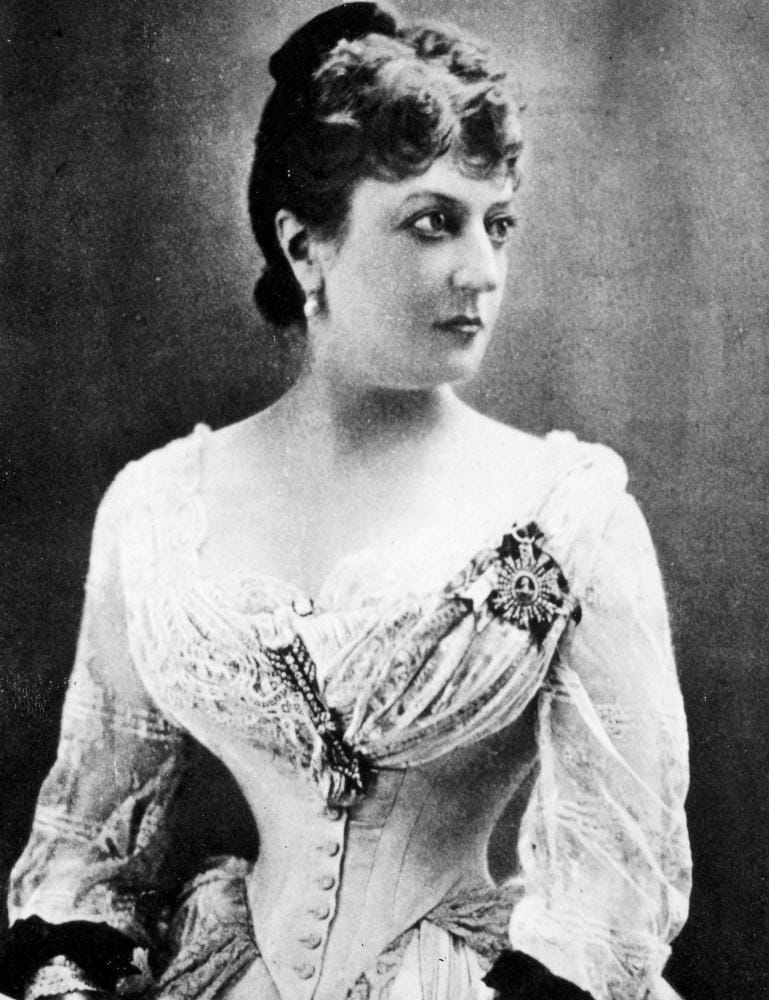
He separated from his first wife, Sarah Ann, with whom he had three sons, and later married Miriam Florence Squier, a talented editor who had been married to one of his business associates.
Their relationship had attracted considerable scandal.
Miriam, however, was no ornamental addition to the publishing household.
She was an intelligent, commercially capable woman who successfully edited several of the company's publications.
Indeed, she would ultimately prove rather better at rescuing the business than her husband had been at protecting it.
Because, for all his ingenuity, Leslie had a serious weakness.
He believed that the next publication, the next venture or the next grand idea might always be worth pursuing.
And eventually the bills caught up with him.
The empire begins to crumble
By the late 1870s, Leslie's publishing business was in serious financial trouble.
His lavish expenditure had contributed to the difficulties, as had the cost of maintaining so many publications.
A substantial loss on an elaborate illustrated history of America's 1876 Centennial Exhibition made matters worse.
In September 1877, the business passed into receivership.
The man who had apparently conquered American publishing now found himself working as general manager of an enterprise whose financial control had passed into other hands.
There was something rather tragic about it.
Leslie had helped revolutionise the way newspapers were produced, built an enormous readership and made himself internationally famous.
Yet he had never quite mastered the comparatively ordinary business of spending less money than he earned.
In 1879, legal proceedings allowed him to regain a substantial part of his publishing interests.
But he was seriously ill.
On 10 January 1880, Frank Leslie died at his home on Fifth Avenue in New York, aged 58.
His once-mighty enterprise was left burdened with debt.
The future looked decidedly uncertain.
And then the remarkable Miriam Leslie took charge.
The second Frank Leslie
The story might have ended there, with a collapsed newspaper empire and a once-famous name fading into history.
Instead, Miriam inherited the business, fought legal challenges and set about restoring its finances.
In an extraordinary manoeuvre, she legally adopted her late husband's name.
She became Frank Leslie.
There is a certain delicious irony in this.
Henry Carter had adopted the name Frank Leslie to escape the expectations of his family.
Decades later, his widow adopted the same name to defend the business he had created.
And she succeeded.
She revived the newspapers, rebuilt their commercial fortunes and remained a formidable figure in American publishing for many years.
The original Illustrated Newspaper, under various versions of its title, survived until 1922.
The name invented by a young Ipswich engraver had become a publishing brand lasting more than four decades beyond his death.
There is one final, rather unexpected chapter.
When Miriam died in 1914, she left a substantial fortune to support the campaign for women's voting rights in America.
After lengthy legal battles, much of the money was used to finance suffrage publicity and organisation.
It helped support the movement that secured the Nineteenth Amendment to the United States Constitution in 1920, extending voting rights to women.
So the money generated by the publishing empire of an Ipswich glove-maker's son eventually helped fund one of the great democratic reforms in American history.
Not a bad outcome for a career that his father had originally considered unsuitable.
The boy who drew Ipswich
Frank Leslie is not a household name in his hometown.
There is no grand statue of him on the Cornhill, and few people walking through Ipswich today would immediately recognise Henry Carter as one of the town's more extraordinary exports.
Yet his story deserves to be remembered.
He was not a flawless hero. His business ventures were sometimes reckless, his private life attracted scandal, and his newspapers could be sensationalist.
But he had imagination, ambition and an unusual ability to recognise what the public wanted before the established industry had worked out how to provide it.
He understood something fundamental about journalism.
People do not simply want to be told that something has happened.
They want to understand it, picture it, see the people involved and appreciate why it matters.
Sometimes that means exposing unpleasant truths. Sometimes it means explaining a war thousands of miles away. And sometimes it simply means finding a better way to tell a story.
It is a principle that remains as relevant to a small independent news publication in Suffolk as it was to a rapidly expanding newspaper empire in Victorian New York.
And perhaps that is the most appealing thing about Frank Leslie.
Before the wealth, the famous friends, the scandals, the country estates and the hundreds of employees, there was a boy in Ipswich who was supposed to be making gloves.
Instead, he made pictures.
The first was of his hometown.
And the rest, quite literally, became history.
Don't forget: If you enjoy our content, please add Ipswich.co.uk as a "preferred source" on Google so you can easily find more of the content you value.
This article cost us ~£142 to produce
It's free for you to read thanks to the generous support of our partners. Please support us by supporting them.
Below the line