
Did you know Ipswich once had a race course?
And it was rather grand, too.

For more than 200 years, the thunder of hooves, the cheers of spectators and the occasional spectacular mishap were part of life in Ipswich. Today, thousands live on the site of the town's forgotten racecourse, many without knowing what once happened beneath their feet.
The sport of kings comes to Suffolk
There's a rather lovely thing about Ipswich. Just when you think you know the place, it produces another little piece of history that makes you wonder why nobody told you about it before.
We know about Portman Road. We know about the docks, the breweries and the old factories. Some will remember speedway and greyhound racing. But horse racing? In Ipswich?
Oh yes. And not just a few gentlemen having an impromptu gallop across a field. Ipswich had a proper racecourse, with a grandstand, prestigious prizes, professional jockeys and crowds eager to see the finest horses of the day.
Our story begins in 1710, when Queen Anne was on the throne and Ipswich was a market town surrounded by open countryside. To the east lay Nacton Heath, a broad stretch of open land where the first recorded Ipswich race meeting was held. A Town Purse worth £40 was contested by what the records charmingly call "high mettled racers".
Forty pounds was a serious prize in those days. The course, on the other hand, was not especially sophisticated. Early races were run over heathland, complete with gorse and rabbit holes. Health and safety, one suspects, had not yet been invented.
Things improved considerably in 1727, when Ipswich was awarded a Royal Plate worth 100 guineas. The ground was prepared, the course properly marked, and the town became a recognised fixture on the racing calendar.
Half a crown for the best seats
And then came the grandstand. The Ipswich Journal advertised a covered stand for the more distinguished spectators, with the rather splendid name "The Gentlemen's Stand". Admission was two shillings and sixpence, and the name was displayed in gold lettering.
Imagine the scene: fine coats, smart hats, horses being paraded, bookmakers calling the odds and the sudden roar as the field charged towards the finish. For a few days each year, Ipswich must have felt like the centre of the sporting world.
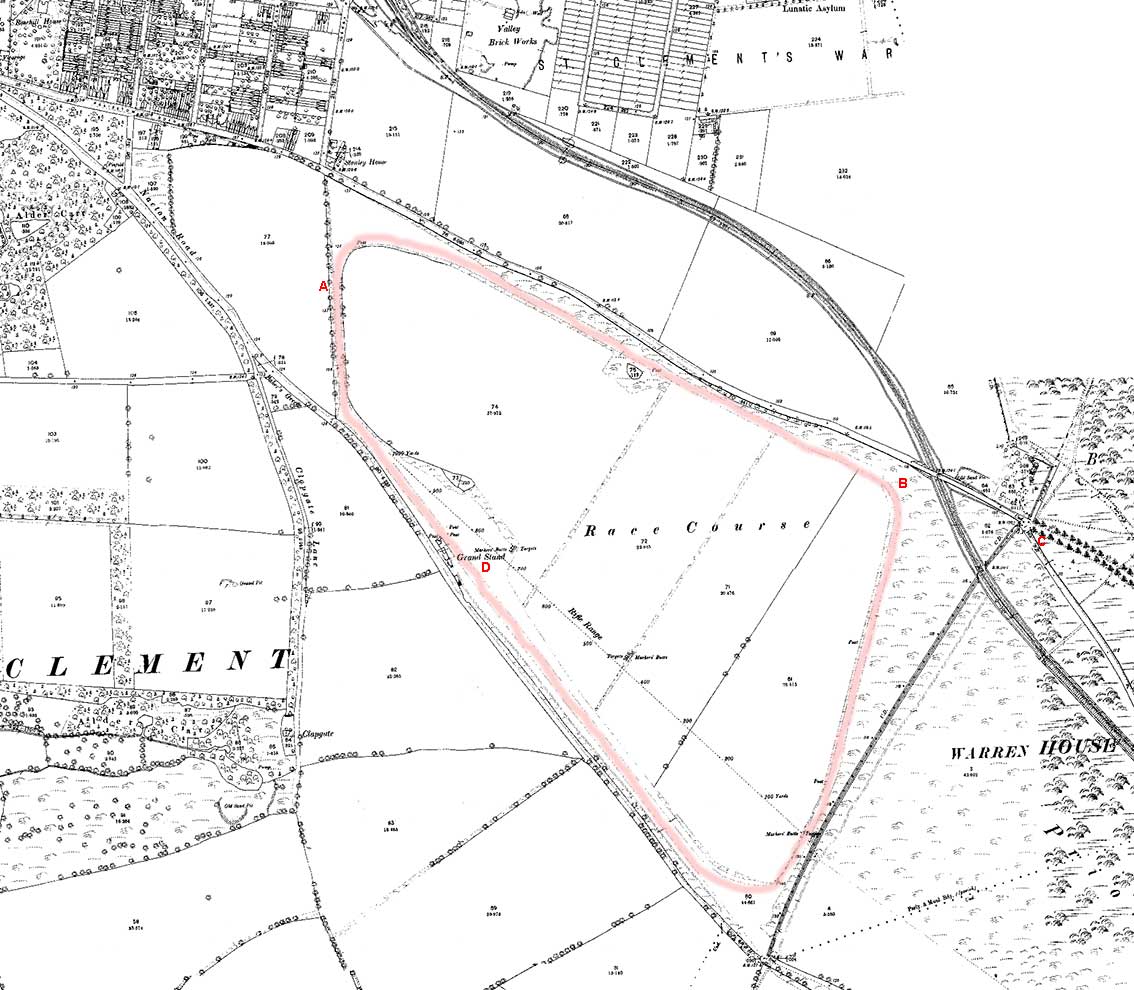
The course was nearly two miles (3.2km) around. Its route followed the general line of today's Lindbergh Road and Cobham Road, swung towards Hatfield Road and ended with a long finishing straight parallel to Nacton Road.
If you know that part of Ipswich, you have probably crossed the old racing ground hundreds of times without realising it. The grandstand stood close to the place later occupied by the Racecourse public house.
Soldiers, steeplechases and an elephant
Like all sporting institutions, the course had its quieter years. Then, in the early nineteenth century, the Army gave it a fresh burst of life.
Ipswich was a garrison town, and cavalry officers were enthusiastic supporters of racing. There are wonderful accounts of officers riding across country towards Nacton church, negotiating hedges and ditches along the way. One local tradition even has them wearing white nightshirts and caps so they could see each other in the dark.
Whether every detail has survived entirely intact is another matter. But the image is irresistible: a troop of officers in nightwear galloping across the Suffolk countryside. Quite what the villagers thought is anybody's guess.
And the racing itself was only part of the entertainment. Race days brought stalls, food, sideshows and all the cheerful bustle of a travelling fair. One historical account records a menagerie at the 1795 meeting, complete with an elephant.
An elephant. In Ipswich. In 1795.
Just when you thought the story could not get any better.
The final furlong
By the late Victorian years, things were changing. Ipswich was growing, the railway age had arrived, and racing faced competition from other attractions. Flat racing ended in the 1880s, leaving the course to stage races over hurdles and fences.
Unfortunately, the hurdles had something of a reputation. Without the guiding wings familiar on modern jumps, a horse could decide that going around was infinitely preferable to going over. The resulting confusion was not always appreciated by the jockeys following behind.
Support declined. On Wednesday, 29 March 1911, the last race meeting took place. After roughly two centuries, Ipswich's racing days were over.
There was no great national farewell. The horses simply stopped coming.
Meanwhile, the town kept growing. Houses spread over the heath, particularly in the twentieth century, and the former course gradually disappeared beneath streets, gardens and rooftops.
Yet a few reminders survived. In 1897, John Dupuis Cobbold presented land for a recreation ground. At the northern entrance to Murray Park, a plaque still records his gift of the Racecourse Recreation Ground to the borough.
For generations, the Racecourse pub on Nacton Road also kept the old name alive. It stood near the former finishing post before being demolished in 2008. Another little piece of Ipswich history gone.
But here's the twist
You might assume that after more than a century of development, nothing remains of the racing circuit. No horses. No jockeys. No grandstand. No gentleman paying half a crown for a good view.
But here's the rather wonderful thing.
The racecourse is still there.
Not as turf or railings, but as a shape in the town itself. Suffolk's Historic Environment Record confirms that property boundaries preserve much of the old course's outline. The builders of modern Ipswich followed, in places, the lines once traced by racing horses.
And the historical record has one more surprise: a map from 1755 shows two oval racecourses, both labelled "The Courses". The familiar circuit was not the whole story.
The bottom line
Next time you walk around Cobham Road, Lindbergh Road, or the streets off Nacton Road, look at the way the roads and gardens curve. Beneath the ordinary business of modern life is the ghost of a racecourse.
Where we see parked cars and neatly clipped hedges, they once saw horses charging towards the winning post.
And somewhere beneath an entirely ordinary Ipswich garden, perhaps an old horseshoe still waits to be found.
Don't forget: If you enjoy our content, please add Ipswich.co.uk as a "preferred source" on Google so you can easily find more of the content you value.
This article cost us ~£95 to produce
It's free for you to read thanks to the generous support of our partners. Please support us by supporting them.
Below the line