
The council has made a national publisher with titles in two rival cities exclusive media partners of Ipswich's City of Culture bid – we ask why
Ipswich Borough Council has exclusively handed its City of Culture bid's official media partnership to Newsquest, a US-owned media company with titles in Swindon and Wrexham — two towns competing against us for the same prize. We asked why. The answer simply is not good enough.


Helen Pluck, the council's chief executive, said that Ipswich.co.uk is "one of the most valuable media voices in our town." She acknowledged that we were among the first to champion the bid. She said the council wants to work with us as a "valued media partner" and that everyone should feel "included and able to play their distinct role."
What she did not offer us, though, is equal status or equal value.
That gap — between warm words and a level playing field — is precisely the problem. And the response, intended to resolve the issue after a standoff that has lasted three days now, has only sharpened it.
The national reach argument does not hold
The council's case for designating Newsquest's titles — the Ipswich Star and the East Anglian Daily Times — as the bid's official media partner rests on one claim: national reach.
Helen Pluck's response states that the partnership was "set up to extend the bid's reach beyond Suffolk and connect it to national media through Newsquest's wider network."
It is a reasonable argument on the surface, but it just does not survive contact with the facts.
Newsquest is a large, US-owned media group with titles across the United Kingdom — including in Swindon and Wrexham. Both cities are on the City of Culture 2029 longlist. Both are competing directly against Ipswich for the same shortlist places. One of them is regarded as the hot favourite. The council has designated a media company operating in two rival towns as its official partner, and is apparently content to trust that Newsquest will prioritise Ipswich's interests above Wrexham's and Swindon's.
No one at the council has addressed that conflict. No one has explained how a commercial media group is expected to advocate loudly for one entrant while its titles in two others are pursuing the same prize.
Mo paywalls, mo problems
There is another dimension to the national reach argument that the council has not addressed, and which makes its position significantly more difficult to defend.
Newsquest operates paywalls across its titles. Anyone outside Ipswich who encounters a piece about the City of Culture bid in the Ipswich Star or the East Anglian Daily Times or any of Newsquests's titles will, in most cases, be unable to read it. The national audience the council says it is trying to reach will hit a payment screen. No one in Southampton is going to subscribe to read about Ipswich's City of Culture bid.
A media partnership built on national cut-through, delivered via paywalled local titles, is not a strategy. It is an embarrassment.
Exclusively 'non-exclusive'
The council has been consistent on one point: the media partnership carries no contract, no financial commitment, and no exclusivity. Helen Pluck's response repeats it — she calls it a "non-exclusive media partnership."
But there is an obvious problem with that description. One media group has been publicly designated as the official media partner of the bid. No other outlet has. Despite public outcry at the decision, it is refusing to budge.
That is not a non-exclusive arrangement. That is an exclusive arrangement presented in language designed to make it sound like something else.
If the designation truly carries no formal weight, the cost of extending it to every local outlet prepared to back the bid is zero. The council has chosen not to do that. Which suggests it understands — even if it will not say so — that the title means something and that an agreement is in place with Newsquest.
We have issued a Freedom of Information request to understand the terms of that agreement, meaning the council now has 20 working days to provide it. We will publish it in full, along with the amount of money the council already spends with the Ipswich Star and East Anglian Daily Times – a sum that is thought to be considerable.
What we have given, and what we have received
Ipswich.co.uk is a two-person operation. We do not have the resources of a national media group. What we do have, however, is genuine reach and real influence in this town — the kind that changes how residents, businesses and visitors see Ipswich, rather than simply counting the number of people who have attempted to read a story.
We were the first media outlet in the town to champion this bid. We have been present at every significant stage of its development. We have amplified the bid's ambitions, scrutinised its decisions, and asked difficult questions — because a bid that cannot withstand fair coverage is not a bid that is ready for a national panel of judges.
The Ipswich Star and the East Anglian Daily Times have covered the bid. But coverage and championship are not the same thing. The editorial voice that once made those titles indispensable to this town — the kind of engaged, senior leadership that drove Ipswich's story in the days of editors like Terry Hunt, who understood what the town needed — has not been part of this bid's story.
Newsquest's titles reach large audiences, and any bid of this scale needs distribution. This is not an argument against working with the Star or the EADT. It is an argument against handing one outlet a designation — without process, without contract, and without justification — that places it above every other media organisation in the town.
What happens next
We have given this more than the benefit of the doubt. We raised the issue directly and publicly. We have the support of the public and the people that this bid relies on. The council has responded. Its response does not resolve the matter.
We are giving Ipswich Borough Council until Friday, 26 June, to announce that the official media partner designation will be extended to all local media outlets prepared to back the bid — including Ipswich.co.uk. The ask has not changed. It requires no budget, no procurement process, and no formal agreement. It requires only the political will to treat local media fairly.
If the council does not act by that date, we will withdraw our active support for the City of Culture 2029 bid and focus our efforts on fair scrutiny of the project and process.
We do not say that lightly. This bid matters to us. It matters to this town. But we are not in a position to commit even more time, resource and editorial energy to a campaign that has, as one of its first significant decisions, handed our biggest competitor a designation we have not been offered — and then asked us to feel grateful for being called valuable.
The council needs to hear from you
If you believe that Ipswich's City of Culture bid deserves the support of every local voice — on a fair and equal basis — please take a moment to contact Helen Pluck, Ipswich Borough Council's chief executive, at helen.pluck@ipswich.gov.uk.
You are welcome to copy and paste the message below:
Dear Helen,
I am writing as a resident of Ipswich to ask that Ipswich Borough Council reconsider its decision to designate a single media group as the official media partner for the City of Culture 2029 bid.
With the full bid due on 10 August, the council needs as many local voices as possible pulling in the same direction. I would ask that the council extend the official media partner designation to all local outlets prepared to support the bid, including Ipswich.co.uk.
This bid belongs to all of Ipswich. Please make sure its media strategy reflects that.
Yours sincerely,
[Your name]
The bottom line
The council's response was warm. It was also inadequate. Acknowledging our value while denying us equal status is not inclusion — it is a managed brush-off. We are asking for fairness, not favours. The deadline for the council to reconsider is Friday, 26 June.
Previous posts
 Oliver Rouane-Williams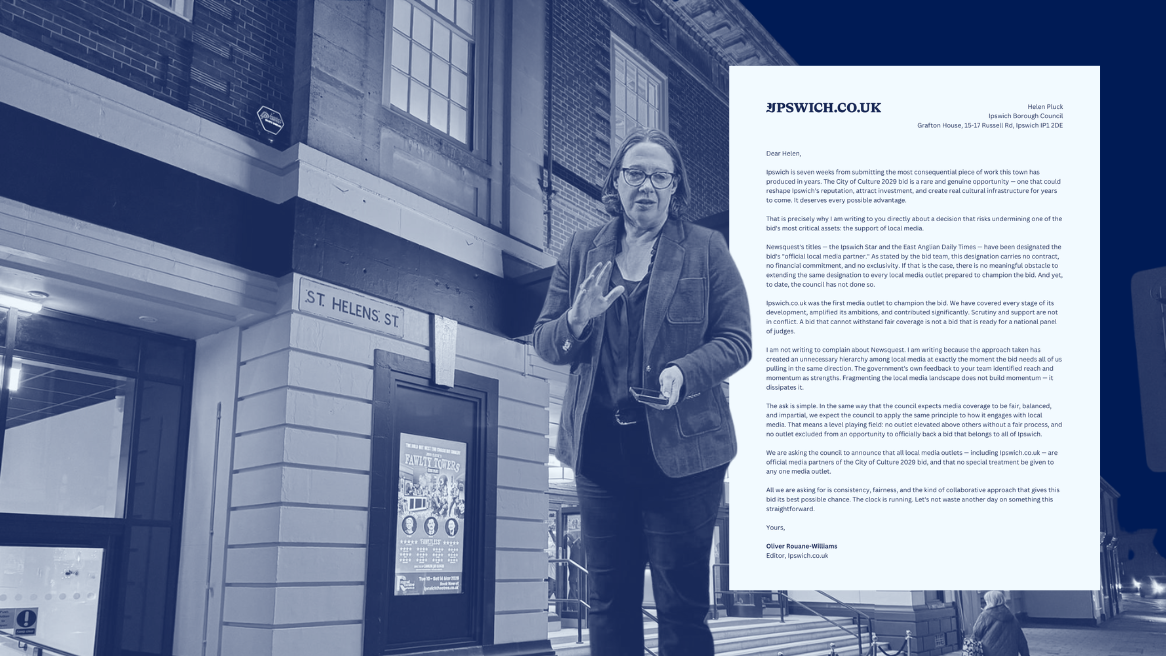
 Oliver Rouane-Williams
Don't forget: If you enjoy our content, please add Ipswich.co.uk as a "preferred source" on Google so you can easily find more of the content you value.
Local journalism is expensive to produce
It's free for you to read thanks to the generous support of our partners. Please support us by supporting them.
Below the line