
The £6,000 gap: The surprising truth about the cost of living in Ipswich
Ipswich has cheaper houses and lower rents than many of its East Anglian neighbours, but the latest government figures reveal a town where wages lag behind the region, rents are rising faster, and the apparent advantages of affordable housing conceal a different picture.


The £6,000 difference
The biggest problem with the cost of living in Ipswich might not be what things cost. It might be what people earn.
According to the Office for National Statistics, the median full-time employee living in Ipswich earned £691.30 a week in 2025. Across the East of England, the equivalent figure was £804.90.
That is a difference of £113.60 a week, or £5,907 over a year.
Compared with Great Britain as a whole, the typical Ipswich full-time worker earned nearly £4,000 less annually.
This is not a comparison between a highly paid London executive and somebody working in an Ipswich shop. These are median earnings, meaning half of full-time employees earn more and half earn less.
The figures suggest that while Ipswich residents may benefit from cheaper housing than those living in Cambridge or Colchester, many start with considerably less money in their pockets.
Median weekly earnings for female full-time workers living in Ipswich were £623, compared with £730.60 across the East of England. That amounts to another £5,595 a year.
The figures are gross earnings before tax, rather than take-home pay, but they expose a fundamental problem. Ipswich is part of one of England's more prosperous regions without necessarily sharing equally in that prosperity.
An average house costs less than half the Cambridge price
There is some good news, particularly for buyers.
The average property in Ipswich cost £226,000 in August 2026, according to the latest provisional figures from the ONS and Land Registry.
In Cambridge, the average was £470,000. In Colchester, £294,000. Even Norwich was slightly more expensive at £228,000.
In fact, an average Cambridge property costs more than twice as much as its Ipswich equivalent.
First-time buyers in Ipswich paid an average £202,000, compared with £394,000 in Cambridge and £247,000 in Colchester.
On paper, Ipswich looks like something of a property bargain.
But the same wage figures that explain why people struggle with household bills also help explain why relatively inexpensive houses can remain difficult to buy.
A first-time buyer earning the Ipswich median full-time salary of approximately £35,948 would be looking at a property costing about 5.6 times their annual gross earnings.
That is not an official mortgage affordability calculation, and joint incomes, deposits and borrowing arrangements make a considerable difference. Nevertheless, it illustrates the distinction between a cheap house and an affordable one.
Ipswich might be inexpensive by East Anglian standards, but that does not mean it is inexpensive to the people who live here.
Ipswich rents are rising five times faster than Norwich
For renters, the picture is more troubling.
The average monthly private rent in Ipswich reached £1,002 in September 2026, passing the £1,000 mark.
That represents an increase of 4.5% in a year, compared with just 0.8% in Norwich and 1.7% in Colchester.
Although Ipswich remains cheaper than either city, its tenants are experiencing significantly faster increases.
Average monthly private rent, September 2026
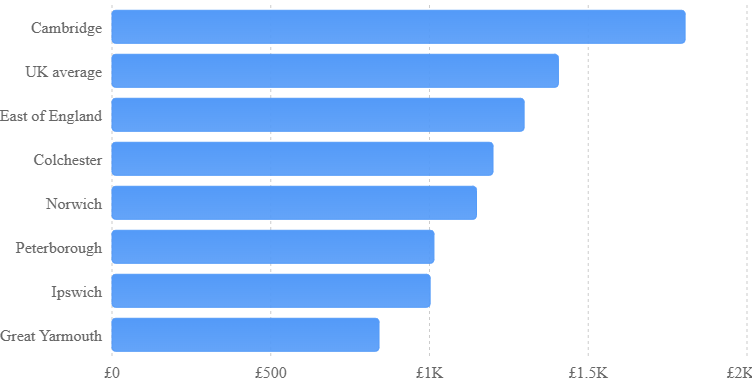
ONS estimates cover rents paid across existing and new private tenancies, not just newly advertised properties. Office for National Statistics+5
There is another revealing comparison.
An average rented home in Norwich now costs £146 more a month than one in Ipswich. But the typical full-time Norwich resident earns £22.50 more each week.
That means the extra annual rent in Norwich is greater than the annual difference in median full-time gross earnings between the cities.
Neither city offers a simple answer to the question of affordability.
For an Ipswich resident earning the local median full-time salary, £1,002 in monthly rent represents about a third of gross earnings, before income tax, National Insurance, energy bills, food or transport.
That is an illustration for one worker paying the rent alone, rather than an official measure of housing affordability. Two-income households would have a different calculation.
But for someone living independently on an ordinary Ipswich wage, it shows just how quickly the budget can become uncomfortable.
The town with £4,000 less to spend
Perhaps the most revealing statistic comes from a measure rarely discussed outside economic reports.
Gross disposable household income, or GDHI, estimates the money available to households for spending or saving after taxes and benefits. It includes income beyond wages and is expressed per head of population.
The latest ONS figures put Ipswich at £21,816 per head in 2024.
Across the UK, the figure was £25,965.
That is a gap of £4,149 per person, leaving Ipswich about 16% below the national average.
The distinction matters. Ipswich does not just have lower wages among its full-time employees. Its wider household income position also falls behind the country.
A town where residents have thousands of pounds less available to spend is a town where local businesses face an additional challenge.
It may help explain why retailers, restaurants and other businesses competing for household spending cannot necessarily expect the same purchasing power that exists in wealthier parts of East Anglia.
It does not, by itself, prove why individual shops close or businesses struggle. But it is an important part of the economic backdrop.
The extraordinary divide between two parts of Ipswich
The latest deprivation figures reveal another uncomfortable truth.
According to Suffolk's 2025 analysis of the government's Indices of Multiple Deprivation, 30.9% of Ipswich residents live in neighbourhoods ranked among the most deprived 20% in England.
That is almost three times the proportion across Suffolk as a whole.
But here is the surprise.
At the opposite end of the scale, 14.9% of Ipswich residents live in areas ranked among England's least deprived fifth. That is actually slightly higher than Suffolk's countywide figure of 14.1%.
Ipswich is not simply a uniformly poor town. It is a town of considerable contrasts.
The report identifies neighbourhoods around Stoke Park Drive and Winchester Way in Chantry among the most deprived in Ipswich.
Meanwhile, the area around Borrowdale Avenue and Tuddenham Road, on either side of Valley Road, is identified as the least deprived.
Seven of Ipswich's ten county electoral divisions contain neighbourhoods within England's most deprived fifth.
In Bridge and Chantry divisions, around half the population live in such neighbourhoods.
The contrast matters because a town-wide average can conceal households living in dramatically different circumstances, sometimes within a relatively short distance of one another.
It also means that national policies aimed at an 'average household' can have very different effects across Ipswich.
Cheaper homes can come with expensive energy bills
Another overlooked element of the cost of living is the quality of the housing people occupy.
A cheaper property is not necessarily cheaper to run.
Ipswich Borough Council's own housing evidence, drawing on older fuel poverty estimates for 2020, recorded 10,803 households in fuel poverty, equivalent to 17.4% of households at that time.
The corresponding figure for England was 13.2%.
Those numbers should not be mistaken for the current position. Fuel poverty statistics and their underlying methodology have changed, and more recent estimates are available nationally.
Nevertheless, the council's evidence raises an important structural issue.
Its analysis of Energy Performance Certificates issued between 2013 and 2023 found that 40% of assessed Ipswich dwellings were rated D, with another 36% rated C. Only 9.3% were rated B, compared with 14.3% nationally.
These figures do not cover every property and are not a complete picture of the town's present housing stock.
But they help illustrate why a household paying a relatively modest rent or mortgage can still face substantial running costs.
For residents with poorly insulated homes, the cost of heating may erase part of the advantage of living somewhere with cheaper property prices.
Inflation has slowed, but that doesn't mean prices have fallen
There is also the national picture to consider.
The UK's annual Consumer Prices Index inflation rate was 3.5% in September 2026, up from 3.1% in August.
Food and non-alcoholic beverage inflation was considerably lower, at 1.3%.
That sounds encouraging until one remembers what inflation actually measures.
A slowing rate of inflation generally means prices are rising more slowly. It does not mean that the increases of previous years have been reversed.
For an Ipswich household with little spare income, even relatively modest increases can matter when they are added to council tax, transport, rent, insurance and energy costs.
And there is one particularly significant local difference.
While the latest annual national inflation rate was 3.5%, Ipswich's average private rent was increasing at 4.5%.
Renters in Ipswich are therefore facing a major household expense rising faster than the overall national price index.
So is Ipswich really a cheap place to live?
The answer depends on who you are comparing it with, and how much you earn.
Against Cambridge, Colchester and much of the wider East of England, Ipswich looks attractive on property prices.
An average home costs £112,000 less than the regional average. Average monthly rent is £296 below it.
Those are meaningful advantages.
But they sit alongside full-time earnings that are almost £6,000 below the regional median, household disposable income below the UK average, and neighbourhoods where financial hardship is concentrated.
It is possible for Ipswich to be cheaper than its neighbours and still be difficult for its own residents to afford.
That may be the most important conclusion from the figures.
Because the question facing Ipswich is not simply how to keep housing affordable or how to control rising prices.
It is how to build a local economy in which ordinary residents earn enough to enjoy the advantages that living here ought to offer.
Ipswich's problem may not be that it costs too much to live here. It may be that too many people are paid too little to live comfortably.
Don't forget: If you enjoy our content, please add Ipswich.co.uk as a "preferred source" on Google so you can easily find more of the content you value.
This article cost us ~£87 to produce
It's free for you to read thanks to the generous support of our partners. Please support us by supporting them.
Below the line