
Plans to turn Great White Horse Hotel into flats to go before planners
Proposals to convert Ipswich's long-vacant Great White Horse Hotel into 21 homes and community space are set to go before the borough council's planning committee on Wednesday, 3 June, with officers recommending approval.

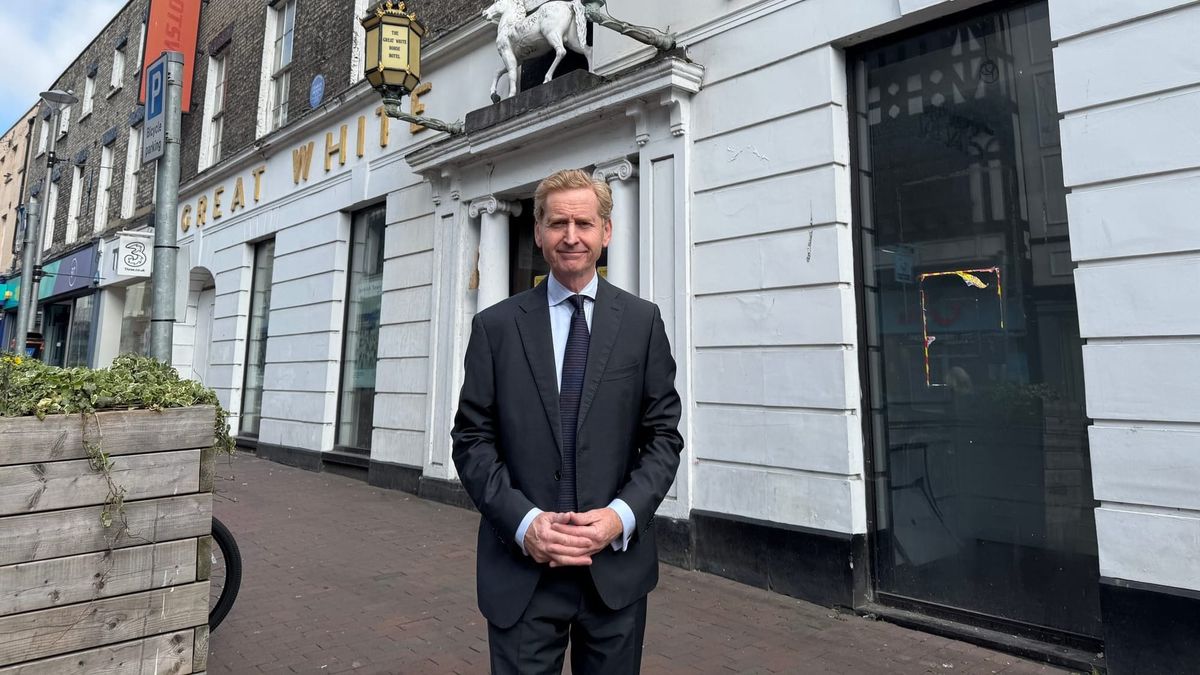
Why it matters: The Great White Horse Hotel on Tavern Street is one of Ipswich's most prominent historic buildings. Grade II* listed and with origins dating to the 16th century, it has been on Historic England's Heritage at Risk Register after falling into a long period of decline following its closure as a hotel in 2008. The proposals would bring it back into active use for the first time in nearly two decades.
The details: The application, submitted by White Horse Ipswich Ltd – the investment vehicle of developer John Howard and his business partner David Carr – proposes converting the upper floors into 21 residential flats, a mix of one and two-bedroom units, while retaining three existing ground-floor retail units. Community spaces would be created on the ground floor and in two of the hotel's most historically significant rooms: the Dickens Bar and the Trafalgar Room on the first floor.
Extensive repair and refurbishment works would be required across the building, including to the roof, windows and wider building fabric, before it could be made habitable.
For context: The hotel has its origins in the 16th and 17th centuries and is closely associated with the writer Charles Dickens, who stayed there and based an inn in his novel The Pickwick Papers on the building. Previous attempts to revive the hotel use have not proved viable. Howard and Carr have also explored the possibility of restoring the building as a 48-room boutique hotel with the support of a Towns Fund grant, but with a grant looking unlikely at this stage, residential conversion is looking most likely.
What they're saying: Speaking to Ipswich.co.uk, Howard said: "Quality residential town centre developments are the lifeblood of town centres, and the Great White Horse is a great example of what can potentially be achieved to save a very important historic building."
Planning officers said the hotel had seen "a long process of decline", particularly in the hotel and hospitality parts of the building, and concluded that the proposals would bring it back into use while causing "less than substantial harm" to its heritage significance – harm they said would be "comprehensively outweighed" by the benefits of the scheme.
Historic England raised no objection to the conversion on heritage grounds.
The viability question: An independent assessor commissioned by the council found the scheme is projected to make a loss of more than £2.6m. As a result, the council has not sought the legal financial contributions – known as Section 106 obligations – that would normally be required from a development of this size, covering costs such as education, public open space and infrastructure.
Officers said the viability issues, combined with the importance of bringing the listed building back into use and the council's need to boost housing supply, weighed in favour of supporting the application despite the absence of those contributions.
No objections to the plans have been received from residents or consultees.
The bottom line: Planners are being asked to approve a scheme that would rescue one of Ipswich's most significant historic buildings from further decline – but the projected £2.6m loss means the council will forgo the infrastructure contributions it would normally expect from a development of this scale. While some may take issue with that, most residents we've spoken to would rather see the building restored and bought back into use than remain a blight on the town centre.
Don't forget: If you enjoy our content, please add Ipswich.co.uk as a "preferred source" on Google so you can easily find more of the content you value.
This article cost us ~£27 to produce
It's free for you to read thanks to the generous support of our partners. Please support us by supporting them.
Below the line