
NEET in Suffolk: 'Short-changed' and 'not yet good enough'
Suffolk's rate of young people not in education, employment or training (NEET) is above national and regional averages, and has risen over four years. The council says the government is shortchanging it, but a local teenager's account reminded councillors what those numbers represent.


Zak became NEET – not in education, employment or training – at 17. By the time his voice filled the King Edmund Chamber at Endeavour House, councillors had already spent an hour on slides, percentages and cohort sizes. His was the first account they heard from someone with direct experience of the challenge at hand.
In March 2026, Suffolk had 828 young people in the position Zak had been in.
Going 'nowhere in life' and destined to be a 'junkie'
Zak's account of secondary school is not one of conflict or exclusion. It is one of being overlooked.
"They kind of left me to do my own thing, which wasn't very good," he said. One comment in particular has stayed with him: a teaching assistant told him he would go "nowhere in life" and would end up a "junkie".
"I did kind of say to her, you don't say that to a student, do you? You're just gonna put them down," he said.
One teacher was the exception. "He's been the one that helped me the most," Zak said, describing a member of staff who supported him more than anyone else.
Asked whether he had received careers advice as he approached post-16 education, Zak said he did "a bit", but that his parents mostly sorted things out for him.
"I didn't really have any help," he said.
Zak went on to study agriculture. "That's what I wanted to do at that time," he said.
Then he stopped attending. For around six months, he did not go in. When he tried to return, the course he had chosen no longer felt like the same place.
"I didn't enjoy it as much as I did, and people weren't being as nice as they were, like, before everything happened, so I just kind of gave up," he said.
He was withdrawn in October 2025 and spent a period at home, in neither education, employment nor training.
He was clear about what he thought had cost him most. He said he could have had more help with his GCSEs, adding: "[There were] a lot of questions I couldn't understand."
"I think [if] I had my GCSEs, [it] would have been a lot better for me, like, getting a job."
Since February, Zak has been working with a support worker who helped him bounce back and find an apprenticeship. It was that worker who interviewed him in the recording played to the committee, and who described his turnaround as "a really successful outcome".
What the numbers say
The figures presented to the Education and Children's Services Scrutiny Committee put Zak's experience in context.
In March 2026, 4.88% of Suffolk's 16 and 17-year-olds were NEET – 828 young people out of a cohort of 16,951. In March 2022, the figure was 3.74%, or 589 young people.
Suffolk's rate is above England's 3.58%, above the East of England's 4.00%, and above the 3.80% recorded by its statistical neighbours, the group of councils with similar demographic and economic characteristics used for comparison.
Those young people are not evenly spread across the county. The council's evidence records "higher concentrations of NEET (16-18 years) in parts of Ipswich and Lowestoft", alongside significant numbers dispersed across villages, particularly in the Babergh and Mid Suffolk areas. Where a young person lives, the council concludes, shapes their participation as much as their individual circumstances do.
The rate did fall slightly year on year, from 4.97% in March 2025. But Garath Symonds, the council's assistant director for youth and communities, was blunt about what that meant: "Although there was a small annual reduction, Suffolk has not achieved a significant sustained reduction."
Mr Symonds concluded by acknowledging that, "like other authorities, the overall position is not yet good enough".
The signals are visible in primary school
Suffolk analysed 7,787 young people who completed statutory education in 2022/23, looking for indicators in their primary years linked to becoming NEET later.
It found that children with some form of social care involvement were 89% more likely to become NEET. Persistent absence increased the likelihood by 81%. Low attainment at Key Stage 1, the first stage of primary school, increased the risk by 80%. Pupils who had been suspended had around double the odds.
Special educational needs and disabilities, low attainment and attendance problems were all "substantially more prevalent" among young people who became NEET.
"The findings support earlier identification and intervention around attendance, attainment, behaviour and vulnerability," they said.
Yet by its own account, the greatest preventative focus currently sits in Year 11 and the transition into post-16 education – years after the indicators first appear – and often too late.
'An inequality issue'
The evidence describes NEET in Suffolk as "an inequality issue, not simply a post-16 destination issue".
In March 2026, 44.7% of young people known to Youth Justice Services were NEET – 17 out of 38. The proportion has risen from 23.40% in March 2022, when it was 11 out of 47. Mr Symonds cautioned that "rates should be read alongside underlying counts, particularly for the smaller Youth Justice cohort".
Among children in care, 21.0% were NEET – 53 out of 253. Among young people with an Education, Health and Care Plan, 11.3% were NEET – 171 out of 1,512, a cohort that has almost doubled in five years.
December 2025 data for Year 12 learners alone sharpened the picture further. The overall Year 12 NEET rate was 3.69%, or 311 young people. Among those who had attended less than half of Year 11, it was 20.1% – 99 young people, more than five times the overall rate. Among those with a recorded mental health need, it was 17.8%, or 83 young people. Among those electively home educated in Year 11, it was 12.9%, or 49.
"The strongest risks are visible early enough to support targeted prevention," Mr Symonds told the committee.
Where Suffolk has moved the needle
One set of figures ran the other way. The proportion of children in care and care leavers in Years 12 and 13 who were NEET fell from 22.0% in September 2024 to 14.8% in September 2025 – a drop of 7.2 percentage points.
The council attributes this to "enhanced oversight, targeted support and partnership working", including close involvement from the Virtual School and Virtual College, social care and personal advisers, focused not only on securing a destination but on sustaining one.
The council also regards its tracking as a strength. Suffolk's rate of young people whose status is unknown remains low, which the evidence says gives "greater confidence in the NEET and participation data". In other words, Suffolk believes it knows where its young people are.
Somewhere to come back to
Knowing is not the same as having somewhere to send them.
The council's evidence sets out growing demand for Entry Level, Level 1 and transition programmes alongside "a reduction in flexible re-engagement opportunities, mid-year starts and roll-on roll-off provision". All three of Suffolk's further education colleges are managing rising demand against what the papers call "a very challenging financial outlook".
Research from autumn 2025 tracked young people who left one of Suffolk's three FE colleges early. Of 344 leavers, 133 became NEET.
That drift is measurable. The council's evidence shows that by April 2026, for the 2024 leaver group, the NEET figure rose from 4.02% to 6.04% in the intervening four months.
Apprenticeships for 16 to 18-year-olds have not increased, and the number of young people moving into all forms of employment has fallen.
One line in the council's presentation summarised the problem: "Tracking identifies the cohort; sufficient pathways determine whether progress is sustained."
The council's funding fight
Days after the committee met, Cllr Simon Aalders, the council's Cabinet Member for Children and Young People's Services, wrote to Education Secretary Lucy Powell asking her to correct what he called an historic imbalance in what Suffolk receives for children's services and education.
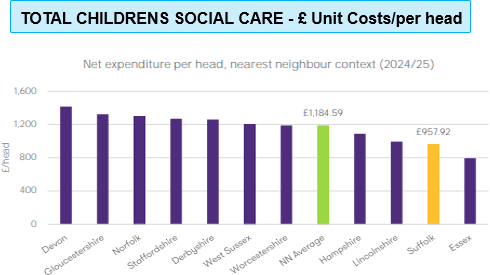
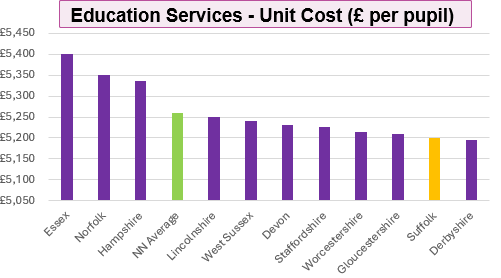
The council published the letter on Monday, 28 September 2026. It says Suffolk spends £957.92 per head on children's social care, the second lowest among its nearest neighbours and around £227 below that group's average, and that Suffolk is also the second lowest spender per pupil on education services.
"This funding system has left Suffolk residents short-changed for far too long, and our children and young people at a severe disadvantage," Cllr Aalders said. "We are not asking the Government for special treatment. We are asking for fair treatment."
Both figures cited are measures of what the county spends rather than what it is granted, and both comparisons are against nearest-neighbour authorities rather than a national average. The council's own evidence to the scrutiny committee does not attribute Suffolk's NEET position to county funding levels. Where it does raise money, it points to national 16-19 study programme funding and the pressure on further education colleges.
What happens next
A refreshed education, employment and training strategy is in development. Mr Symonds told the committee it would provide "the framework for coordinated system change".
It is built around three themes:
- Prevent earlier, using participation and risk data to spot emerging concerns and strengthening attendance, inclusion and mental health support.
- Remove barriers, addressing financial hardship, transport, housing instability and digital exclusion.
- Broaden pathways, expanding apprenticeships, supported internships, traineeships and work experience, and developing flexible provision for young people who cannot sustain traditional routes.
The council's four stated ambitions are to turn early insight into action, secure successful and sustained transitions, broaden pathways and remove barriers, and mobilise the whole system.
Opening the discussion, Cllr Aalders described it as an "important discussion" and one "close to his heart". He said being NEET negatively affected every element of a young person's life and that the role boredom played could not be underestimated. He acknowledged that not everything was rosy, but said the council had a moral duty alongside its statutory one, and that "everyone is wholly focused" on allowing young people to thrive.
Sarah-Jane Smedmor, the council's executive director of children and young people's services, put it more simply before handing over to officers.
"No young person's future should be determined by their current circumstances," she said.
The bottom line
Zak's account lasted a few minutes. The council's report runs to dozens of pages and reaches the same conclusion from the opposite direction: that the risks are visible years before anyone becomes a statistic, but that support still arrives largely in Year 11.
Suffolk is now making a case to government that it has been short-changed for years, and that case may well be a fair one. But it is a separate argument from the one its own officers set out to councillors, which was about when help arrives and whether there is anywhere to send a young person who wants to come back.
Every month that gap stays open, more young people move through it. The council has set out what a refreshed strategy should do. The test is whether it changes when help arrives, rather than how precisely it counts the problem.
Don't forget: If you enjoy our content, please add Ipswich.co.uk as a "preferred source" on Google so you can easily find more of the content you value.
This article cost us ~£162 to produce
It's free for you to read thanks to the generous support of our partners. Please support us by supporting them.
Below the line