
Leaked report exposes depth of East Suffolk's bin crisis
An internal report seen by this publication shows 45,936 bin collections were still missed last week, nearly two months into the troubled bin rollout in East Suffolk. Officers describe "marked improvement", but the figures, and a growing row around them, tell a different story.

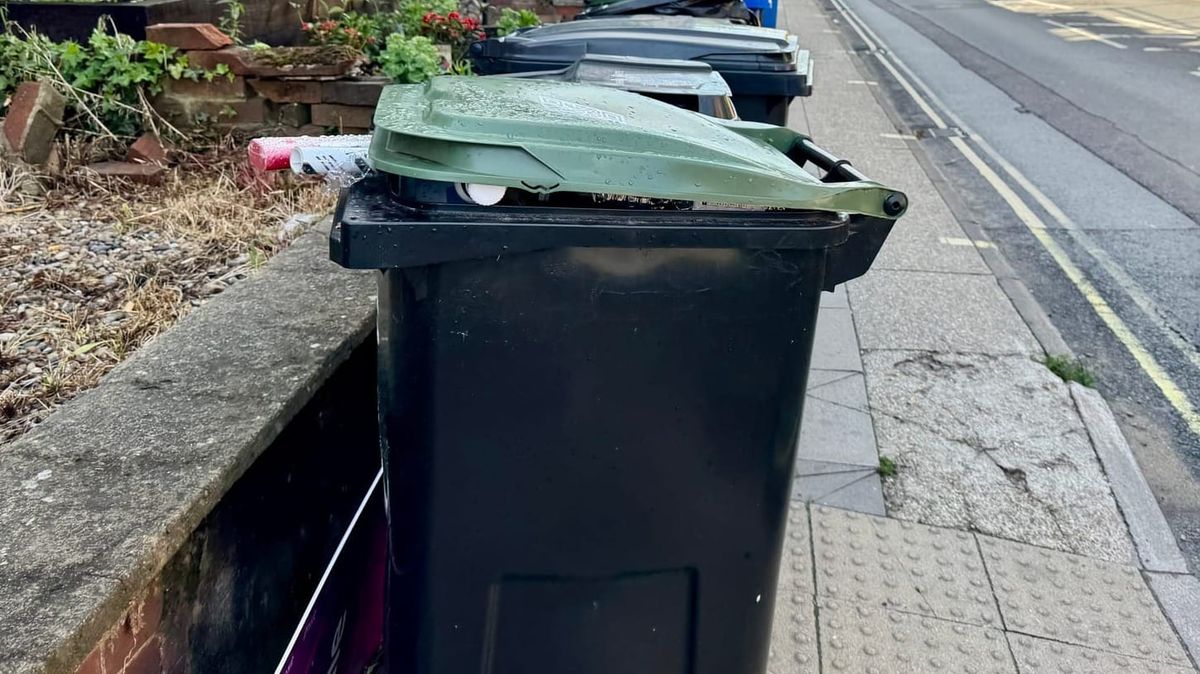
The update, sent by Strategic Director Kerry Blair to councillors on 17 July 2026, sets out collection performance across the week of 14 to 17 July.
What the leaked data shows
Across all waste streams, 224,587 of 270,623 planned collections were completed that week — an overall rate of 83.0%, with 45,936 collections missed. Tuesday, 14 July, was the worst-performing day, accounting for 42.5% of all missed collections that week, with only 66.0% of scheduled collections completed.
Food waste fared worst of all, averaging just 73.1% completion across the four days, dipping as low as 54.7% on Tuesday. Paper and card fared best, averaging 93.5%, while residual (general) waste averaged 81.8%.
By Friday, 17 July, performance had climbed to 91.4% across all rounds — the improvement Mr Blair's update refers to. Even so, that would mean roughly one in twelve bins still went uncollected on what the council itself describes as its best day of the week.
In his email, Mr Blair acknowledged the scale of the problem. "This isn't the improvement on last week that we wanted to see, and you'll see that Tuesday was a particularly bad day," he wrote, attributing it "in part" to "issues with routing and use of the in-cab system drivers use to follow rounds."
He added: "While urban route performance has improved in a number of areas since the introduction of the new service, there remain unacceptable levels of missed collections and delays in some locations, particularly in rural areas and at properties where access is more challenging. We recognise the frustration this is causing residents and Members."
Below the standard
Analysis of the figures against published guidance suggests East Suffolk's performance sits well below both statutory expectations and comparable councils.
Defra guidance calls for consistent weekly collection of residual waste and food waste, with missed collections rectified within two working days. Against that standard, East Suffolk completed only 83% of planned collections that week, with food waste averaging 73.1% and no published timeline for clearing the backlog.
Industry benchmarks published by the Chartered Institution of Wastes Management typically expect councils to achieve at least 98% collection completion, with fewer than 2% of collections missed in any given week. East Suffolk's 17% missed-collection rate for the week is roughly eight times higher than that benchmark.
Neighbouring authorities, including Babergh, Mid Suffolk and Waveney, are understood to typically report weekly completion rates of between 97% and 99% — suggesting East Suffolk may be performing between 14 and 16 percentage points worse than comparable district councils, though the council has not been asked to confirm or dispute this figure directly.
The council's own pre-launch messaging promised residents a "reliable, consistent service" with "minimal disruption" during the rollout. Nearly two months on, the leaked data shows persistent multi-week delays, with rural areas and hard-to-reach properties disproportionately affected.
Recovery plans and rising costs
Mr Blair's update outlines a series of measures intended to stabilise the service, including additional driver capacity, new arrangements with the council's agency staffing provider, continued recruitment, and extended vehicle lease arrangements to secure sufficient fleet capacity. Daily monitoring of performance and route completion rates has also been introduced "to identify issues more quickly and intervene earlier."
To tackle the backlog, East Suffolk Services Ltd (ESSL), which delivers the service on the council's behalf, deployed four recovery crews on Saturday and eleven crews on Monday — a day not normally used for collections.
Notably, a copy of the update seen by this publication carries handwritten annotations, questioning several of the council's claims. Beside the reference to Monday working, one note asks: "Why not before?" A similar question is repeated beside the announcement that rural collection routes are now under urgent review. Other annotations query the cost implications of the additional driver capacity and agency arrangements.
Mr Blair's update states that a formal recovery plan is "currently being drafted" with ESSL, bringing together "the range of operational, workforce, route-planning and system improvement actions that are underway," with further announcements expected "next week."
But speaking to this publication, Cllr Ewart said: "As each week goes by, this seems to get worse and worse. I'm dismayed by the number of residents throughout East Suffolk directly contacting me with their stories of failure."
According to Cllr Ewart, concerns raised with her include drivers being asked to stand on the back of collection vehicles to gauge weight or capacity manually, and food waste and residual routing being managed using artificial intelligence software based in Germany — two of eight factors that this publication has been told are contributing to the botched rollout of the scheme.
Cllr Ewart was also critical of the council's political leadership. "So far into this, I'm worn out with being expected to swallow the excuses," she said. "I've not heard a single word — that I've seen — from the leader, Caroline Topping. That one word that might have helped would have been, 'We're sorry for failing so many residents.' This is just one of the challenging services that this council provides. On this occasion, it impacts more residents than planning."
A governance question, too
The performance data has landed against the backdrop of a broader campaign by Cllr Julia Ewart — Suffolk County Council's Scrutiny Chair, County Councillor for Saxmundham & District and District Councillor for Kelsale & Yoxford — to force a change in East Suffolk Council's leadership.
On 16 July, as reported by this publication, Cllr Ewart wrote to chief executive Chris Bally proposing a "Transitional Cross-Party Administration," arguing that the GLi Group Cabinet was "running out of road" and no longer commanded a secure working majority.
 Oliver Rouane-Williams
A further letter, dated 17 July and seen by this publication, is addressed to the council's Monitoring Officer, Chris Bing, and takes the campaign in a new direction — from politics towards statutory governance oversight.
In the letter, Cllr Ewart invokes section 5 of the Local Government and Housing Act 1989, which places a personal statutory duty on a council's Monitoring Officer to report where a proposal, decision or omission has given rise to, or is likely to give rise to, unlawfulness or maladministration.
She notes that East Suffolk Council currently operates without an outright majority in any political group, with Full Council reliant on the Chairman's ordinary and, where necessary, casting vote. That arrangement, she writes, "does not, in itself, represent poor governance," but "increases the importance of rigorous professional advice, robust challenge from statutory officers and careful identification of operational and reputational risks before significant decisions are implemented."
She cites the Better Recycling rollout as a "current example," writing that "the relevant governance question is whether these operational, reputational and public confidence risks were properly anticipated and escalated before implementation."
The letter poses eight questions to the Monitoring Officer, including whether governance risks arising from the council's political arrangements have been formally assessed, what assurance reports have been received from ESSL regarding the rollout, and what governance lessons the scale of public concern might demand.
Cllr Ewart concludes: "Public confidence depends not merely upon governance arrangements existing on paper, but upon those arrangements operating effectively, particularly during periods of political uncertainty or significant service change."
The other side
A spokesperson for East Suffolk Council said: "We are continuing to make every effort to resolve issues affecting waste collection following the roll-out of the Better Recycling scheme.
"We understand the frustration of residents who have experienced missed bin collections, and we apologise for the inconvenience this has caused. We are also aware that these issues have, since the changes were implemented, had a recurring knock-on effect for some residents.
"The disruption is the result of a combination of operational challenges, including mechanical and hydraulic adjustments to new food waste collection vehicles, adaptation to entirely new rounds and routes, and operative-staff sickness. In addition, the recent hot weather has impacted the completion of rounds.
"While the majority of residents are receiving a good service, particularly for wheeled bin collections, our crews are working hard to recover missed bins, resolve issues on rounds, and return services to the usual consistent standard our residents expect.
"Once again, we want to thank residents for their patience and understanding. The Council and East Suffolk Services Limited are working as hard as possible to resolve these initial issues, and every single member of staff is doing their very best on behalf of residents."
Residents can check for updates in their area via the council's mobile app.
The council did not directly address the governance letter to its Monitoring Officer, nor the specific claims relating to vehicle weight capacity or AI-managed routing, in its response.
Deputy Leader Cllr Paul Ashton previously told this publication, in response to Cllr Ewart's earlier letter to Mr Bally, that the council had "a comprehensive action plan in place" and that "the outstanding issues surrounding Better Recycling are of an operational nature that will not be resolved by changes to the composition of the Cabinet."
The bottom line
Seven weeks into the Better Recycling rollout, East Suffolk Council's own data shows the service still falling well short of the standard residents were promised — and, on early indications, also well short of national benchmarks, too. However, this is no longer only a story about bins, but about how East Suffolk is governed, and by whom. We expect it to continue developing in the build-up to the next Full Council meeting at East Suffolk House this Wednesday.
Don't forget: If you enjoy our content, please add Ipswich.co.uk as a "preferred source" on Google so you can easily find more of the content you value.
This article cost us ~£122 to produce
It's free for you to read thanks to the generous support of our partners. Please support us by supporting them.
Below the line