
Is it really the end for Trimley’s extraordinary water tower - or could it be saved?
As plans to demolish the 92-year-old Suffolk landmark come under scrutiny, other redundant water towers have found remarkable new lives. And East Suffolk Council has confirmed it possesses a legal power that could give Trimley’s tower a fighting chance.


There is something rather reassuring about a familiar landmark. It tells us where we are, how far we have travelled and, sometimes, that we are nearly home.
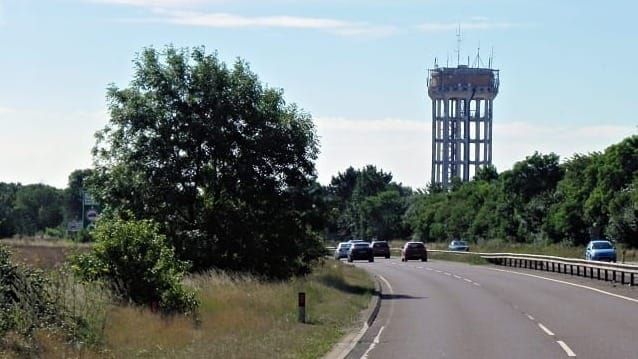
For generations of people travelling towards Felixstowe, the great concrete water tower at Trimley St Mary has served precisely that purpose.
It is not conventionally beautiful. Its exposed concrete legs support a circular tank high above the surrounding rooftops, and there is something distinctly industrial about its appearance. But it is unmistakable, and has stood there for 92 years.
Now its future hangs in the balance.
The tower's owners, a London-registered company called Propland Estates Limited, want to demolish the structure, which was built in 1934 to help supply water to Felixstowe and surrounding communities.
The tower stands approximately 210 feet high and once held 150,000 gallons of water. It was taken out of water-storage service in 2002 and has subsequently been used for telecommunications equipment.
Its owners describe it as having reached the end of its economic life. There have also been longstanding concerns about deteriorating concrete, including reports of fragments falling from the structure.
But does the end of a building's original purpose necessarily mean the end of the building itself?
And, perhaps more importantly, has anybody seriously investigated whether this remarkable piece of Suffolk's engineering history could be saved?
Demolition is not yet approved
East Suffolk Council has confirmed to Ipswich.co.uk that it has not granted the final prior approval being sought for the demolition method.
Instead, the Council determined on 4 June 2026 that further information was required before it could be satisfied that demolition could proceed without unacceptable environmental consequences.
The original application, numbered DC/26/1405/DEM, proposed demolishing the structure using heavy equipment, including a long-reach excavator, crane and concrete-breaking machinery.
But the Council's own records identify insufficient information about demolition methods, environmental impacts and the potential effects on protected species.
One particularly sensitive issue concerns peregrine falcons reported to be nesting on the structure.
The Council has said the applicant must provide further information, which will be subject to additional consultation.
It is important to understand, however, that this procedure is principally about how demolition would take place, rather than whether the building deserves to survive.
And that leads us to an interesting legal possibility.
A little-known power that could save the landmark
Most people assume that demolishing a substantial building requires a full planning application. Surprisingly, that is not always the case.
Under national planning rules, certain demolition works enjoy what are known as permitted development rights. These allow owners to proceed without obtaining an ordinary planning permission, provided the relevant legal requirements are met.
Councils can examine specified practical questions, including the proposed demolition method and restoration of the site, but this is not necessarily an opportunity to consider the full historical merits of preserving the building.
There is, though, another mechanism.
It is called an Article 4 Direction.
In simple terms, an Article 4 Direction removes specified permitted development rights from a particular property or area.
If East Suffolk Council made an effective direction covering demolition of Trimley Water Tower, its owners could be required to make an ordinary planning application before knocking it down.
The Council would then have an opportunity to consider a much wider range of planning matters, including the structure's heritage significance.
An Article 4 Direction does not guarantee that a building will be saved. It changes the rules of the decision- making process.
And East Suffolk Council knows how to use this power, because it has already used it in Felixstowe.
The Felixstowe building that was given a second chance
In 2023, the proposed demolition of Landguard Lodge in Manor Terrace prompted objections from heritage organisations and Felixstowe Town Council.
East Suffolk responded by making an emergency Article 4 Direction removing the owner's ordinary permitted development right to demolish the building.
The direction was subsequently confirmed, meaning that demolition would require planning permission.
Felixstowe Town Council welcomed the decision, having argued that the building possessed architectural significance and that its preservation deserved proper consideration.
That is a particularly relevant precedent.
Indeed, when ipswich.co.uk asked East Suffolk Council whether Trimley's historic tower had been assessed for protection, the Council specifically referred to its ability to make an Article 4 Direction and cited Landguard Lodge as an example.
What its response did not explain was whether that option had actually been considered for the water tower.
We have asked the Council to clarify that point.
What other communities have achieved
Before accepting that redundant towers inevitably become rubble, it is worth taking a short journey around our region.
Across the Orwell at Freston stands another concrete water tower, built in the 1950s and unused for decades.
Its owners saw something quite different in the redundant structure.
After a five-year project, the old water tower was transformed into The Concrete Castle, an extraordinary seven-storey holiday property with accommodation for 18 guests, a cinema room, games room, passenger lift and roof terrace.
It remains recognisably a water tower, but is now a commercial visitor destination.
The owners describe their achievement as giving new life to a prominent landmark that might otherwise have remained derelict.
It is difficult to imagine a more relevant example, barely a few miles from Ipswich.
And then there is Colchester.
Its enormous Victorian water tower, affectionately known as Jumbo, has spent decades awaiting a sustainable future.
Built in 1882, the Grade II*-listed structure became redundant and deteriorated.
But rather than demolish it, a heritage-led regeneration project is working to create a publicly accessible attraction, with opportunities for events, community activities and spectacular views over the city.
The scheme has attracted major National Lottery Heritage Fund support.
On 19 October 2026, Colchester City Council and Essex County Council announced a further £100,000 commitment to the project.
That represents a strikingly different approach: treating redundant infrastructure not simply as a liability, but as a potentially valuable heritage asset.
Of course, neither Freston nor Colchester provides a ready-made engineering solution for Trimley. Every tower has different structural characteristics, different costs and different possibilities.
But both demonstrate that redundancy need not automatically mean demolition.
Who owns Trimley's tower?
The company behind the demolition application is Propland Estates Limited, registered in London in January 2004.
Companies House identifies Barry Ackerman and Naomi Ackerman as directors. The company is controlled through Bana One Limited, another London-registered company in which Barry Ackerman is recorded as holding a majority controlling interest.
The Companies House records also show that Propland Estates has filed accounts as an audit-exempt subsidiary of a wider corporate group.
Propland's registered business classification is other business support services, rather than a specific heritage or water engineering activity.
None of this indicates anything improper. However, it does establish that decisions about the future of a familiar Suffolk landmark are being made by a privately controlled corporate owner.
An important question remains unanswered: what is intended for the land once the tower has gone?
East Suffolk Council told ipswich.co.uk that it understood the immediate priority was removal rather than development, but said no public information was available about future plans and referred questions to the owner.
We would welcome the company's explanation of its plans, the engineering evidence behind its demolition proposal and whether it has explored any viable alternatives.
Should we at least investigate saving it?
Nobody should suggest that a deteriorating 210-foot concrete structure can simply be left standing without regard for the safety of nearby residents.
Nor should the presence of nesting birds be treated as a reason to overlook genuine structural dangers.
But there is a substantial difference between accepting that a building needs attention and accepting that it must be demolished.
Would a programme of stabilisation be possible? Could the structure have a new use? Might heritage organisations, specialist engineers or private investors see possibilities that have not yet been explored?
Those questions deserve answers.
The tower's remarkable exposed-leg design is part of the history of public water supply in Suffolk, and its presence in the landscape has outlived generations of residents.
Once demolished, it cannot be replaced.
The very least this 92-year-old landmark deserves is an informed examination of whether it has a future.
After all, a redundant water tower at Freston became a remarkable holiday destination. Colchester's Jumbo is being given a new lease of life through an ambitious heritage project.
Perhaps it is time to ask whether Trimley's tower might have a second chapter, too.
Don't forget: If you enjoy our content, please add Ipswich.co.uk as a "preferred source" on Google so you can easily find more of the content you value.
This article cost us ~£108 to produce
It's free for you to read thanks to the generous support of our partners. Please support us by supporting them.
Below the line