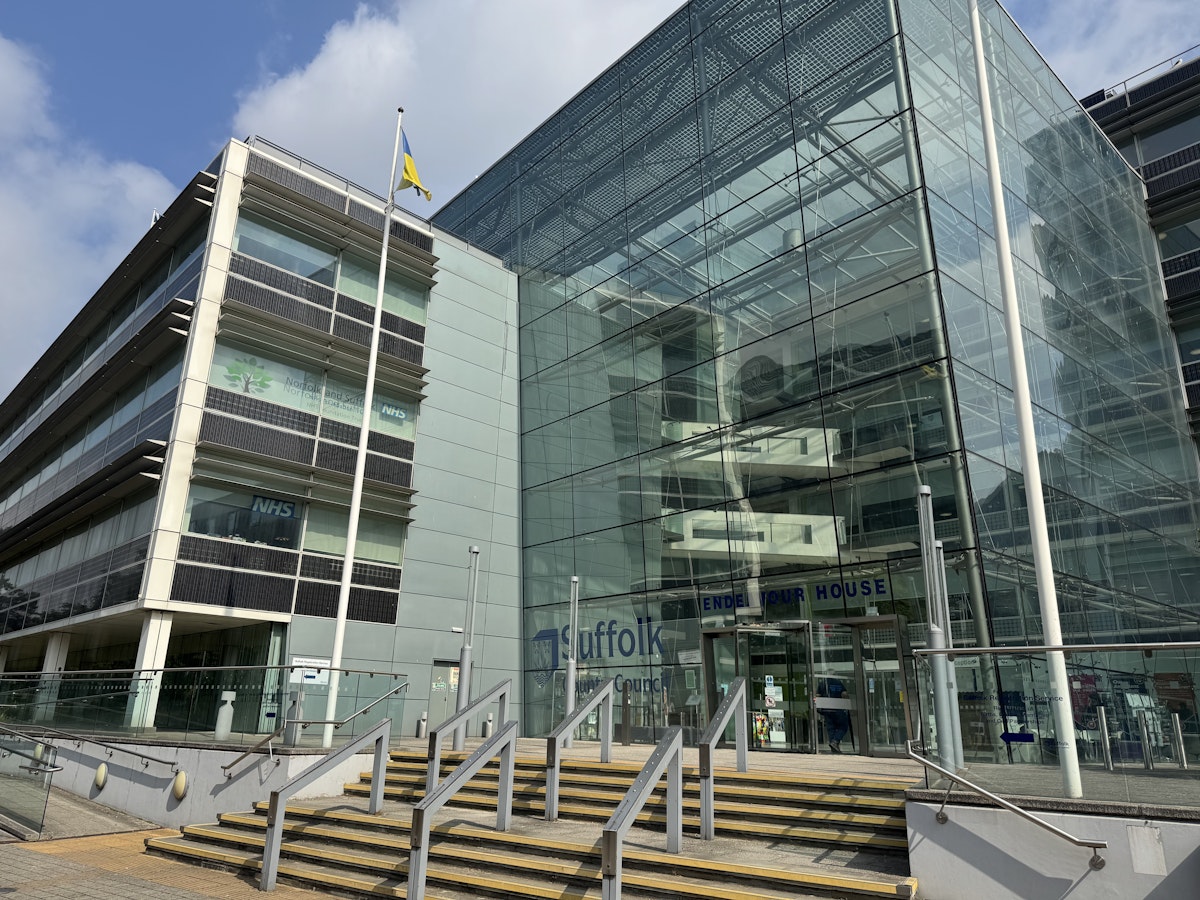
Why it matters: Suffolk County Council cabinet members yesterday unanimously approved the One Suffolk proposal for submission to Government by 26 September. This is one of two competing business cases that will be considered by Westminster, with district and borough councils set to submit their rival plan for three separate unitary authorities.
The details: The heated debate saw all county councillors vote 43 in favour, 17 against and two abstentions, though this was largely a formality as the formal decision rested with cabinet members, who unanimously approved the proposal. The approved plan would replace Suffolk's six councils with a single unitary authority serving 760,000 residents.
Cllr Richard Rout, the county's lead for council reform, presented the business case as a "menu for opportunity", with conservative estimates showing £78.2 million in savings after the first five years, and a further £39.4 million every year after that.
"This is an opportunity for a fresh start," he said, "to take what is done well and to ensure it continues, and to fix what is done badly. It is a chance for a reset, to change culture, to create an authority that is an enabler and not a blocker."
What they're saying: County council leader Matthew Hicks urged councillors to "back this proposal not just because it saves money, but because it serves the people of Suffolk better."
"Let's do what's right for our future, for our county, let's take this really rare opportunity to shape a better, a fairer and more resilient Suffolk for us all," he added.
However, opposition councillors launched fierce attacks on the proposal. Cllr Andrew Stringer, leader of the Green, Liberal Democrat and Independent (GLI) group, said: "My group is in favour of devolution as a principle that genuinely empowers and brings decision-making closer to local communities, but this is not what is being proposed."
"We will keep fighting to keep the 'local' in local democracy every step of the way," he warned.
The other side: Opposition councillors questioned both the financial promises and the impact on local democracy. Cllr Stringer argued: "Suffolk is a county with areas of different character and need. What is best for Ipswich, for example, may not be best for rural Mid Suffolk, or the coastal communities of East Suffolk."
The GLI leader also criticised existing county services, saying, "Services in Suffolk that are currently centralised, such as SEND and Highways, are in an appalling state. I'd be surprised if anyone in the county is convinced by these claims."
He also criticised the county council's spending on promoting the One Suffolk campaign, highlighting £37,000 on leaflets, £6,700 on photographs and £500 on badges. "This is how much they care about saving you money," he said.
Labour leader Cllr Sandy Martin raised concerns about democratic representation: "The whole point of a local authority is to give residents a local and approachable voice who will be able to reflect their concerns in the decision-making of the authority – the larger that authority becomes, the less real influence any single member will have."
Meanwhile, Cllr Andrew Reid, whose portfolio includes special educational needs and disabilities, disagreed with opposition fears that services would not improve: "Breaking up a universal service like children and young people's services would not only cost money, it would cost children their futures."
On council tax: The One Suffolk plan promises to harmonise council tax to Mid Suffolk's current level, potentially making Ipswich taxpayers the big winners, saving them up to £489 per year, depending on their property band. It also includes a £40 million capital investment fund for market towns.
Cllr Stringer challenged claims about council tax reductions, citing research showing "Band D council tax bills are an average of £250 a year higher for households in council areas with more than 500,000 people compared to those in areas with smaller populations."
What's next: Government will receive both business cases by 26 September – the county council's single authority proposal and the district and borough councils' plan for three unitary authorities anchored in Bury St Edmunds, Ipswich and Lowestoft. Westminster will then decide which proposal to take forward to public consultation, expected to conclude in early 2026, with a final decision later that year.
If approved, elections for a "shadow council" would take place in May 2027, operating alongside current structures until full implementation in May 2028.
The bottom line: Suffolk County Council has formally backed their vision for a single mega-authority, but the final decision rests with government ministers who must choose between competing proposals that offer fundamentally different approaches to local democracy and accountability.