
From Viking banks to Norman fires: Local archaeologist's 40-year mission to uncover Ipswich's hidden history
For over 40 years, Keith Wade was "in the right place at the right time" to excavate Ipswich's archaeological treasures, from 7th-century cemeteries to Viking defences, preserving the town's remarkable Anglo-Saxon heritage in a stunning new publication.

Why it matters: Gipeswic: The Anglo-Saxon Town of Ipswich captures a lifetime of archaeological work in Ipswich, revealing the town's 1,400-year history during a critical period of redevelopment that would have destroyed all archaeological evidence without prior excavation.
The big picture: The book supports Keith's long-held assertion that Ipswich is the country's oldest town with continuous occupation on the same site, dating back to the 7th century, as one of three earliest English towns alongside Southampton and London.
Suffolk County Council Archaeological Service has published the book, where Keith worked as County Archaeologist from 1991 until his retirement in 2012.
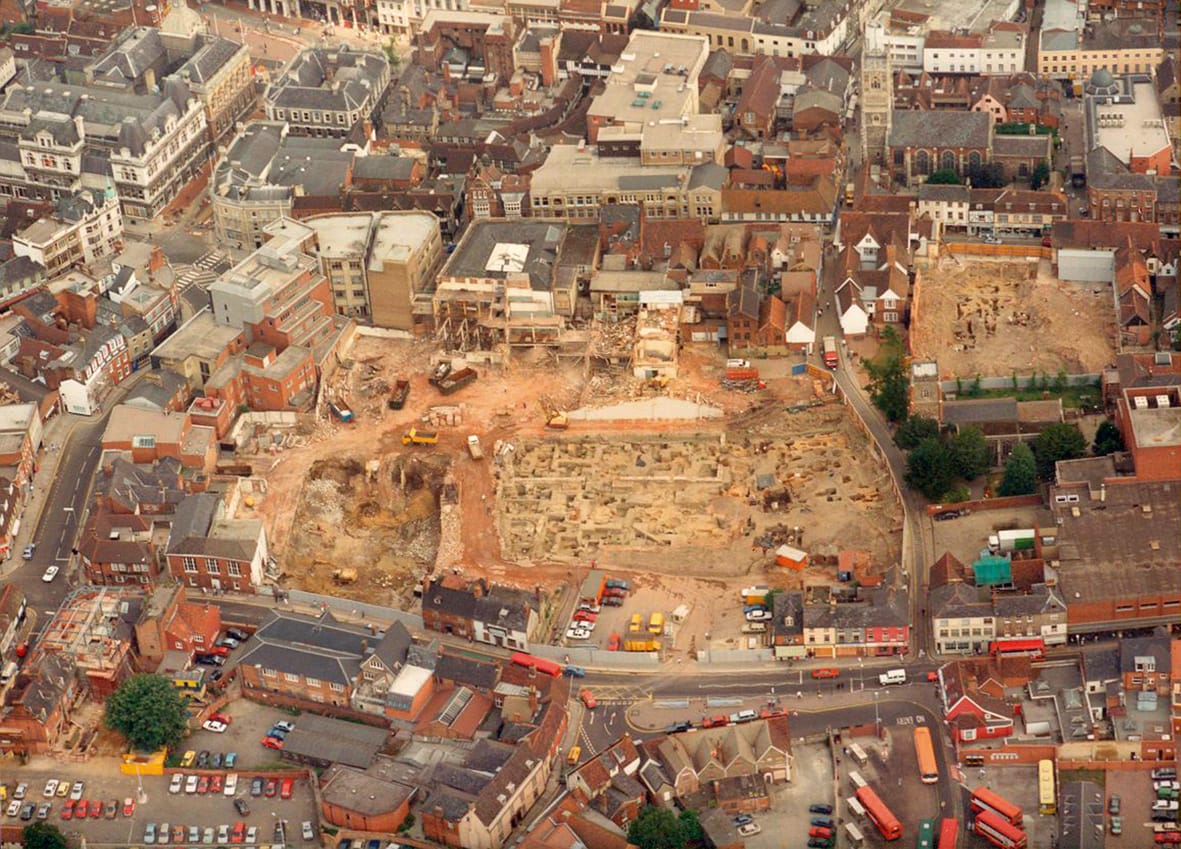
The highlights: Keith's favourite excavation was prior to the building of the Buttermarket Shopping Centre, where a 7th-century cemetery was discovered, overlaid by streets and buildings of the 8th to 11th centuries. The site then became the medieval Carmelite Friary.
Another significant discovery was the excavation east of Foundation Street, uncovering the first town bank and ditch built by the Vikings, alongside the medieval Dominican Friary, the remains of which were consolidated for public view rather than being built over.
What the book reveals: Ipswich (Gipeswic) was operating as a landing place for continental visitors by sea in the 7th century and as a permanent town from the early 8th century.
Throughout the Anglo-Saxon period, its primary function was as a port, importing wine and mill stones from northern France, Belgium and the Rhineland, but it was also a major craft production centre, dominated by pottery production.
The town was particularly important during the Viking settlement of eastern England in the late 9th century. The Danish occupation was associated with an economic boom, and the town was first surrounded by a bank and ditch.
Soon after the Norman Conquest in 1066, the town was ravaged by the Conqueror, and many burnt-down houses have been excavated of late 11th-century date. In some, the charred remains of their contents survived, including some bread rolls. However, the town soon recovered, and a castle was built in the 12th century, which was demolished decades later.
What they're saying: Keith Wade said: "For me, Ipswich has been an outstanding archaeological project. I have many fond memories of the sites and the many diggers, without whom none of it would have been possible.
"I was privileged to be in the right place at the right time to excavate in Ipswich for over 40 years. This was a period of considerable redevelopment, which would have destroyed all the archaeological evidence if we had not excavated beforehand.
"My hope is that this book will make the early importance of Ipswich more widely known and for it to help inform future local exhibitions and displays.
"I'd love to see it provide a source of interest for many years to come – not just for its residents but for the wider academic community interested in the origin of our English towns."
Councillor Debbie Richards, Suffolk County Council's deputy cabinet member for Archaeology and Landscape Partnerships, said: "This is a stunning publication and a unique look into Ipswich's history. Keith's passion for his work shines through, and I would be surprised if there is anyone more informed about the town's past.
"I thank Keith for his commitment to the county council's archaeological service through the decades. I'm delighted that his knowledge will live on in this book, and be a part of Ipswich's future for the benefit of researchers and historians."
For context: Keith Wade gained a degree in Archaeology from Southampton University in 1973 and joined the Suffolk Archaeological Unit in 1974 to take up the post of Urban Archaeologist. Between 1974 and 1990 he directed 35 excavations in Saxon and medieval Ipswich. In 1991 he became County Archaeologist at Suffolk County Council, a post he held until retirement in 2012.
He has served as a trustee with many organisations in Suffolk, including the West Stow Anglo-Saxon Village Trust and the Sutton Hoo Research Trust. He founded Ipswich Archaeological Trust in 1982 and is still a trustee and honorary secretary.
The bottom line: The monograph is volume 184 in the journal East Anglian Archaeology, priced at £35 and available from Script Books and through Suffolk Community Libraries.
This article cost us ~£27 to produce
It's free for you to read thanks to the generous support of our partners.
Below the line