
A14 summit: The outcomes, the gaps and what happens next
The Suffolk Chamber of Commerce brought together MPs, council leaders and transport experts in Ipswich last week for the second summit on the A14 and Orwell Bridge. Here is what was agreed, what remains unresolved, and why the stakes have rarely been higher.

Every time the Orwell Bridge closes — whether for maintenance, an accident or high winds — around 60,000 vehicles a day are forced onto alternative routes, bringing Ipswich's road network to a standstill. Businesses lose money, workers are stranded, and residents miss medical appointments. It is estimated that each closure day costs the local economy around £1 million.
The bridge is already operating at around 85% of capacity. Planned housing development in the Ipswich area is expected to add a further 15% to traffic volumes. The pressure, in other words, is only going one way.
The 19 June summit was by invitation, bringing together local MPs, Suffolk's Police and Crime Commissioner, senior councillors, including the new Suffolk County Council leader Michael Hadwen, and political and management representatives from Babergh, East Suffolk, Ipswich and Mid Suffolk Councils. Updates were received from Freeport East, National Highways, Suffolk County Council and Transport East. Notable absentees were Ipswich MP Jack Abbott and North Ipswich & Central Suffolk MP Patrick Spencer.
The meetings operate under Chatham House rules, which is why the media are not present. Paul Simon, Suffolk Chamber's head of public affairs, explained: "The summits are deliberately by invitation and under Chatham House to allow participants a guaranteed safe space to build trust with each other and freely discuss the various part-solutions." All very well – but it does make reporting on these presumably important meetings somewhat tricky.
The Copdock Interchange
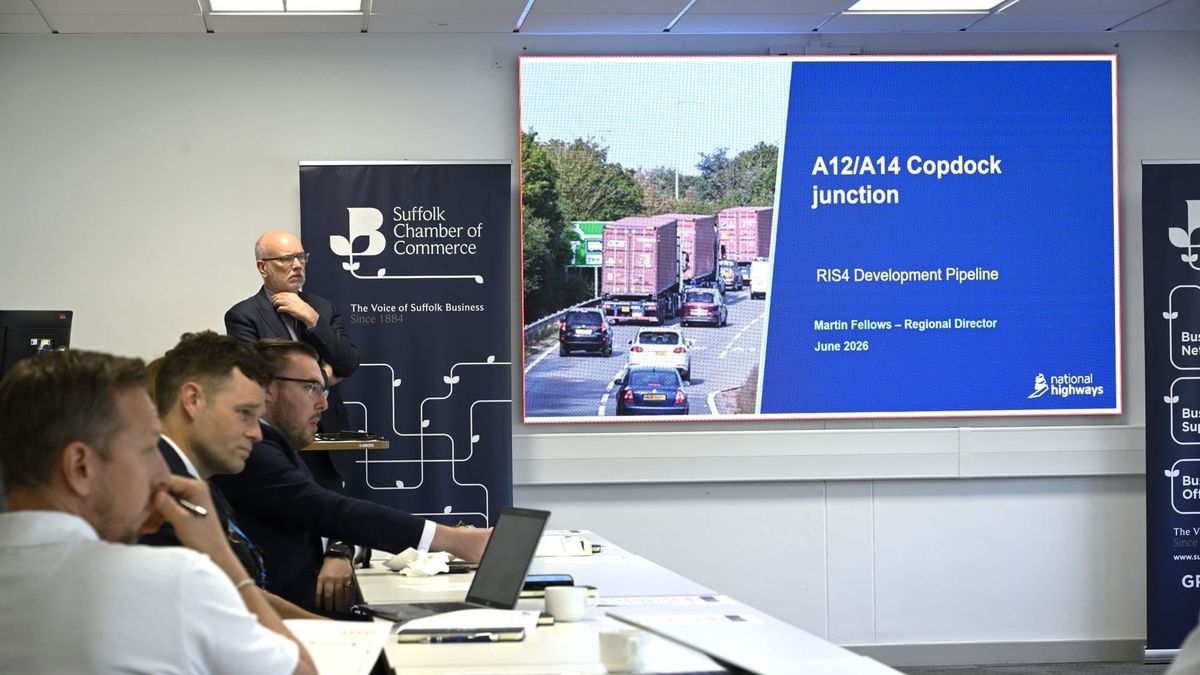
The most significant development to emerge from the summit concerns the A12/A14 Copdock Interchange — one of Suffolk's most congested junctions and a critical gateway for freight traffic to and from the Port of Felixstowe.
The process to update investigations into the interchange as part of the fourth Roads Investment Strategy (RIS4) pipeline begins later this year. Crucially, Copdock is now one of only five schemes in that pipeline nationally — a position that gives it a substantially stronger prospect of securing funding in the next investment cycle than it has had for years.
The brief is clear: to deliver "improvements to increase capacity and to improve performance of a key junction serving freight traffic to and from the Port of Felixstowe." Inclusion in the pipeline does not guarantee delivery, but it does mean design work, assessments and statutory processes can advance, giving the scheme a far better chance of being included in the confirmed RIS4 programme after 2031.
Paul Simon of the Suffolk Chamber welcomed the development, while acknowledging that "it won't be until 2031 and beyond at the earliest before any funding is finally confirmed."
What else was agreed
National Highways is to commission a specific piece of evidencing into the impacts of congestion and delays around the Felixstowe and Ipswich road network, encompassing both the Orwell Crossing and Copdock. A separate collaborative assessment programme — designed to quantify the wider economic impacts of A14 closures — has been finalised in scope. That work involves Suffolk Chamber, Freeport East, National Highways, Transport East and Suffolk County Council, and the group is now seeking funding to commission consultants.
Suffolk Chamber has written to the Secretary of State for Transport backing two short-term measures: extending the 60mph speed limit from the A14/A140 junction to the Seven Hills junction to reduce accidents, and deploying National Highways staff alongside Suffolk Constabulary to improve incident clearance times.
On rail freight, the campaign for improvements to the Ely and Haughley rail junctions — which would remove nearly 100,000 freight journeys per year from Suffolk's roads — is being reformatted ahead of the next Spending Review, repositioned as an enabler for the Cambridge growth strategy.
Suffolk County Council's cabinet is due to receive a broad options report in September covering the full range of potential solutions to the capacity problems on the roads network. The summit hoped it would be "as broad-based as possible," though no shared view on prioritising any specific solution was reached.
The northern bypass question
The September cabinet report will be the next meaningful test of where Suffolk County Council's new Reform UK administration intends to take the northern bypass issue specifically.
In May, the council's new administration backed an amendment replacing a Labour motion — which had set out specific bypass commitments, route protections and a business case deadline — with a broader instruction to consider all possible options. These included a northern bypass, tunnel and an estuary route which has yet to be publicly defined.
Labour leader Councillor Martin Cook accused Reform UK of having "hollowed out" the motion and bringing back "fantasy tunnel schemes." Ipswich MP Jack Abbott said the amendment had made delivery of the bypass "impossible."
Reform UK's Councillor Tony Love, who seconded the amendment, said it "does not preclude nor favour any solution" and called for a "forensic examination of local, national and environmental concerns."
Labour points to the council's own 2020 study, which assessed 32 options for addressing Ipswich's transport problems. The top five were all variants of a northern route. A tunnel under the River Orwell — estimated to cost around three times as much as a bypass — ranked second-to-last. Doing nothing ranked last.
Mark Ling, a long-time bypass campaigner, has been characteristically direct about what he sees as the consequences of inaction. Writing on LinkedIn following the summit, he pointed to London Gateway's 52% growth in 2025 — now at 3 million TEUs per year — and warned that without infrastructure investment, Felixstowe risks losing its status as Britain's largest container port within two years. "Once the crown is lost," he wrote, "so too critical mass, prestige, jobs and profits."
The chamber's position, and its limits
Suffolk Chamber has consistently declined to back any single solution, and the summit reinforced that stance. Simon said the binary debate between bypass and no bypass was "unhelpful and undermines our convening role in bringing coalitions together to back all potential part-solutions."
The Chamber's ask is for all options to be brought forward to at least an outline business case stage as quickly as possible, with no participant vetoing evidence-building. A third summit is expected towards the end of 2026 or in early 2027.
The bottom line
Copdock's elevation to one of five schemes in the national RIS4 pipeline is progress, and the most concrete outcome to emerge from last week's summit. But it will not be felt on the ground for years. The Orwell Bridge is running out of capacity now. The northern bypass feels like an option unlikely to be backed by the new county council administration. And with local government reorganisation looming as a deadline, the window for decisive action is narrowing. We wait for September's cabinet report.
Don't forget: If you enjoy our content, please add Ipswich.co.uk as a "preferred source" on Google so you can easily find more of the content you value.
This article cost us ~£108 to produce
It's free for you to read thanks to the generous support of our partners. Please support us by supporting them.
Below the line