
'You might just save that person's life': Students take on 24-hour CPR marathon
More than 50 University of Suffolk paramedic students are performing continuous CPR for 24 hours to demonstrate that using the yellow and green defibrillator boxes found across Ipswich is straightforward, with the ambulance service providing step-by-step guidance to anyone who calls 999.

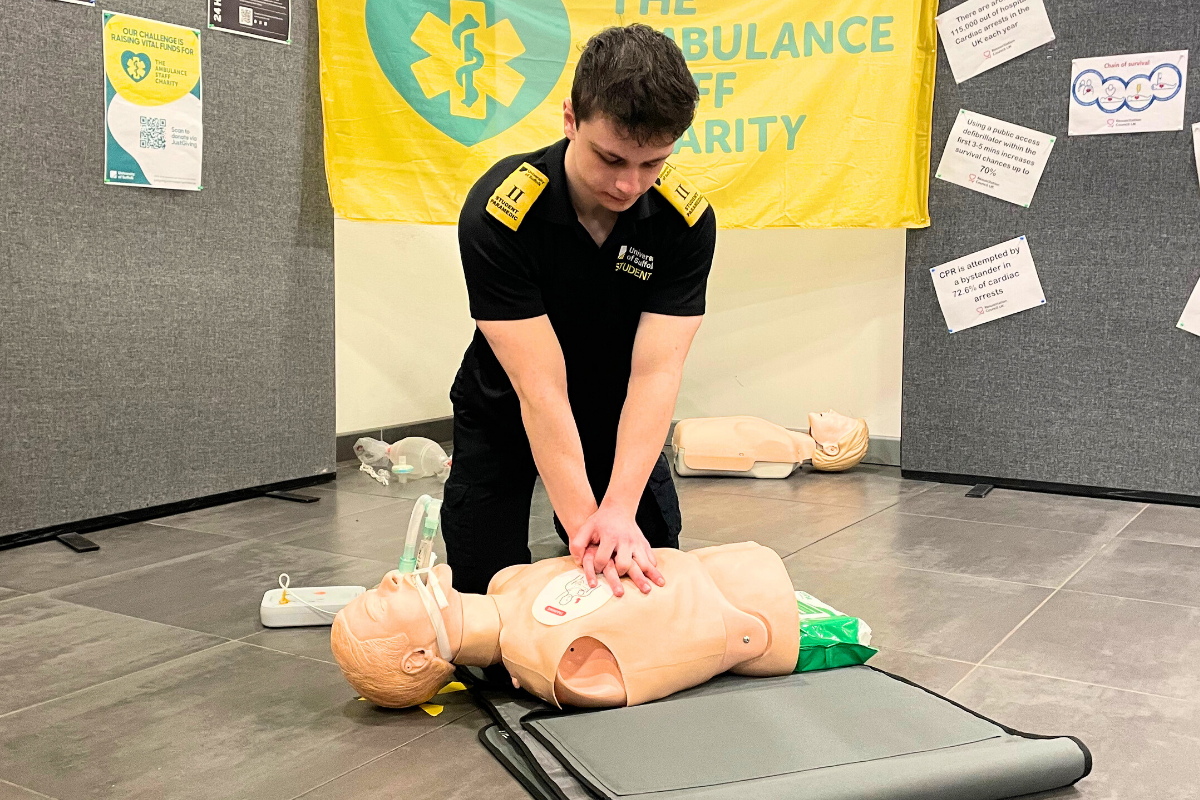
At 07:00 this morning, as most of Ipswich was just beginning to stir, 52 University of Suffolk paramedic students began a gruelling 24-hour challenge that will see them perform 170,000 chest compressions. Some left home at 04:30 to get there on time. When the marathon finishes at 07:00 tomorrow morning, they hope their message will be clear: using a public defibrillator is straightforward and could save a life.
Five hours into the marathon at the Waterfront Building, the students have already completed around 24,000 compressions – approximately 20% of their target. The challenge will continue overnight, with fresh groups of students rotating in two-minute shifts until 07:00 tomorrow morning.
A life-saving gap
The challenge was born from a troubling statistic. Whilst 72% of people perform CPR when witnessing a cardiac emergency, less than one in 10 use a public access defibrillator, despite the yellow and green boxes being found outside pubs and shops across the town.
"We noticed that a lot of people do not feel confident using public access defibrillators," said Chris Matthews, the second-year student who organised the event. "And we really want to encourage people to know that they are not going to go wrong with it."
The process, he explained, is straightforward. When someone collapses and is not breathing normally, the first step is to call 999. If they have got no pulse and are not breathing normally, CPR should be started immediately.
"Then the ambulance service would say your nearest defibrillator box is at the end of the road. Can somebody go and get it? And then they will talk you through step by step, how to use it, and you cannot go wrong," Matthews said.
Something is better than nothing
Bethany Weeks, deputy course leader and lecturer on the paramedic science programme, has witnessed first-hand, as a frontline paramedic, how CPR saves lives. She graduated from the university in 2020 and worked with the ambulance service in East Suffolk before returning as a lecturer in January 2023.
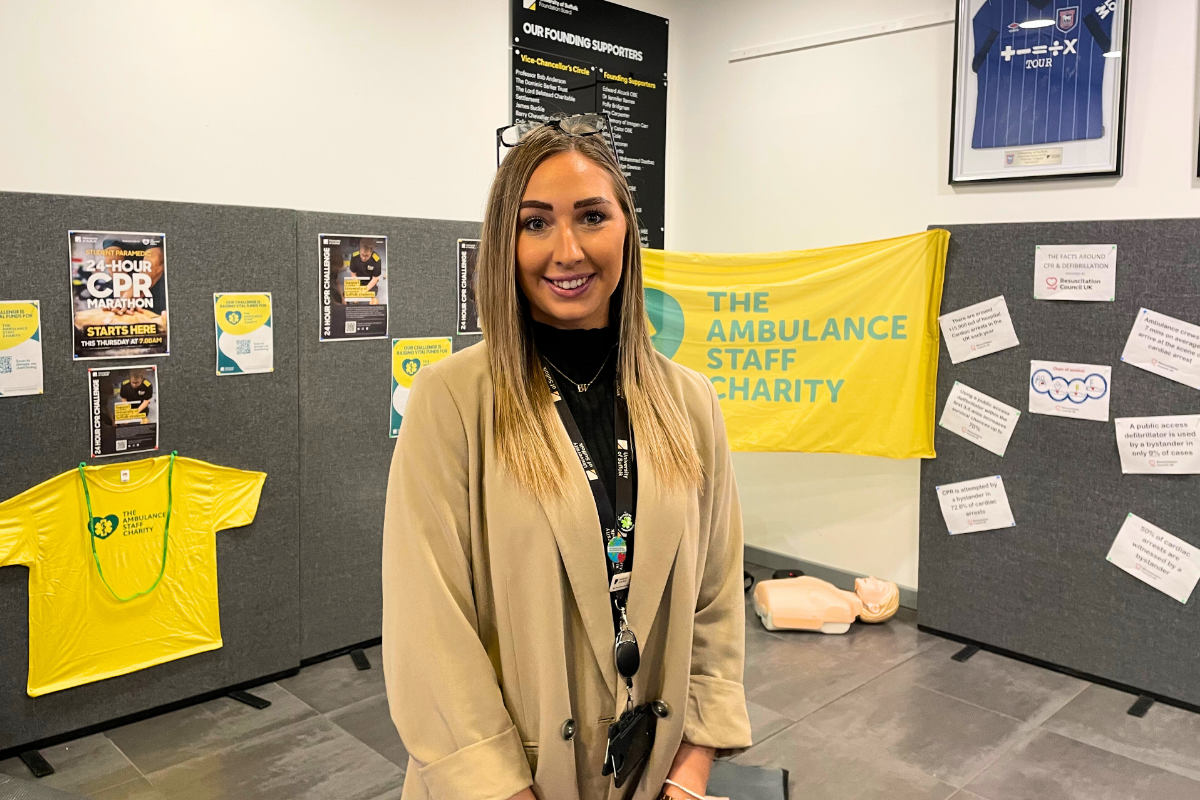
Her message to the public is unequivocal: "The most important thing we always say is that we would always urge you to do something, because something is better than nothing. You might just save that person's life."
"Even if you only know how to do CPR, then that is absolutely fine," Weeks continued. "But when you do CPR and you phone an ambulance, you would also get told if there is a defibrillator nearby. You can send someone else to get it, and then keep doing CPR for as long as you can until the ambulance service arrives, because it really does save lives."
How it started
Matthews is a mature student who changed careers to pursue paramedicine. The idea for the marathon came during a break between classes. "A group of us were just chatting in a break and decided that we wanted to do something for charity," Matthews explained. The conversation turned to giving back to the ambulance community, and the idea began to take shape.
The charity they chose was The Ambulance Staff Charity, known as TASC. "They help colleague wellbeing by providing financial support and suicide awareness courses. They also have a 24-hour mental health crisis line for paramedics and other ambulance colleagues," Matthews said.
The national charity is open to any private or public serving or former serving ambulance colleagues, and provides a wide range of resources. The students have set a fundraising target of £3,000 for TASC, with donations continuing to come in throughout the challenge.
A year in the planning
What began as a casual conversation became a year-long project. Matthews sent his first email about the event in June last year, and the planning process involved multiple steps.
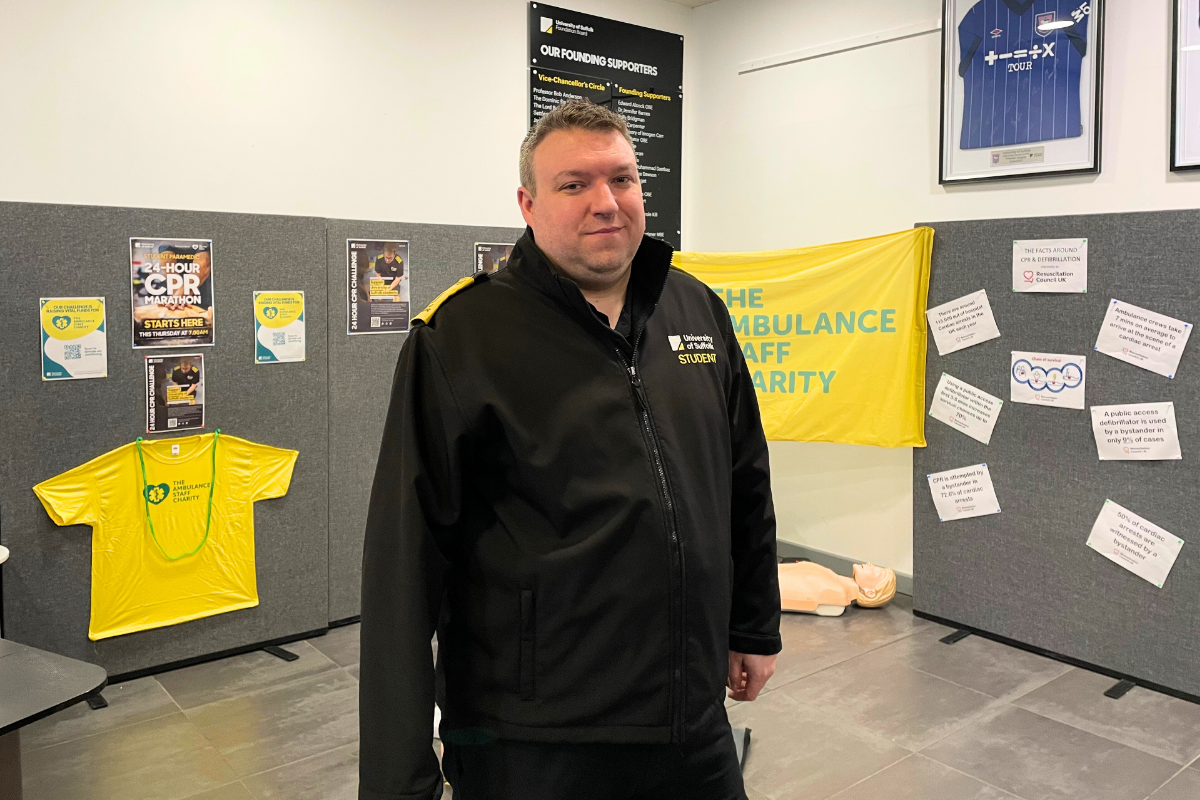
"We initially proposed our idea to the course lead and went through a number of steps around risk assessment and getting it authorised by the university," he said. "And then it was just formulated over time, really."
The marathon was designed to include as many students as possible. Following official resuscitation guidelines, students are performing CPR in two-minute shifts to maintain effectiveness. "The official time, the recommended time, is two minutes, and then swap," Matthews explained. "But it is proven in research that if you exceed six to eight minutes, you start decreasing the efficiency of your CPR."
The response from fellow students exceeded expectations. "I was really hesitant, because who wants to be on the TV and on the radio whilst they are doing chest compressions?" Matthews admitted. "However, the uptake was really great. We had over 60 inquiries from students."
Not all participants were comfortable performing CPR in front of the public, but many promoted the cause on social media. The final group includes an equal split between first, second and third-year students.
"For the guys that have turned up at 07:00 this morning, some of them have left home at 04:30 to get here on the train," Matthews said. "So I can only thank them for their efforts. And actually, nearly two grand for a charity that supports our colleagues is amazing."
Teaching through experience
Weeks, who teaches across all three years alongside a team of five lecturers, said the course team was proud of the students' initiative. "Chris came up with the idea, and then came to us as a course team, and we had to obviously speak to the wider university and check that we were actually allowed to run this sort of event," she said.
"To be honest, with credit to Chris, he has organised a large majority of it, with the support of us from the course team."
The event presented logistical challenges, given how busy students are with their studies. "Our year twos finished their assessments yesterday, our year threes are currently working on their dissertation, and the year ones have just come off placement," Weeks said.
But the turnout demonstrated the calibre of students on the programme. "It just goes to show what students we have. There are so many of them that have signed up to do their stint, and we have got a load of them coming in overnight for the night shift," she added.
Matthews was keen to emphasise the collaborative nature of the project. "It is very much been a team effort. There is no way that we could have made this happen if everyone had not been involved," he said.
Community support
The event has attracted support from across Ipswich and beyond. Associated British Ports, which runs the waterfront port, donated £500 to the cause. A local pizzeria is providing lunch and dinner throughout the 24 hours, and medical companies have supplied first aid cover.
The university has provided the training equipment being used for the challenge, including a half-sized training doll that can tolerate an airway and have CPR performed on it. The facility also houses more advanced equipment, including mannequins that breathe, have a pulse, and can simulate various medical scenarios.
A world record bid
The students are recording the entire 24-hour event on time lapse and plan to submit the footage to Guinness World Records, along with witness statements and physical data. If successful, they will have set a world record for the longest marathon for basic life support.
"We have made sure that we tick the different evidence criteria," Matthews said. Once the challenge finishes tomorrow morning, the evidence will be compiled and submitted.
A post-event celebration is planned for a few months' time to thank everyone who has supported the marathon.
A message worth spreading
For Weeks, the potential impact of the event extends far beyond the university. "If we can help one person learn a skill from this event today, then it will be absolutely worth it," she said.
"The hope is by making it as visible as we can on our social media and getting the name out about CPR, but equally about The Ambulance Staff Charity - TASC," she said. "They are a wonderful charity that support clinicians and students that are involved within the ambulance service."
The university, where Weeks both studied and now teaches, provides students with extensive practical experience. Students go on ambulance placements within their first six months on the programme, and throughout all three years have opportunities for non-ambulance placements in hospitals, midwifery, intensive care, nursing homes and other settings.
Third-year students undertake a four-week elective placement, with some travelling as far as Tanzania, Vietnam and India to understand how healthcare works in different countries.
This real-world experience informs the teaching approach. "We try and keep it much more conversation based rather than just a presentation," Weeks said. "We like to talk about those topics and think about what experiences they have had on placement and think about what experiences we might have had on the road to try and help advance their understanding."
The bottom line
As the marathon continues through Thursday evening and into the early hours of Friday morning, 52 students are demonstrating to Ipswich residents that public defibrillators are simple to use and could save a life. What began as a conversation during a university break became a year-long mission that is raising money for ambulance staff mental health and potentially setting a world record. But perhaps most importantly, it is delivering a message that could save lives: when someone collapses, using that yellow and green box is straightforward, and you cannot go wrong.
People can follow updates on Instagram at cprchallenge26.
This article cost us ~£87 to produce
It's free for you to read thanks to the generous support of our partners.
Below the line