Why it matters: The decision will fundamentally reshape how essential services like social care, housing and highways are delivered to Suffolk's residents, with competing visions offering different approaches to balancing cost savings with local accountability and representation.
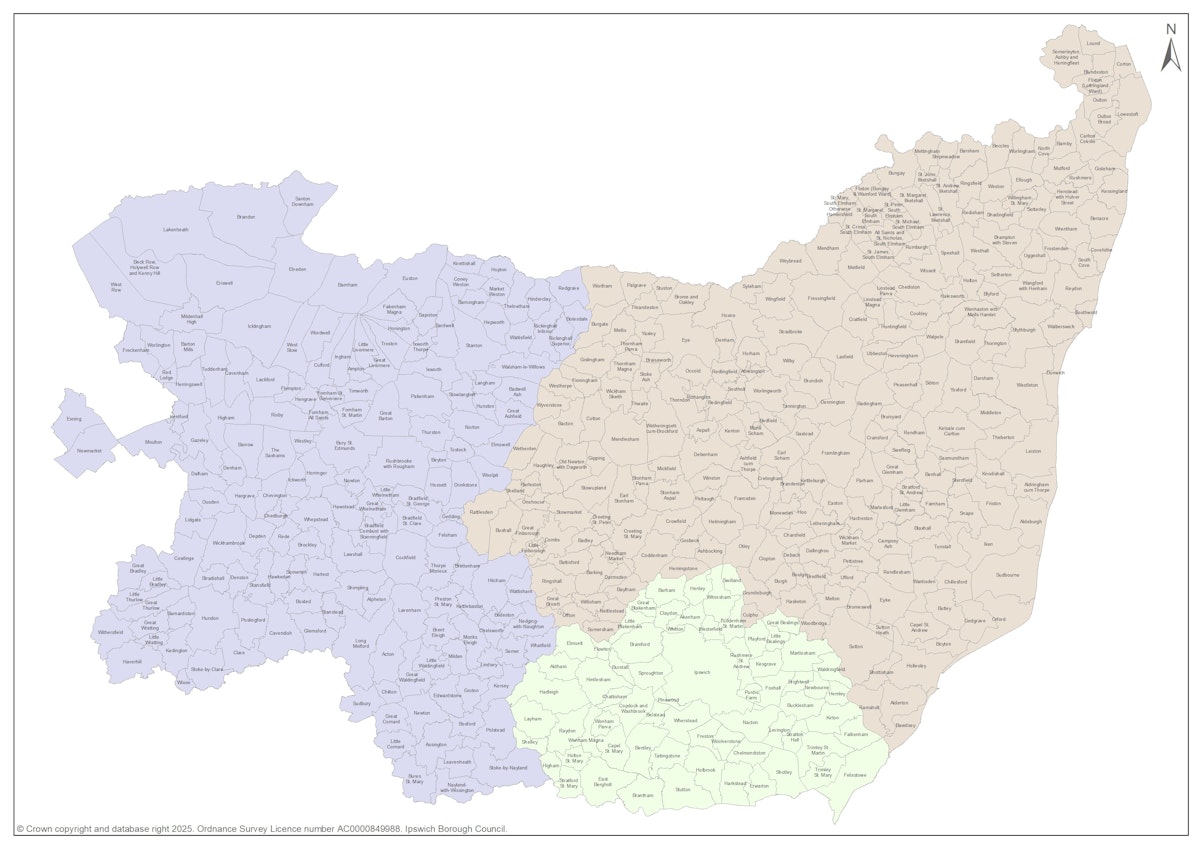
The boundaries: The proposed boundaries, which mirrored previously leaked documents, would create three new unitary authorities:
Western Suffolk, anchored by Bury St Edmunds
Ipswich & Southern Suffolk, anchored by Ipswich, and including Felixstowe, Hadleigh, Kesgrave and the Shotley Peninsula
Central & Eastern Suffolk, anchored by Lowestoft, and including Woodbridge and Stowmarket
These are working names, with residents to be invited to help choose the final names in due course.
What they're saying: In a joint statement, district leaders said: "People across Suffolk are proud of where they live, and they want decisions made by those who understand their communities. The Three Councils For Suffolk proposal delivers just that."
Councillor Caroline Topping emphasised the model is "large enough to achieve economy of scale, small enough to reflect local needs".
However, Cllr Richard Rout, Suffolk County Council’s cabinet member for devolution, local government reform and NSIPs, criticised the proposals as "chaotic, confusing, and ultimately unworkable." He added: "The financial figures that the districts and borough are putting forward are optimistic to the point of being dangerous."
Financial comparison: Independent analysis commissioned by the district councils projected the three-council model could unlock £34 million in annual savings whilst allowing reinvestment of £20 million yearly back into vital services – a net saving of £70 million over five years.
However, independent analysis commissioned by Suffolk County Council, projected that a single unitary authority could realise net savings of £104 million over the same period.
Service delivery concerns: District councils argue that current delivery "is broken and needs an overhaul", particularly for Special Educational Needs and Disabilities services, with one official stating "people aren't happy with how it's being delivered now".
Suffolk County Council accepted that improvement is needed but argued "the boroughs and districts do not have the expertise" for such complex services, warning against "experimenting with people's lives".
Cllr Rout said, "Breaking up key expensive care services, that are currently delivered county-wide, won't just cost more as they employ new senior teams, it will put the most vulnerable in our community at risk. They will create a postcode lottery for care."
Council tax impact: District leaders described harmonising tax rates as "nowhere near as difficult as others would have you believe" and insisted "no one's council tax on April 2028 is going to go up because of unitarisation, except what it would've gone up normally".
However, Rout argued that the districts' proposals will result in "higher council tax across the county, but particularly in places like Felixstowe, Hadleigh, Kesgrave, the villages south of Ipswich and the Shotley peninsula". He pointed to Ipswich's high tax rates, claiming that Ipswich residents could pay less tax in a single unitary council.
What's next: The five councils will formally consider their final business case in September before submitting the proposal on 26 September 2025. The Government will run a public consultation from November 2025 to February 2026, with outcomes shared in March 2026.
If accepted, elections to new councils would take place in May 2027, with new authorities taking control from April 2028.
The bottom line: Government ministers will make the final call, but not before Suffolk residents have their say in what represents the biggest shake-up of local democracy in the county's recent history.