
Ipswich to get enhanced bus services as Suffolk launches biggest expansion since 1998
Ipswich and the surrounding communities will get new and improved bus routes from late August, funded by a £2.8m government grant.

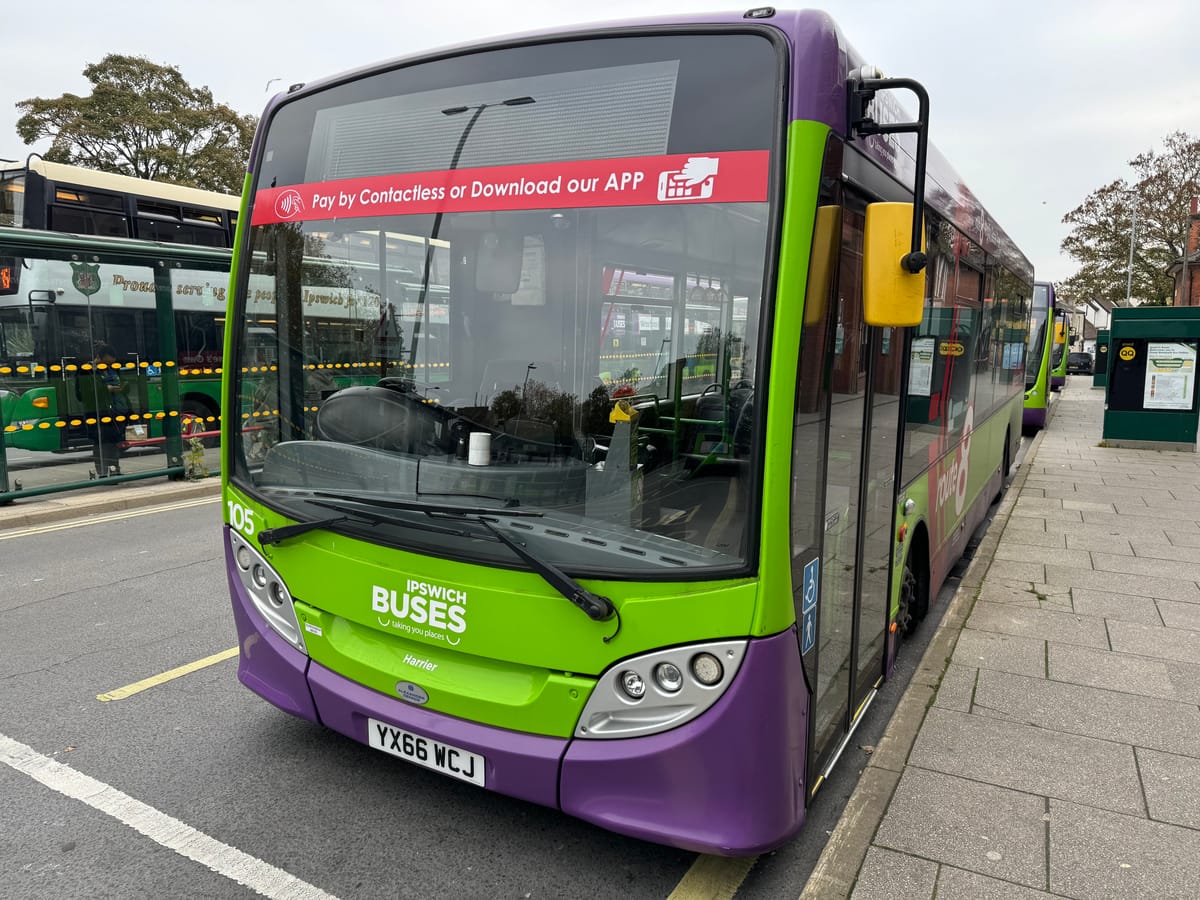
Why it matters: The expansion represents the most significant positive change to Suffolk's bus network in over 25 years, with routes chosen based on community suggestions.
The big picture: Suffolk County Council received the Local Authority Bus Grant from the Department for Transport on 1 June, enabling the launch of enhanced services across multiple routes serving Ipswich and the rest of Suffolk.
The details: The new funding will deliver:
- Enhanced evening services and increased frequencies on several existing routes
- Sunday services on routes 1 (Waitrose-Greenwich-Town Centre) and 3E (Town Centre-University of Suffolk-Nacton Road-Greenwich)
- Withdrawal of planned service reductions on routes 92 (Ipswich-Holbrook-Brantham-Manningtree) and 93 (Ipswich-Capel St Mary-East Bergholt-Colchester)
- New peak AM journey from Brantham to Manningtree on route 92
- Increased peak-hour frequency on route 4 (Town Centre-Broke Hall-Bixley) and enhanced Monday-Friday frequency on route 5 (Town Centre-Foxhall Road-Ipswich Hospital)
- Additional trips and increased peak-hour frequency on routes 7 and 16 (Ipswich Town Centre-Dale Hall-Castle Hill-Anglia Retail Park and Ipswich Town Centre-Belstead Road-Halifax)
- Increased frequency on route 15/15A (Town Centre-Station-Maidenhall-Pinewood-Chantry)
- New Sunday service plus additional Monday-Saturday journeys on Chambers routes 90 and 91 (Ipswich-Hadleigh-Sudbury)
- Route 800 (Ipswich Park & Ride) will see a revised route taking in the University of Suffolk and Ipswich Hospital's Garrett Anderson Centre rather than Woodbridge Road, with some journeys extended to Rendlesham via Martlesham, Woodbridge and Melton.
What's next: Most services are expected to start in late August or early September.
What they're saying: Cllr Chris Chambers, Cabinet Member for Transport Strategy, Planning and Waste, said: "These changes represent the biggest positive change to bus services across the County since 1998 and along with our previous route improvements, show our commitment to supporting local communities and the bus industry."
For context: The routes were suggested by the community through the council's "scheme on a page" initiative, demonstrating direct resident input into transport planning.
By the numbers: Alongside the £2.8m revenue funding for new services, the county council also previously announced £5.2m of capital funding from the Department for Transport for infrastructure improvements including new bus stops, bus stations, and bus priority measures.
The bottom line: Suffolk's investment in public transport connectivity addresses community-identified gaps in service provision, with the expansion marking the most substantial improvement to local bus networks in a generation.
This article cost us ~£19 to produce
It's free for you to read thanks to the generous support of our partners.
Below the line